
Introduction
The silky anteater (Cyclopes didactylus), also known popularly as the pygmy anteater or silky anteater, represents one of the rarest and most enigmatic jewels of Brazilian biodiversity. As the smallest living representative of the order Pilosa and the only member of the family Cyclopedidae, this small xenarthran mammal challenges common perceptions of anteaters due to its reduced dimensions and strictly arboreal habits. In the vast ecosystem of the Pantanal, its presence is an indicator of environmental health, although its detection is a constant challenge even for the most experienced researchers.
Scientific Classification
| Kingdom | Animalia |
| Phylum | Chordata |
| Class | Mammalia |
| Order | Pilosa |
| Family | Cyclopedidae |
| Genus | Cyclopes |
| Species | Cyclopes didactylus |
| Common name | Silky Anteater, Pygmy Anteater |
The importance of the silky anteater in the Pantanal biome transcends its rarity. As a specialized predator of arboreal insects, it plays a fundamental ecological role in controlling populations of ants and termites in the tree canopies. Unlike its larger relatives, such as the jaguar or the capybara, which are easily spotted on riverbanks, the silky anteater inhabits a vertical world, remaining camouflaged among foliage and vines, far from human sight and many terrestrial predators.
Historically associated with the tropical forests of the Amazon and the mangroves of the Northeast, recent records and taxonomic studies have expanded knowledge about its distribution, suggesting that populations inhabiting the edges of the Pantanal and the gallery forests of the Paraguay River may belong to distinct evolutionary lineages, such as the revalidated species Cyclopes catellus. Regardless of the specific nomenclature, the silky anteater remains a symbol of the "invisible fauna" of the Pantanal, whose conservation directly depends on the preservation of forest corridors and the integrity of the riparian forest canopy.
Physical Description
The silky anteater is notable for its diminutive proportions, often compared to the size of a closed human fist. Adults measure between 35 and 45 centimeters in total length, of which almost half corresponds to its extremely versatile prehensile tail. Body weight varies significantly between 250 and 450 grams, making it light enough to move through the thinnest branches of trees, where larger competitors cannot reach.
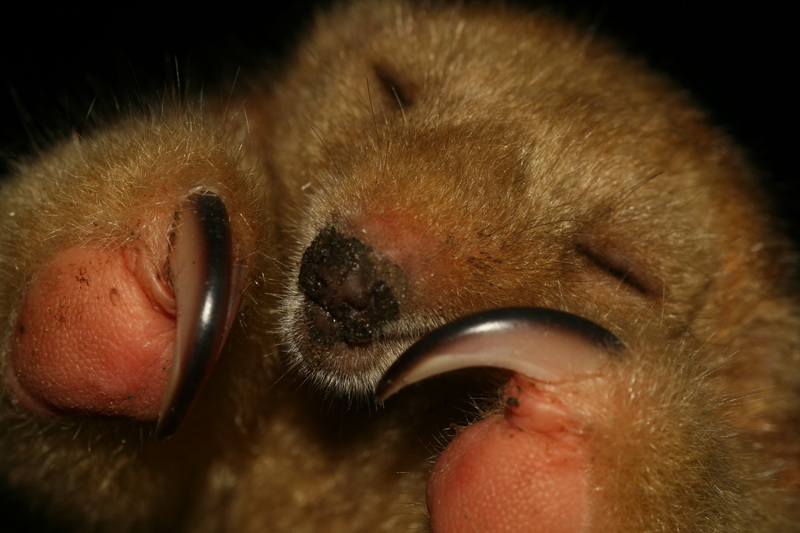
The most distinctive feature of this species is its dense, short, and extremely soft fur, which presents a yellowish or golden coloration, sometimes with silvery reflections, earning it the name "silky anteater." This coloration is not merely aesthetic; it functions as perfect camouflage against the dried fruits and pods of trees such as the kapok (Ceiba pentandra). In some populations, a dark dorsal stripe can be observed, helping to break the animal's silhouette against the branches.
Morphologically, the silky anteater presents fascinating evolutionary adaptations for life in the heights. Its front paws have only two functional toes (hence the specific epithet didactylus), each armed with a long, curved claw, essential for breaking into ant nests and for safe locomotion. The hind paws have four toes and are modified to grip branches firmly. The snout is short and slightly curved downward, housing a long, sticky tongue, typical of myrmecophagous animals, capable of capturing hundreds of insects in a few seconds.
| Characteristic | Silky Anteater (Cyclopes) | Lesser Anteater (Tamandua) |
|---|---|---|
| Average Weight | 300g - 400g | 4kg - 7kg |
| Habit | Strictly Arboreal | Semi-terrestrial / Arboreal |
| Front Digits | 2 main claws | 4 main claws |
| Tail | Fully Prehensile | Prehensile |
Habitat and Distribution in the Pantanal
In the context of the Pantanal, the silky anteater finds its refuge in the forest formations that make up the mosaic of the floodplain. It prefers gallery forests, which follow watercourses like the Paraguay River and its tributaries, and "cordilheiras" — slightly elevated portions of land that do not suffer seasonal flooding and house dense arboreal vegetation. Canopy connectivity is a critical requirement for the species, as the silky anteater rarely descends to the ground, where its locomotion is slow and vulnerable.
The geographical distribution of the species in the Pantanal is considered discontinuous and still poorly mapped. Historical records indicated its presence mainly in the north of the biome, in Mato Grosso, but recent sightings and camera trap studies in canopy areas confirmed its occurrence also in the Southern Pantanal, in Mato Grosso do Sul. The species seems to avoid open areas of clean field or paratudo, concentrating where the density of lianas and epiphytes is higher, offering both food and protection against aerial predators, such as the harpy eagle.
The silky anteater's relationship with the Pantanal's water regime is indirect but vital. During floods, gallery forests become islands of biodiversity, and the integrity of these forests is what guarantees the survival of silky anteater populations. The fragmentation of these habitats, caused by the opening of pastures or the construction of roads like the Transpantaneira, represents a significant risk, as it isolates populations and limits the gene flow necessary for the species' resilience in the region.
Behavior
The behavior of the silky anteater is defined by discretion and economy of movement. It is a solitary and strictly nocturnal animal, starting its activities at dusk and returning to rest before dawn. During the day, it adopts a unique passive defense strategy: it curls into a compact ball, hiding its snout and paws under its prehensile tail, resembling a wooden knot or an abandoned termite nest. This absolute immobility is its main defense against visually oriented predators.
When it feels threatened and cannot flee, the silky anteater exhibits a characteristic defensive posture that has earned it the nickname "forest boxer." It supports itself firmly on branches with its hind paws and prehensile tail, raises its trunk, and places its front paws near its face, ready to deliver quick strikes with its sharp claws. Although small, the strength of its claws is sufficient to cause injuries to persistent aggressors.
Communication between individuals is little known, but it is believed to be based mainly on olfactory signals. The silky anteater has scent glands that it uses to mark territory on the branches where it travels. Movement is slow and deliberate; the animal tests each branch before transferring its weight, a necessary adaptation to avoid falls in an environment where the ground can be 20 meters away or covered by deep waters during Pantanal floods.
Diet
The silky anteater is a trophic specialist, classified as a strict myrmecophagous. Its diet consists almost exclusively of arboreal ants, although occasional consumption of termites and other small insects has been recorded. Studies conducted with stomach contents and field observations indicate that a single individual can consume between 700 and 5,000 ants in a single night of foraging. It prefers genera abundant in the Pantanal canopy, such as Camponotus, Crematogaster, and Dolichoderus.
The feeding technique is highly efficient. Using its keen sense of smell, the silky anteater locates ant trails on branches or small nests in trunk cavities. With its front claws, it opens small slits in the wood or bark and introduces its filiform tongue, covered by a viscous saliva produced by hypertrophied submaxillary glands. The ants stick to the tongue and are quickly ingested, being crushed by a muscular stomach that compensates for the total absence of teeth.
The ecological role of the silky anteater in the Pantanal is of extreme relevance for maintaining tree health. By controlling the density of herbivorous and leaf-cutting ants, it reduces stress on arboreal vegetation. Furthermore, by opening small cavities to feed, it ends up creating microhabitats that can be used by other small invertebrates, contributing to the complexity of the canopy food web.
Reproduction
The reproductive cycle of the silky anteater is one of the least documented aspects of its biology, due to the difficulty of observation in the wild. It is known that the species does not have a rigidly defined reproductive season, and births can occur throughout the year, although in the Pantanal there may be a concentration of births coinciding with the end of the dry season and the beginning of the rains, when insect availability tends to increase.
Gestation lasts between 120 and 150 days, culminating in the birth of a single offspring. The newborn already has sparse fur and developed claws, allowing it to cling firmly to the mother's back immediately after birth. A notable and rare behavior among mammals is the male's involvement in parental care; in some observations, the father was recorded carrying the offspring on his back, transferring it to the mother only for nursing.
The development of the young silky anteater is relatively fast. Weaning occurs when the offspring reaches about one-third of an adult's weight, at which point it begins to capture its first ants under parental supervision. Sexual maturity is reached around one year of age. The low reproductive rate — only one offspring per year — makes the species particularly vulnerable to environmental pressures, as population recovery after catastrophic events, such as large forest fires, is extremely slow.
Conservation Status
Globally, Cyclopes didactylus is classified by the International Union for Conservation of Nature (IUCN) as "Least Concern" (LC). However, this classification hides worrying regional realities. In Brazil, the Chico Mendes Institute for Biodiversity Conservation (ICMBio) maintains the species in the LC category at the national level, but recognizes that isolated populations, especially those in the Northeast and those inhabiting transition areas like the Pantanal, face increasing threats.
The main threats to the silky anteater in the Pantanal include:
- Habitat Loss: Deforestation for converting forests into pastures eliminates the arboreal corridors essential for its survival.
- Forest Fires: Due to its low mobility and arboreal habit, the silky anteater is one of the species most affected by fire, often dying carbonized in the canopy.
- Fragmentation: The construction of infrastructure without aerial wildlife crossings isolates genetic groups, increasing the risk of local extinction.
The conservation of the species in the biome depends on the creation and maintenance of Permanent Protection Areas (APPs) along rivers and the implementation of private reserves (RPPNs). The silky anteater is considered a "sentinel species" for forest health. For Pantanal ecotourism, sighting a silky anteater is considered the "Holy Grail" of wildlife observers, surpassing in difficulty even an encounter with the giant otter.
Scientifically, the genus Cyclopes underwent a revolution in 2017, when Brazilian researcher Flávia Miranda and her team demonstrated, through molecular and morphological analyses, that what we thought was a single species was actually at least seven distinct species. This reinforces the need for specific studies for the Pantanal population, which may represent a unique lineage even rarer than previously imagined.
References
[1] IUCN. (2014). *Cyclopes didactylus*. The IUCN Red List of Threatened Species. Available at: https://www.iucnredlist.org/species/6019/47440020
[2] GARDNER, A. L. (2008). *Mammals of South America, Volume 1: Marsupials, Xenarthrans, Shrews, and Bats*. University of Chicago Press.
[3] EISENBERG, J. F.; REDFORD, K. H. (1999). *Mammals of the Neotropics, Volume 3: Ecuador, Bolivia, Brazil*. University of Chicago Press.
[4] EMBRAPA PANTANAL. (2024). *Fauna do Pantanal*. Embrapa Pantanal. Available at: https://www.embrapa.br/pantanal/fauna
[5] ALHO, C. J. R. (2008). *Biodiversidade do Pantanal*. Editora UNIDERP.
[6] WETZEL, R. M. (1985). *The identification and distribution of Recent Xenarthra (=Edentata)*. In: MONTGOMERY, G. G. (Ed.). *The Evolution and Ecology of Sloths, Anteaters, and Armadillos*. Smithsonian Institution Press.