
Myrmecophaga tridactyla (Giant Anteater)
Introduction
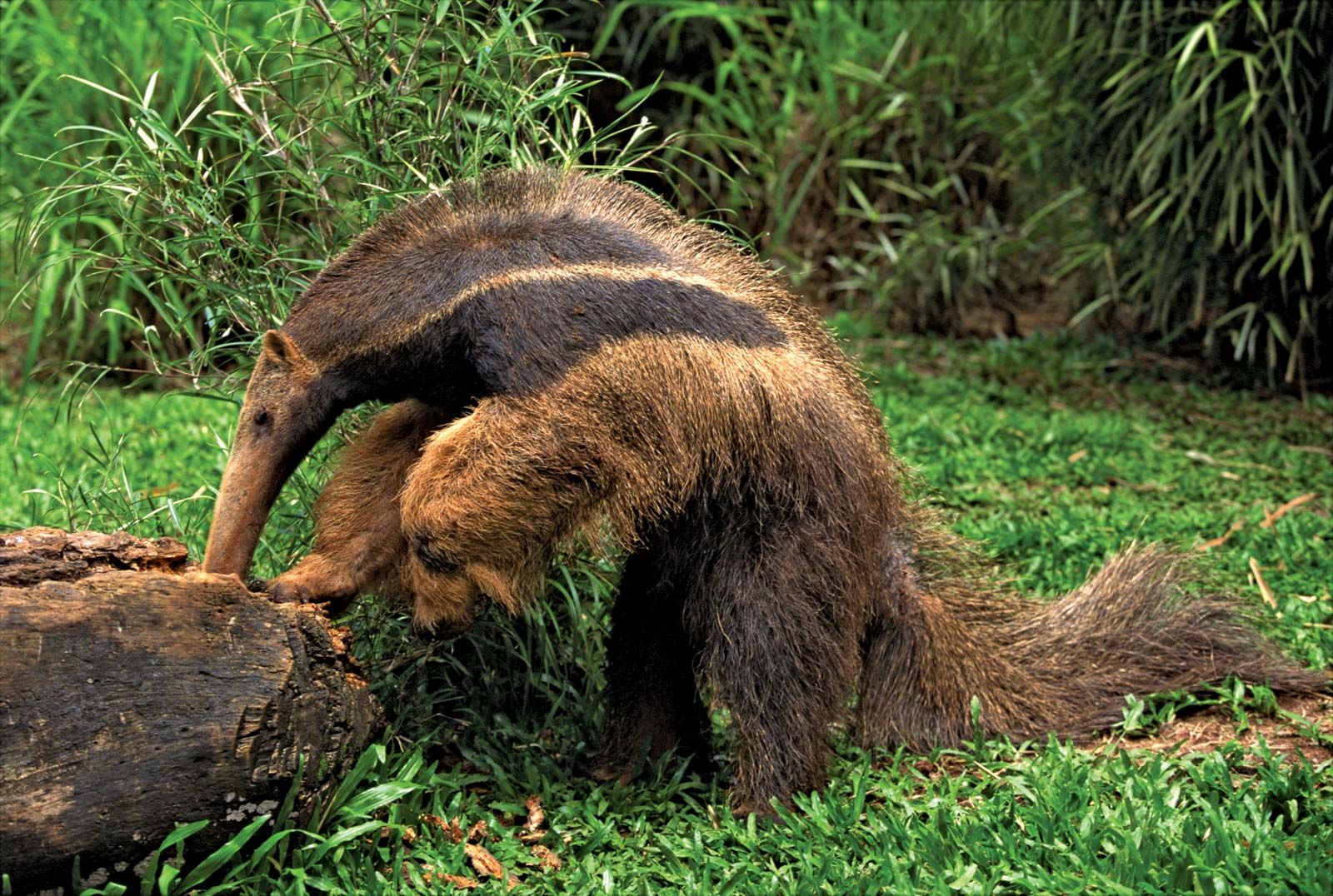
The giant anteater (Myrmecophaga tridactyla) is one of the most emblematic and unique mammals of South American fauna, recognized as the largest representative of the suborder Vermilingua. Its distinct appearance, characterized by an extremely elongated snout, a voluminous tail resembling a flag, and a coat with black, white, and gray geometric patterns, makes it a central figure in the biodiversity of the Brazilian Pantanal. This species is a fascinating example of evolutionary specialization, having adapted its morphology and behavior for a strictly insectivorous diet based on the consumption of ants and termites.
In the Pantanal ecosystem, the giant anteater plays a vital ecological role as a regulator of social insect populations. Its presence is an indicator of environmental health, as it requires vast home ranges encompassing a mosaic of habitats, from open fields to dense forest formations. Despite its broad historical distribution, the species faces significant challenges to its survival, including habitat loss, roadkill, and wildfires, classifying it as vulnerable on several conservation lists. Understanding the biology and ecology of this gentle giant is fundamental to ensuring its preservation in the floodplains of Mato Grosso and Mato Grosso do Sul.
Scientific Classification
| Category | Classification |
|---|---|
| Kingdom | Animalia |
| Phylum | Chordata |
| Class | Mammalia |
| Order | Pilosa |
| Family | Myrmecophagidae |
| Genus | Myrmecophaga |
| Species | Myrmecophaga tridactyla |
| Common Name | Giant anteater, jurumim, tamanduá-cavalo |
Description
The giant anteater possesses a highly specialized morphology, the result of millions of years of evolution directed toward the consumption of colonial insects. The body is robust, covered by a dense and coarse coat, predominantly gray, with a diagonal black stripe bordered by white extending from the chest to the middle of the back. Its most striking feature is the elongated snout and tubular mouth, which houses a vermiform tongue that can reach up to 60 centimeters in length. This tongue is covered with extremely sticky saliva, produced by hypertrophied salivary glands, allowing the animal to capture thousands of insects in a few seconds.
Unlike other mammals, the giant anteater is completely toothless (edentulous). To compensate for the lack of teeth, it has a muscular stomach that assists in grinding the ingested insects, often aided by the accidental ingestion of sand and debris. Its forepaws are equipped with three powerful, curved claws used to break open hardened termite mounds and for defense against predators. When walking, the animal tucks its claws inward, supporting itself on its “knuckles” (knuckle-walking), which prevents nail wear and maintains their effectiveness for foraging. The tail, long and densely hairy, is not prehensile but serves as an excellent thermal insulator when the animal curls up to sleep, in addition to aiding balance during locomotion.
| Feature | Value |
|---|---|
| Total Length | 1.8 to 2.2 meters |
| Tail Length | 65 to 90 centimeters |
| Adult Weight | 30 to 50 kg (males) / 25 to 45 kg (females) |
| Tongue Length | Up to 60 centimeters |
| Body Temperature | Approximately 33°C (one of the lowest among mammals) |
| Longevity | 15 to 25 years (in captivity) |
Distribution and Habitat
The geographic distribution of Myrmecophaga tridactyla extends from Honduras in Central America to northern Argentina and Uruguay. However, the largest remaining populations are found in Brazil, especially in the Cerrado and Pantanal biomes. In the Pantanal, the species demonstrates remarkable plasticity in habitat use, occupying an environmental mosaic that includes open fields, wooded savannas (cerradão), gallery forests, and cordilheiras (sandy elevations with forest vegetation). This diversity of environments is crucial for the thermoregulation of the animal, which has a low basal metabolism and little body fat.
Studies conducted in the Nhecolândia region indicate that giant anteaters use open areas predominantly for foraging, where the density of termite mounds and anthills is higher. On the other hand, forest formations and capões de mato (forest patches) are essential as thermal refuges and resting places. During the hottest hours of the day, the animal seeks the dense shade of the woods to avoid overheating, while on cold nights, the closed vegetation acts as a buffer against heat loss. The flood and drought dynamics of the Pantanal also influence its movement, forcing individuals to concentrate in higher areas during the peak of floods.
Behavior
The giant anteater is a predominantly solitary animal, except during the mating season or the period of parental care. Although not strictly territorial, each individual occupies a home range that can vary from 5 to 12 km², depending on the availability of food resources and shelter. In the Pantanal, its activity pattern is directly influenced by the ambient temperature. On days of intense heat, the animal tends to be more crepuscular or nocturnal, starting its food search activities at dusk. In colder periods, it can be observed foraging during the day to take advantage of solar heat.
Social interaction between adults is rare and generally avoided. When two males meet, dominance displays or physical confrontations may occur, in which the animals stand on their hind legs and use their front claws to strike the opponent. Despite its slow appearance and clumsy gait, the giant anteater is capable of galloping short distances if threatened and is an excellent swimmer, crossing corixos and vazantes (seasonal channels) with ease. Its sense of smell is extremely keen, being about 40 times superior to that of humans, which compensates for its limited vision and hearing in locating underground prey.
Feeding / Nutrition
The diet of the giant anteater is a classic example of trophic specialization. It feeds almost exclusively on ants and termites, consuming about 30,000 insects per day. In the Pantanal, fecal analysis studies reveal a preference for ants of the genera Solenopsis (fire ants) and Camponotus (carpenter ants), as well as termites from the families Termitidae and Rhinotermitidae. The foraging strategy consists of visiting dozens of colonies per day, spending little time at each one (usually less than a minute). This behavior prevents the animal from being severely bitten by soldier insects and allows the colony to recover, ensuring a renewable food source.
The feeding process begins with identifying the colony by smell. Once located, the anteater uses its claws to open a small slit in the structure of the termite mound or anthill. The tongue is then inserted rapidly, moving back and forth up to 150 times per minute. The insects stick to the viscous saliva and are brought to the mouth, where they are swallowed whole. Although its diet is based on animal proteins and fats, the giant anteater obtains little energy per gram of food, which explains its slow pace of life and its adaptations for energy conservation.
| Food Type | Importance in Diet |
|---|---|
| Ants (Solenopsis spp.) | High |
| Ants (Camponotus spp.) | High |
| Termites (Termitidae) | High |
| Beetle Larvae | Low |
| Honey and Bees | Occasional |
Reproduction
The reproduction of the giant anteater is characterized by a low reproductive potential, which makes the species particularly vulnerable to population declines. There is no strictly defined breeding season in the Pantanal, although births seem to be more frequent at the beginning of the dry season. The gestation period lasts approximately 190 days, culminating in the birth of a single offspring, weighing about 1.3 to 1.6 kg. Twins are extremely rare in nature.
Parental care is provided exclusively by the female. Shortly after birth, the offspring climbs onto the mother’s back, positioning itself so that its black stripe aligns with the mother’s, an efficient camouflage against predators. The offspring continues to be carried by the mother for about six to nine months, although it begins to ingest solid food at three months of age. Sexual maturity is reached around two years of age. Due to the long period of offspring dependency and the interval between births, a female produces, on average, only one descendant every two years, which limits the recovery capacity of populations in the face of environmental impacts.
Ecological Importance
The giant anteater is considered an ecosystem engineer and a fundamental regulator of social insect dynamics in the Pantanal. By consuming thousands of ants and termites daily, it prevents certain insect species from becoming dominant pests, which could affect vegetation and soil structure. Furthermore, by excavating termite mounds and anthills, the anteater creates microhabitats used by other species of small vertebrates and invertebrates for shelter or nesting.
Its role as prey is also relevant, serving as food for large Pantanal predators such as the jaguar (Panthera onca) and the yellow anaconda (Eunectes notaeus). Additionally, because it requires large home ranges encompassing different types of vegetation, the giant anteater is classified as an umbrella species. This means that conservation strategies focused on protecting its habitat indirectly benefit countless other species of fauna and flora that share the same ecosystem. The preservation of ecological corridors between forest patches and open areas is essential to maintain gene flow and the long-term viability of the species.
Conservation Status
Currently, the giant anteater is classified as Vulnerable (VU) by the IUCN Red List and the Red Book of Threatened Brazilian Fauna (ICMBio). In the Pantanal, although the population is considered more stable than in other regions such as the Atlantic Forest, threats are increasing. The main cause of non-natural mortality is roadkill on highways that cut through or surround the biome, such as BR-262. Due to their limited vision and low agility, animals are frequently victims of vehicle collisions, especially at night.
Another significant threat is large-scale wildfires, which have become more frequent in the Pantanal due to climate change and inadequate agricultural practices. The anteater’s dense and highly flammable coat, combined with its difficulty in rapid escape, makes it extremely susceptible to fire. Furthermore, the conversion of native pastures into monocultures of exotic grasses reduces prey diversity and the availability of thermal refuges. Conservation initiatives, such as the “Anteaters and Highways” project, seek to mitigate these impacts through population monitoring and the implementation of wildlife crossings.
Curiosities
- The giant anteater has no teeth, but its tongue can move in and out of its mouth up to 150 times per minute during feeding.
- Despite being a terrestrial animal, it is an excellent swimmer and can cross wide rivers in the Pantanal using its tail as a rudder.
- Its body temperature is about 33°C, one of the lowest among terrestrial mammals, forcing it to have rigorous thermoregulation behaviors.
- The anteater’s front claws are so strong that it can defend itself even from jaguar attacks, adopting a deadly “hug” posture.
- The name “bandeira” (flag) is due to its long, hairy tail which, when stretched, resembles a raised flag, also serving as a thermal blanket during sleep.
References
[1] MEDRI, I. M.; MOURÃO, G. M. (2006). Activity of a specialized insectivorous mammal (Myrmecophaga tridactyla) in the Pantanal of Brazil. Journal of Zoology, v. 271, n. 2, p. 187-192. [2] MEDRI, I. M.; HARADA, A. Y.; MOURÃO, G. M. (2003). Dieta de tamanduá-bandeira (Myrmecophaga tridactyla) no Pantanal da Nhecolândia, Brasil. Edentata, n. 5, p. 29-34. [3] DESBIEZ, A. L. J.; MEDRI, I. M. (2010). Density and habitat use by giant anteaters (Myrmecophaga tridactyla) and southern tamanduas (Tamandua tetradactyla) in the Pantanal wetland, Brazil. Edentata, n. 11, p. 4-10. [4] BERTASSONI, A.; RIBEIRO, M. C. (2019). Space use by the giant anteater (Myrmecophaga tridactyla): a review and key directions for future research. European Journal of Wildlife Research, v. 65, n. 3, p. 39.