
Introduction
The giant armadillo (Priodontes maximus), also known as the tatu-canastra, is the largest and rarest armadillo species in the world, representing a true "living fossil" of South American megafauna. In the Pantanal ecosystem, this mammal plays a fundamental ecological role, classified by scientists as an "ecosystem engineer." Its ability to excavate deep and complex burrows creates essential microhabitats that serve as refuges for dozens of other species of Pantanal fauna, from small rodents to birds and reptiles.
Scientific Classification
| Kingdom | Animalia |
| Phylum | Chordata |
| Class | Mammalia |
| Order | Cingulata |
| Family | Dasypodidae |
| Genus | Priodontes |
| Species | Priodontes maximus |
| Common Name | Giant Armadillo, Tatu-canastra |
Despite its vast geographical distribution in South America, the giant armadillo occurs in extremely low population densities, making each individual vital for the species' maintenance. In the Pantanal, the species finds one of its last safe havens, although it still faces significant challenges related to habitat loss and coexistence with human activities. Its presence is an indicator of environmental health, reflecting the integrity of native vegetation areas and the availability of specialized food resources.
This solitary giant is frequently listed as one of the most desired species for observation in wildlife ecotourism, making up the group of large mammals in the biome, alongside the jaguar and the giant otter. However, due to its strictly nocturnal habits and shy behavior, the giant armadillo remains one of the most enigmatic and difficult animals to study in the wild, requiring continuous conservation efforts and scientific research to ensure its long-term survival.
Physical Description
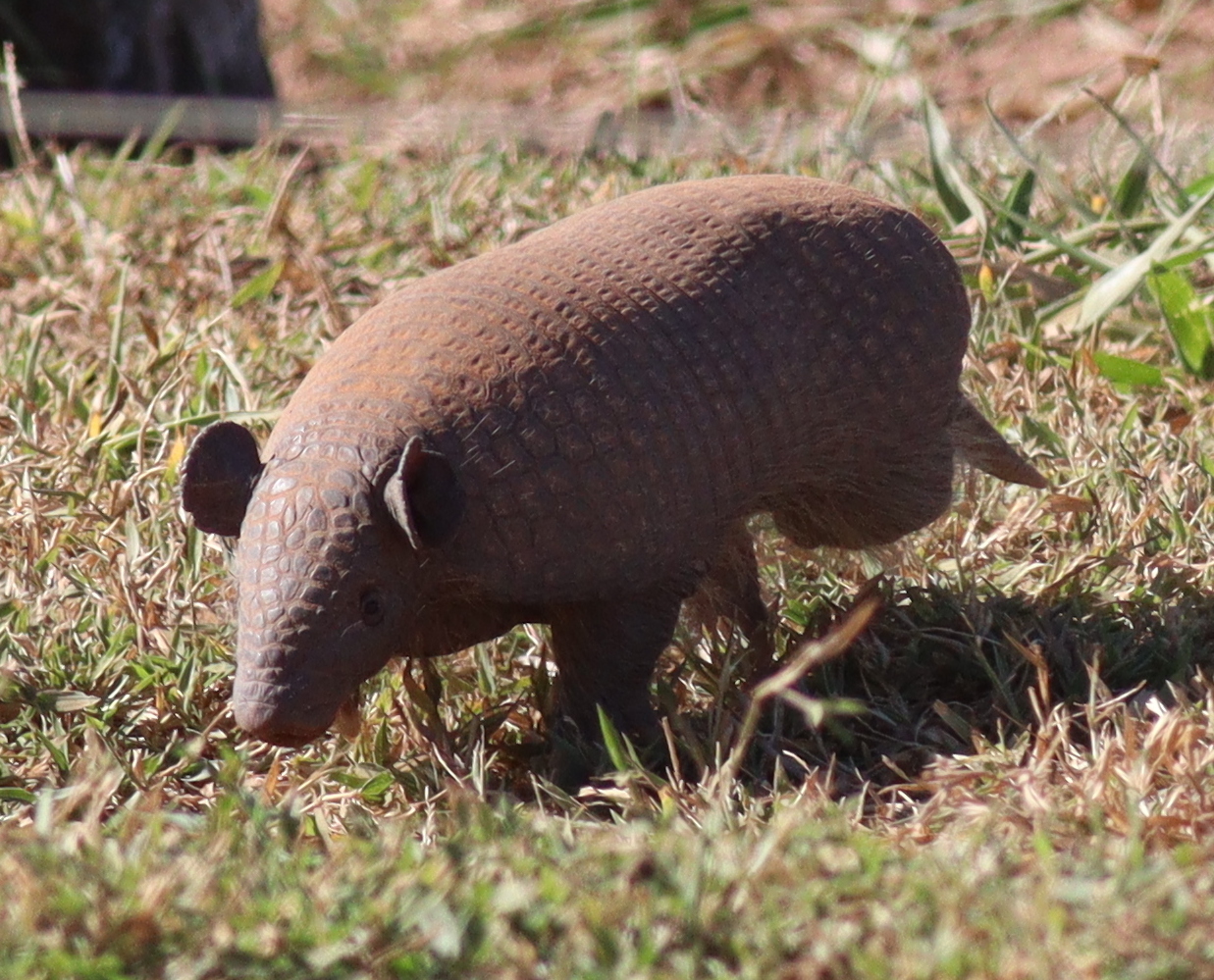
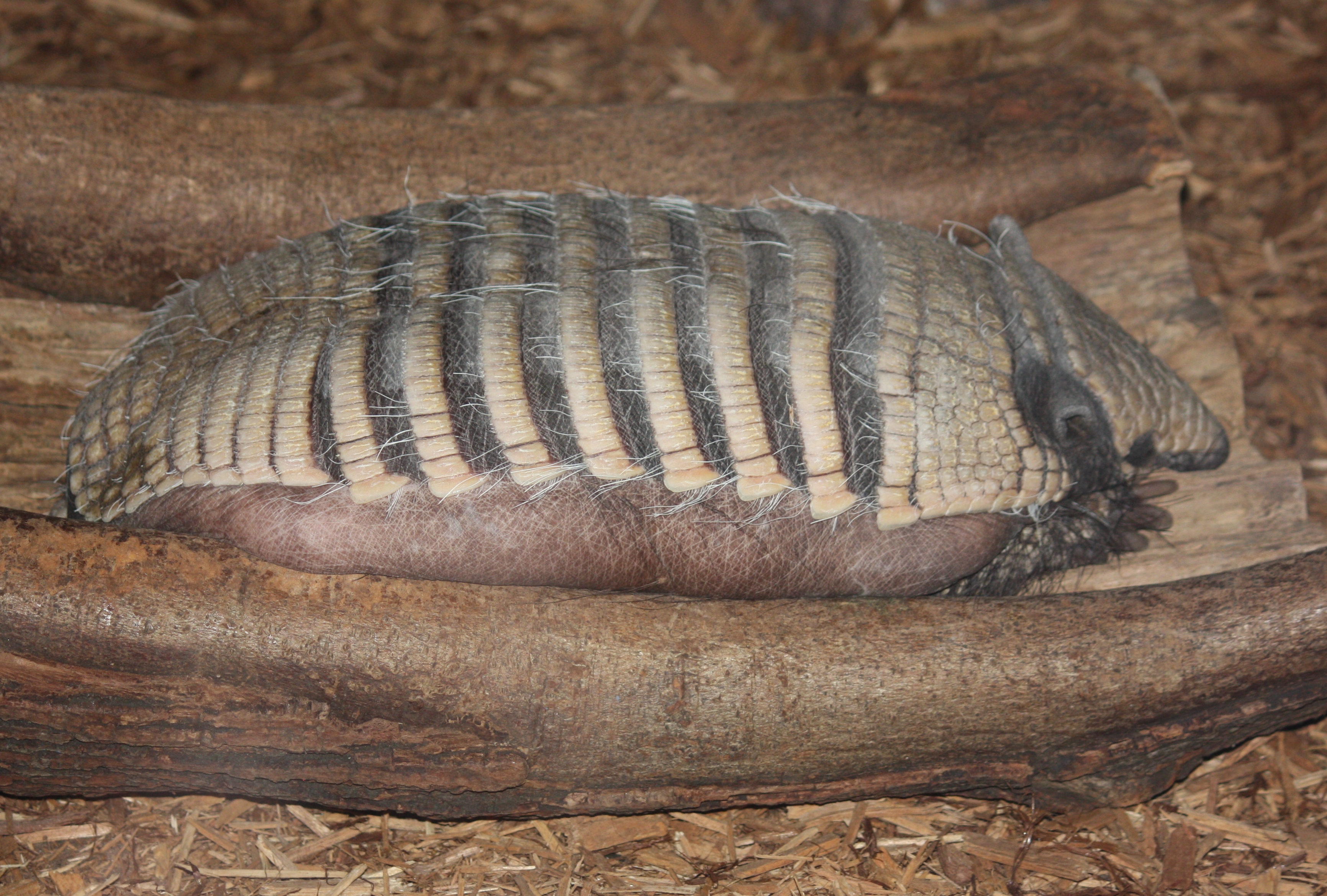
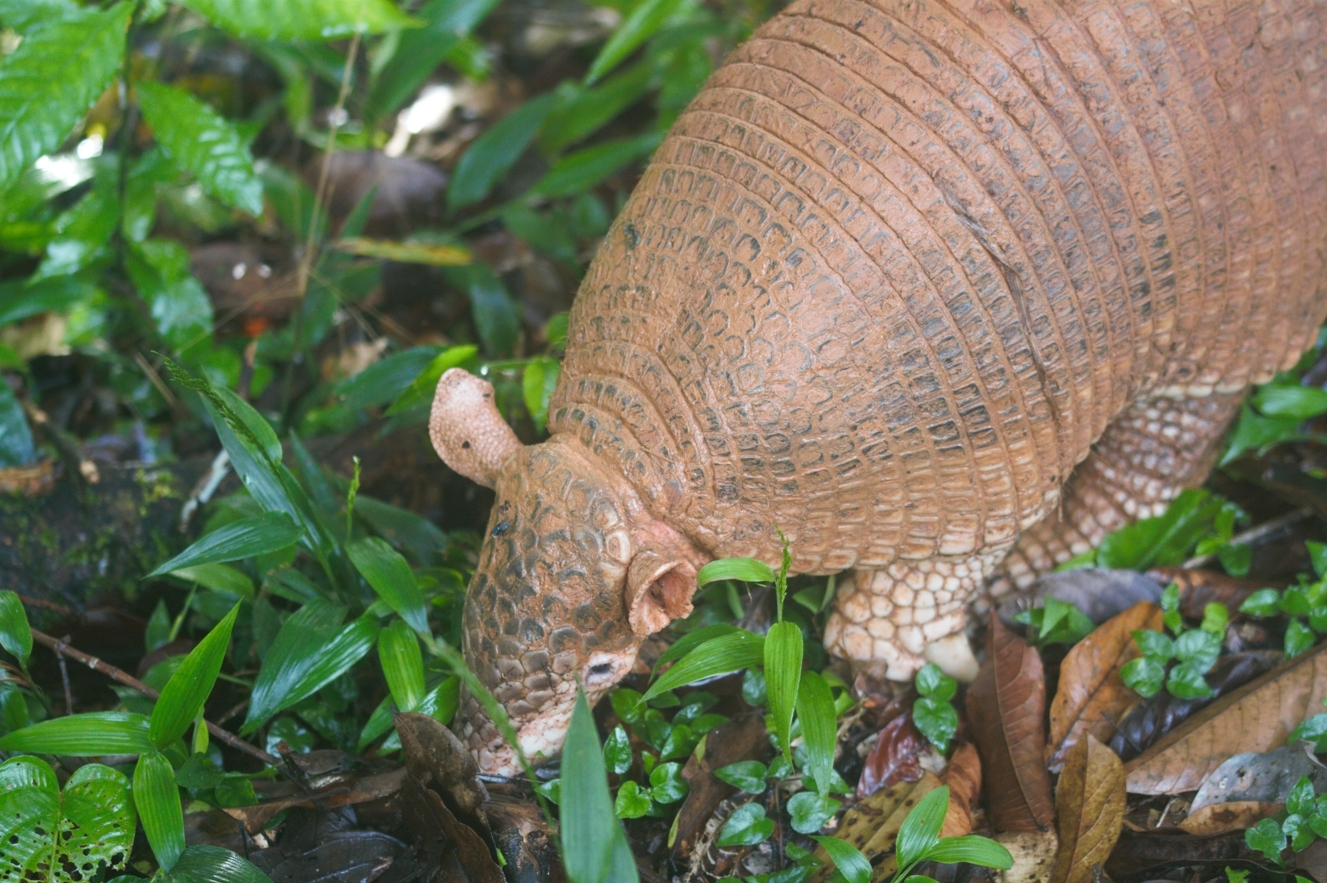
The giant armadillo impresses with its superlative dimensions, reaching up to 1.5 meters in total length, including the tail, and weighing between 30 and 50 kg in the wild—in captivity, some specimens have recorded up to 60 kg. Its most striking feature is the dorsal carapace composed of 11 to 13 mobile and flexible bands, which give the animal surprising mobility for a creature of its size. The carapace coloration is predominantly dark brown, almost black, with a lighter, yellowish or whitish lateral band that delimits the lower edge of the bony shield.
The head and tail are protected by resistant pentagonal shields, while the belly is covered by bare, light skin, devoid of significant hair. Another extraordinary morphological detail is the claw on the third finger of the front paws, which can measure up to 20 centimeters in length. This powerful biological tool is used with surgical precision to break through hardened termite mounds and excavate the compacted soil of the Pantanal's "cordilheiras" (elevated ridges). Its hind legs are robust and have hoof-shaped nails, which help support its weight during foraging.
Unlike other smaller armadillo species, the giant armadillo has a peculiar dentition, with a high number of small and uniform teeth (reaching nearly 100), which lack enamel and grow continuously. This adaptation is directly linked to its myrmecophagous diet, which does not require vigorous chewing but rather the manipulation of large quantities of social insects. Its tongue is long and extensible, facilitating the capture of prey in deep galleries of insect nests.
Habitat and Distribution in the Pantanal
In the Pantanal, the giant armadillo demonstrates a clear preference for areas that do not suffer severe seasonal flooding, known locally as "cordilheiras" (elevations of terrain with arboreal vegetation). These locations are strategic for the construction of its burrows, as they ensure dry and stable soil throughout the year. The species is also found on the edges of gallery forests and Cerrado areas that surround the floodplain, utilizing the heterogeneity of the Pantanal landscape to find food and shelter.
The species' distribution in the biome is wide, covering both the Northern and Southern Pantanal, but the population density is notably low. Studies conducted in the Nhecolândia sub-region, for example, estimate a density of only 7 to 8 individuals for every 100 square kilometers. This natural rarity means that the giant armadillo needs large continuous home ranges to maintain viable populations, making it vulnerable to territory fragmentation caused by the expansion of exotic pastures and human infrastructure, such as the Transpantaneira highway.
Geographically, Priodontes maximus occurs across almost all of South America east of the Andes, from Venezuela and the Guianas to northern Argentina. In Brazil, besides the Pantanal, it inhabits the Amazon and the Cerrado, having been practically extirpated from the Atlantic Forest. The Paraguay River basin acts as an important ecological corridor for the species, connecting different populations and allowing the gene flow necessary for the species' health in the central region of the continent.
Behavior
The giant armadillo is an animal of strictly nocturnal and solitary habits, rarely seen during the day unless disturbed in its refuge. It spends about 75% of its time inside its underground burrows, coming out only after sunset to forage. Its behavior is marked by discretion and impressive physical strength; when feeling threatened, the animal can bury itself quickly or use its powerful claws to defend itself, although its first reaction is generally to flee into dense vegetation.
The construction of burrows is the most fascinating aspect of its behavior. A single individual can maintain several burrows in its home range, using them alternately to avoid predators and stay close to food sources. These structures can reach 5 meters in length and 1.5 meters in depth, featuring a constant and mild internal temperature, which is vital for the animal's thermoregulation during the scorching days of the Pantanal. The burrow entrance is easily identified by its semicircular shape and the large volume of fresh earth accumulated at the entrance.
Socially, the giant armadillo is polygamous, and encounters between males and females occur almost exclusively during the reproductive period. There is no evidence of aggressive territorial behavior between individuals, although the home ranges of different males may overlap with those of several females. Communication between individuals occurs mainly through chemical and olfactory signals left in the environment and at burrow entrances, allowing animals to locate each other and identify each other's reproductive status without the need for frequent visual contact.
Diet
The giant armadillo's diet is classified as opportunistic myrmecophagous, meaning that while it is a specialist in consuming social insects, it can diversify its diet according to the availability of resources in the Pantanal environment. Termites and ants constitute the overwhelming basis of its nutrition, obtained through the destruction of epigeal (above ground) and underground nests. The animal uses its keen sense of smell to locate colonies and its front claws to break through the insects' defensive structures with ease.
Recent studies conducted in the Pantanal revealed that the giant armadillo's diet is more complex than previously assumed. In addition to termites and ants, traces of other invertebrates were found, such as beetle larvae, spiders, and scorpions, as well as small vertebrates like frogs and lizards. Surprisingly, the consumption of fruits and plant fragments was also recorded, suggesting that the animal may act as a secondary seed disperser, contributing to the regeneration of local flora.
The giant armadillo's ecological role in the food chain is of extreme importance. By consuming large quantities of leaf-cutter ants, it acts as a natural pest control agent, which indirectly benefits pastures and native vegetation. Furthermore, by excavating the soil in search of food, the armadillo promotes soil aeration and nutrient cycling, facilitating plant growth and water infiltration, vital processes for maintaining the hydrological and biological balance of the Pantanal.
Reproduction
The giant armadillo's reproductive strategy is one of the main factors contributing to its vulnerability. The species has an extremely slow life cycle, with late sexual maturity occurring only between 7 and 9 years of age. This long period of juvenile development means that the population replacement rate is very low, making the species highly sensitive to any increase in adult mortality.
After mating, the female undergoes a gestation period estimated at about five months. Typically, only a single pup is born per litter, born with a still-soft carapace and totally dependent on maternal care within the safety of the burrow. Parental care is prolonged; the pup remains with the mother for a period that can vary from 6 to 12 months, learning excavation and foraging techniques before becoming independent and seeking its own territory.
The interval between births is another critical point: a female giant armadillo produces a pup only every three or four years. In the dynamic environment of the Pantanal, where extreme events such as major droughts or forest fires can occur, this low reproductive rate makes it difficult for populations to recover quickly after environmental disasters. For this reason, the protection of reproductive females is the highest priority in any conservation strategy for the species in Brazil.
Conservation Status
The giant armadillo is globally classified as "Vulnerable" (VU) by the IUCN Red List. In Brazil, the Ministry of the Environment, through ICMBio, also categorizes it as "Vulnerable" at the national level, although the situation is much more critical in fragmented biomes like the Atlantic Forest, where the species is considered "Critically Endangered." In the Pantanal, the population is considered stable in preserved areas, but the general trend for the species is decline due to continuous anthropogenic pressure.
The main threats to the giant armadillo include habitat loss and fragmentation resulting from the conversion of native areas into exotic grass pastures and monocultures. Hunting, although illegal, still occurs in some regions, motivated both by meat consumption and retaliation, as the animal sometimes destroys beehives in search of larvae, generating conflicts with beekeepers. Furthermore, large-scale forest fires, which have become more frequent in the Pantanal in recent years, represent a direct mortal risk and destroy the species' food sources.
Another significant risk factor is roadkill on highways that cut through the biome. Due to its nocturnal habit and low agility to dodge high-speed vehicles, many individuals perish while trying to cross roads. Conservation projects, such as the Giant Armadillo Project, have worked intensely in the Pantanal to monitor the species, promote environmental education among local farmers, and implement measures that mitigate conflicts between humans and wildlife.
Curiosities
One of the most notable curiosities about the giant armadillo is its title as an "ecosystem engineer." Its abandoned burrows do not stay empty for long; researchers have already recorded more than 100 different species of vertebrates using these holes as shelter, breeding sites, or refuge against extreme heat. Animals such as the crab-eating fox, small cats, lizards, and even birds use the armadillo's engineering to survive, making it a keystone species for maintaining Pantanal biodiversity.
Unlike the capybara, which is easily spotted in large groups, the giant armadillo is one of the rarest and most celebrated encounters for tour guides and biologists in the Pantanal. Its rarity and prehistoric appearance give it an almost mythical status among local communities, where it is respected for its strength. In some regions, it is believed that finding a giant armadillo is a sign of luck, given the difficulty of locating this giant in the vastness of the plain.
In popular culture and ecotourism, the giant armadillo is part of the Pantanal's "Big Five," a term adapted from African safaris to designate the five most emblematic and desired species by visitors: the jaguar, the maned wolf, the giant anteater, the giant otter, and, of course, the giant armadillo. Its preservation, therefore, is not only a matter of biological balance but also a fundamental pillar for the sustainable economy based on nature observation in the region.
References
[1] IUCN. (2014). *Priodontes maximus*. The IUCN Red List of Threatened Species. Available at: https://www.iucnredlist.org/species/18315/47442341
[2] ICMBIO. (2018). *Livro Vermelho da Fauna Brasileira Ameaçada de Extinção*. ICMBio. Available at: https://www.icmbio.gov.br
[3] CARTER, S. P.; SUPERINA, M.; TRUPP, W. (2016). *The Giant Armadillo (Priodontes maximus): A Review of its Ecology, Status, and Conservation*. Edentata, 17(1), 1-13.
[4] ALHO, C. J. R. (2008). *Biodiversidade do Pantanal*. Editora UNIDERP.
[5] SILVEIRA, L.; JAEGER, N.; ALMEIDA, L. B. (2009). *Ecology and conservation of the giant armadillo (Priodontes maximus) in the Brazilian Cerrado*. Mastozoología Neotropical, 16(1), 115-124.
[6] EMBRAPA PANTANAL. (2020). *Tatu-canastra: o engenheiro do ecossistema*. Embrapa Pantanal. Available at: https://www.embrapa.br/pantanal/publicacoes
[7] SOS PANTANAL. (2023). *Tatu-canastra: um gigante ameaçado*. SOS Pantanal. Available at: https://sospantanal.org.br/tatu-canastra-um-gigante-ameacado/