
Turdus leucomelas (White-throated Thrush): White-throated Thrush of the Pantanal
Introduction
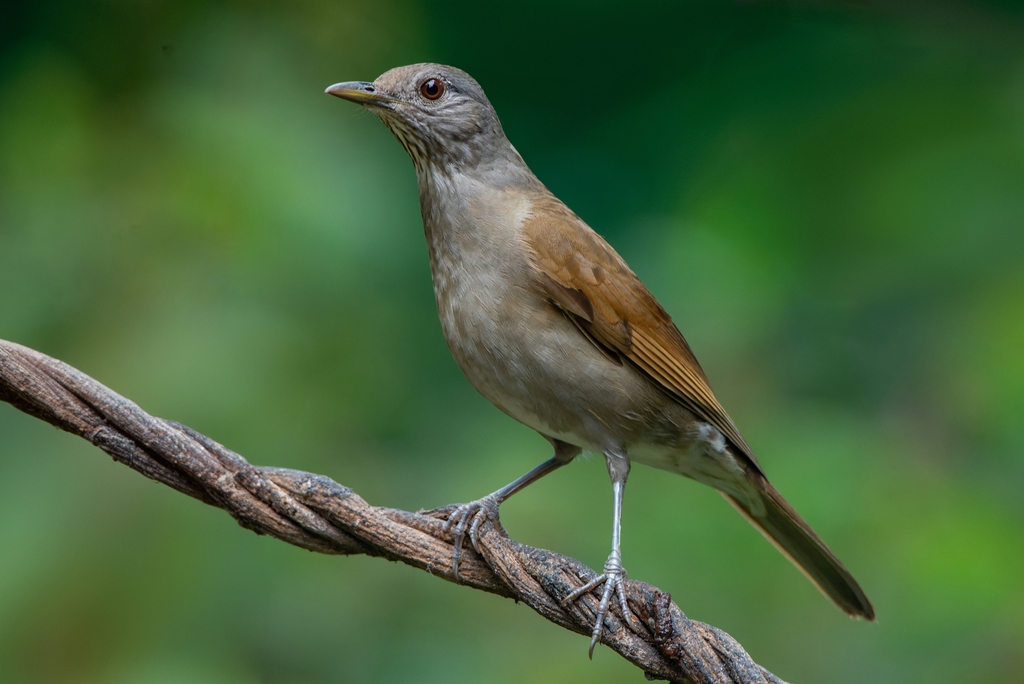
The White-throated Thrush (Turdus leucomelas) is one of the most characteristic species of the Pantanal avifauna. It has brownish-gray upperparts, a white throat with brown streaks, and whitish-yellow underparts. This species is part of the rich bird diversity of the Pantanal, a biome that hosts more than 650 species and is considered one of the best birdwatching destinations in the world [1] [2].
Scientific Classification
| Category | Classification |
|---|---|
| Kingdom | Animalia |
| Phylum | Chordata |
| Class | Aves |
| Order | Passeriformes |
| Family | Turdidae |
| Genus | Turdus |
| Species | Turdus leucomelas |
| Common Name | White-throated Thrush |
Description
Thrush with brownish-gray upperparts, a white throat with brown streaks, and whitish-yellow underparts. Bill and periocular ring are yellow. Legs are yellowish-brown. Length ranges between 22-24 cm and weight between 60-80 g.
Geographic Distribution
Venezuela, Colombia, Trinidad, the Guianas, and Brazil. In Brazil, it occurs in the Pantanal, Cerrado, and Amazon regions. In the Pantanal, it is one of the most common thrushes.
Habitat
Edges of forests, riparian woodlands, cerradão (dense woodland), and urbanized areas. Highly adaptable to modified environments.
Behavior
Solitary or in pairs. Its melodious and varied song makes it one of the most appreciated songbirds of the Pantanal. It sings mainly at dawn and dusk. Feeds on the ground by turning over leaves in search of invertebrates.
Diet
Fruits, earthworms, insects, spiders, and other invertebrates. A generalist feeder.
Reproduction
Cup-shaped nest in shrubs or low trees. Lays 2-4 blue-green eggs with brown spots. Incubation lasts 13-14 days.
Conservation Status
Least Concern (LC) according to the IUCN. Common in the Pantanal.
References
[1] SICK, H. (1997). Ornitologia Brasileira. Nova Fronteira. [2] TUBELIS, D.P.; TOMAS, W.M. (2003). Bird species of the Pantanal wetland, Brazil. Ararajuba, v.11, n.1. [3] DEL HOYO, J. (1992). Handbook of the Birds of the World. Lynx Edicions. [4] IUCN. (2023). Turdus leucomelas. The IUCN Red List of Threatened Species. [5] COLLAR, N.J. (1992). Threatened Birds of the Americas. ICBP.