Introduction
Bradypus variegatus, popularly known as the brown-throated three-toed sloth or common sloth, represents one of the most unique icons of Neotropical fauna. This arboreal mammal is widely recognized for its extremely slow metabolism and deliberate movements, evolutionary adaptations that allow it to subsist on a low-energy folivorous diet. In the context of the Pantanal, the species finds refuge in areas of gallery forests and forest patches (capões), where the density of vegetation offers both food and protection against terrestrial and aerial predators.
The presence of the sloth in the Pantanal biome is an indicator of the health of local forest ecosystems. Although more frequently associated with the Amazon and the Atlantic Forest, Bradypus variegatus inhabits the transition zones and seasonal forests that make up the vegetational mosaic of the Pantanal. Its biology is intrinsically linked to the dynamics of floods and droughts, as connectivity between tree canopies is vital for its movement, minimizing the need to descend to the ground, where it becomes extremely vulnerable.
Scientific Classification
| Category | Classification |
|---|---|
| Kingdom | Animalia |
| Phylum | Chordata |
| Class | Mammalia |
| Order | Pilosa |
| Family | Bradypodidae |
| Genus | Bradypus |
| Species | Bradypus variegatus |
| Common Name | Brown-throated three-toed sloth, Common sloth |
Description
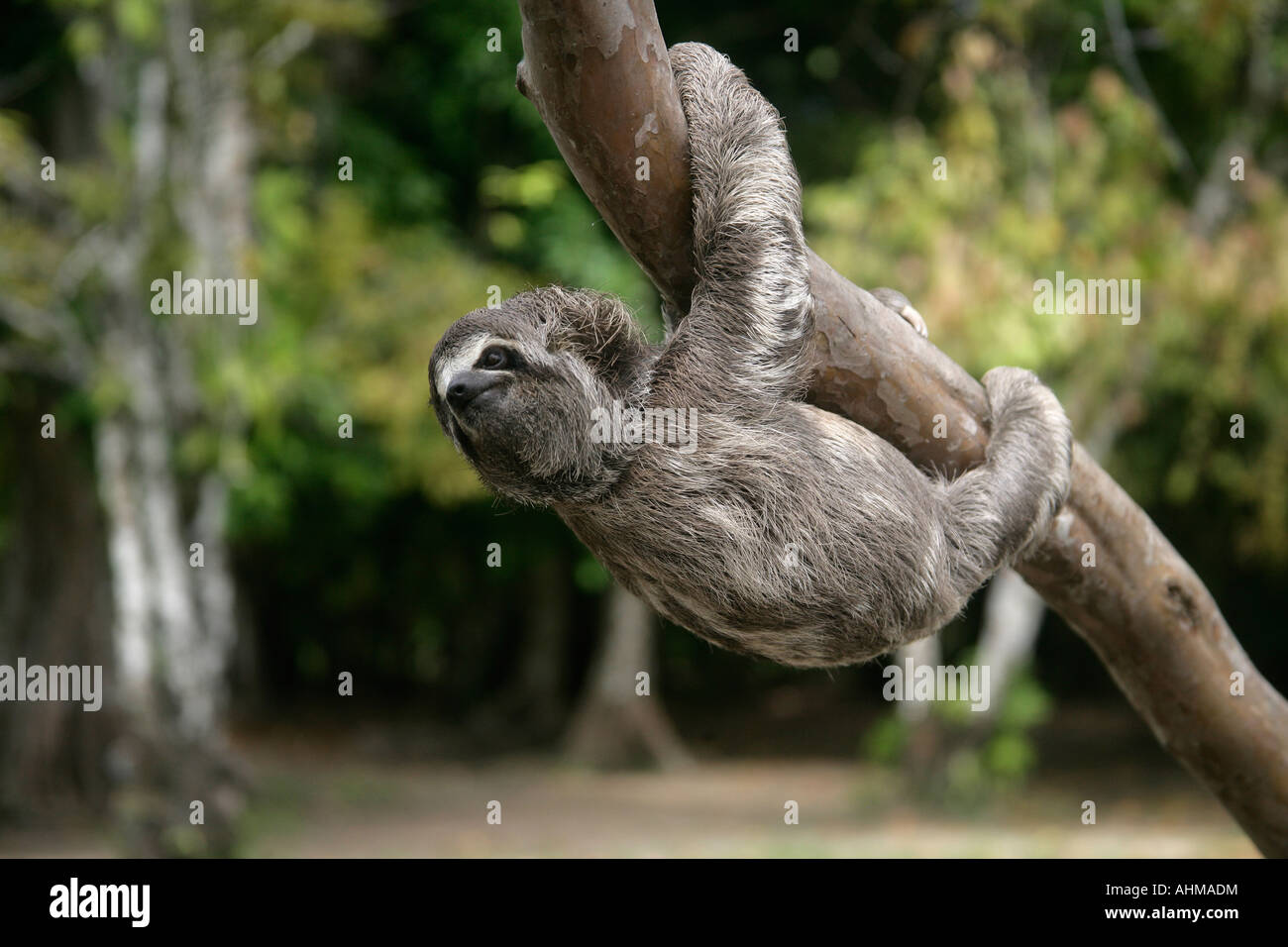
Bradypus variegatus possesses highly specialized morphological characteristics for life in the tree canopies. Its coat is composed of two layers: a short, dense inner layer and a long, coarse outer layer, which often presents a greenish coloration due to symbiosis with chlorophyte algae. This mutualistic relationship provides efficient camouflage against predators such as the harpy eagle (Harpia harpyja). The base coloration varies from pale brown to yellowish, with whitish spots on the back.
A distinctive feature of the species is the facial “mask,” a band of black fur that outlines the eyes and extends laterally, contrasting with the lighter-colored face. Adult males present a speculum, a dorsal patch of short fur with orange or yellowish coloration and a central black line, which facilitates sexual differentiation in the field. Its claws, three on each limb (hence its common name), are powerful tools for gripping branches, functioning as natural hooks that support the animal’s weight without constant muscular effort.
| Feature | Value |
|---|---|
| Body Length | 50 to 75 cm |
| Average Weight | 3.5 to 6.0 kg |
| Claw Length | 7 to 8 cm (front) |
| Number of Cervical Vertebrae | 8 to 10 |
| Body Temperature | 30°C to 34°C (variable) |
The internal anatomy of the sloth is also remarkable. Unlike most mammals that have seven cervical vertebrae, the genus Bradypus has between eight and ten, allowing a head rotation of up to 270 degrees. This range of motion is crucial for vigilance and feeding without the need to move the body, saving precious energy. Its digestive system is multilocular, similar to that of ruminants, housing symbiotic bacteria that process the cellulose in leaves, a process that can take weeks to complete.
Distribution and Habitat
Bradypus variegatus has one of the widest geographic distributions among Neotropical sloths, extending from Central America to northern Argentina. In Brazil, its occurrence is prominent in the Amazon and the Atlantic Forest, but its presence in the Pantanal is of extreme ecological relevance. The Pantanal biome, characterized by its floodplains and seasonal forest formations, offers a complex habitat where the species concentrates in areas of gallery forests and capões (islands of vegetation in flooded areas).
Distribution in the Pantanal is influenced by the availability of trees with dense and connected canopies, essential for safe movement. The species is capable of withstanding changes to its habitat, demonstrating some resilience in transition areas between the Cerrado and the Pantanal. However, forest fragmentation and the loss of connectivity between forest fragments represent significant challenges, as sloths are extremely vulnerable when forced to descend to the ground to cross open areas or roads.
Behavior
The behavior of Bradypus variegatus is guided by energy conservation. Its activities are cathemeral, meaning it can be active both during the day and at night, although it shows peaks of diurnal activity in many regions. It spends about 75% to 80% of its time at rest, often in a sitting-resting position that aids slow digestion. Its movements are slow and deliberate, a strategy that makes it almost invisible to predators that depend on motion detection, such as the jaguar (Panthera onca).
Despite its docile appearance, the brown-throated three-toed sloth can manifest social behaviors and agonistic interactions, especially among males during the breeding season. One of the most notable behavioral curiosities is the habit of descending to the ground approximately once a week to defecate and urinate. This behavior, which consumes energy and increases the risk of predation, is the subject of scientific studies suggesting a complex relationship with the life cycle of sloth moths (Cryptoses choloepi) that inhabit its fur.
Feeding / Nutrition
The diet of Bradypus variegatus is strictly folivorous, based on the consumption of leaves, twigs, and buds from a limited variety of trees. In the Pantanal, sloths show a preference for fast-growing species with open canopies, such as cecropias (Cecropia spp.), whose leaves are rich in nutrients and easy to digest compared to other forest species. However, its diet is more diverse than previously thought, including leaves from various botanical families such as Moraceae and Clusiaceae.
The sloth’s digestive system is a marvel of biological adaptation. It has a large and complex stomach, divided into compartments where bacterial fermentation breaks down cellulose and neutralizes plant toxins. Due to the low caloric value of its diet and the slowness of the digestive process, the sloth has the lowest metabolic rate among non-hibernating mammals. This characteristic dictates its entire lifestyle, from variable body temperature to reduced heart rate.
| Food Type | Importance in Diet |
|---|---|
| Cecropia Leaves (Cecropia spp.) | High |
| Fig Tree Buds (Ficus spp.) | Medium |
| Inga Leaves (Inga spp.) | Medium |
| Moraceae Twigs | Low |
| Seasonal Flowers | Low |
Reproduction
The reproductive cycle of Bradypus variegatus is marked by a high parental investment strategy and a low birth rate. The interval between births is approximately 19 months, with a gestation period of about six months. The offspring size is only one individual per pregnancy, which makes the species vulnerable to rapid population losses. The mating system is characterized by continuous vocalizations from females, which attract males to the tree canopies.
Parental care is provided exclusively by the female, who carries the offspring on her belly during the first months of life. The offspring begins to try solid leaves around two months of age but remains dependent on the mother for transport and protection for up to six months. This period of coexistence is crucial for learning feeding routes and preferred plant species. Sexual maturity is reached between three and five years of age, depending on environmental conditions and resource availability.
Ecological Importance
The brown-throated three-toed sloth plays a fundamental role in the dynamics of the Pantanal’s forest ecosystems. As a specialized herbivore, it influences vegetation structure by consuming leaves of pioneer species, such as cecropias, helping to control the growth of certain plants and in nutrient cycling. Its feces, deposited on the forest floor, function as a concentrated natural fertilizer, returning essential nutrients to the soil and promoting the growth of new seedlings.
In addition to its role as a herbivore, Bradypus variegatus is the center of a miniature ecosystem in its own fur. It houses a diverse community of organisms, including algae, fungi, mites, and moths. This associated biodiversity is unique and demonstrates the complexity of symbiotic relationships in nature. The presence of the sloth also serves as an indicator of habitat quality, as its survival depends on the integrity of gallery forests and connectivity between forest fragments.
Conservation Status
Currently, Bradypus variegatus is classified as Least Concern (LC) by the IUCN Red List and ICMBio, due to its wide geographic distribution and relatively stable populations in large protected areas. However, this general classification can mask significant local threats, especially in biomes under pressure like the Pantanal. Habitat loss due to deforestation for pastures and forest fragmentation are the main threats to the species in the region.
Other threats include roadkill on highways that cut through the biome and predation by domestic animals, such as dogs, when sloths descend to the ground. Wildlife trafficking for “selfie” tourism and as pets is also a growing concern, as these animals rarely survive in captivity due to their highly specialized dietary and metabolic needs. The conservation of the sloth in the Pantanal depends on the maintenance of ecological corridors and the protection of gallery forests.
Curiosities
- The sloth can rotate its head up to 270 degrees, thanks to its extra cervical vertebrae.
- Despite being slow on land, sloths are excellent swimmers, using their long arms to move through the water.
- A sloth’s stomach can represent up to one-third of its total body weight when full.
- The sloth’s fur grows from the belly to the back, which helps drain rainwater while the animal is hanging upside down.
- Sloths sleep about 9 to 10 hours a day in the wild, much less than the 15 to 20 hours observed in captivity.
References
[1] ICMBIO. (n.d.). Ficha de Espécie: Bradypus variegatus. Available at: https://www.gov.br/icmbio/pt-br/assuntos/centros-de-pesquisa/primatas-brasileiros/arquivos/fichas_xenathra/fichas_2019_2021/cingulata/dasypodidae/pilosa/bradypodidae/ficha-bradypus-variegatus.pdf [2] ANIMAL DIVERSITY WEB. (n.d.). Bradypus variegatus (brown-throated three-toed sloth). Available at: https://animaldiversity.org/accounts/Bradypus_variegatus/ [3] IUCN RED LIST. (n.d.). Brown-throated Three-toed Sloth. Available at: https://www.iucnredlist.org/species/3036/47436991 [4] MORAES-BARROS, N. et al. (2011). The evolutionary history of the three-toed sloth Bradypus variegatus. Available at: https://pubmed.ncbi.nlm.nih.gov/21426377/ [5] CHIARELLO, A. G. (2008). Sloth ecology: an overview of field studies. Available at: https://www.researchgate.net/publication/226168533_Sloth_ecology_an_overview_of_field_studies