
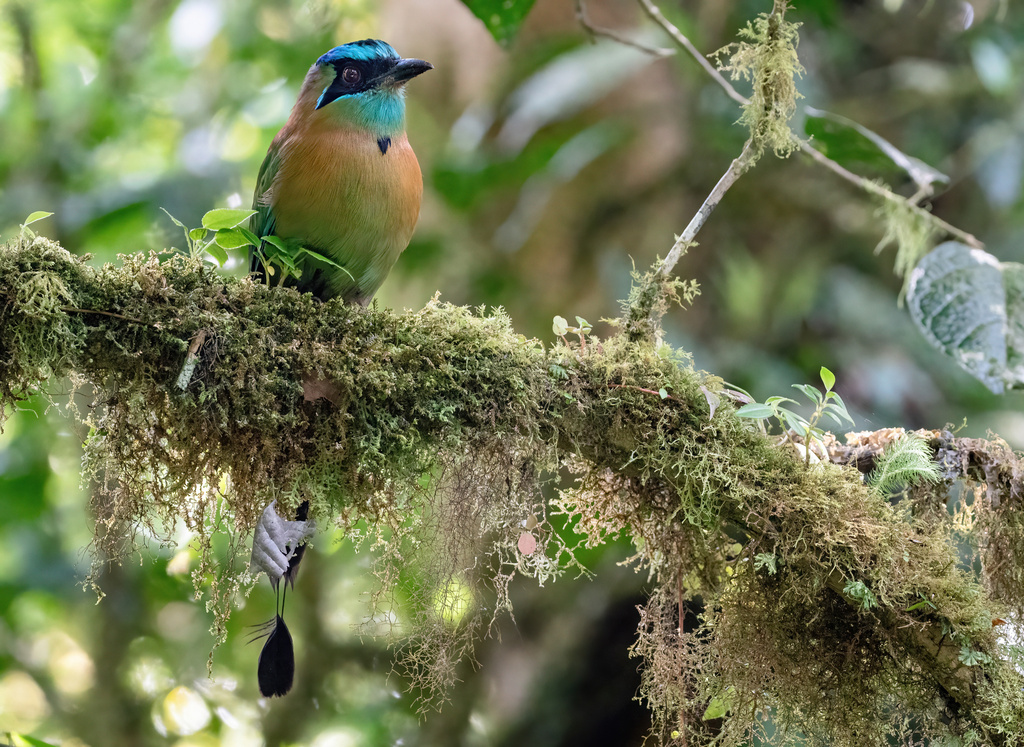
Momotus momota (Blue-crowned Motmot): Blue-crowned Motmot of the Pantanal
Introduction
The blue-crowned motmot (Momotus momota) is one of the most characteristic species of the Pantanal avifauna. It is among the most colorful birds of the Pantanal. This species is part of the rich bird diversity of the Pantanal, a biome that hosts more than 650 species and is considered one of the best birdwatching destinations in the world [1] [2].
Scientific Classification
| Category | Classification |
|---|---|
| Kingdom | Animalia |
| Phylum | Chordata |
| Class | Aves |
| Order | Coraciiformes |
| Family | Momotidae |
| Genus | Momotus |
| Species | Momotus momota |
| Common Name | Blue-crowned Motmot |
Description
One of the most colorful birds of the Pantanal. Turquoise-blue crown with a black center. Upperparts are emerald green. Breast is bluish green with a black patch. Long tail with the two central feathers ending in blue rackets — the tips are bare due to self-cleaning. Length ranges between 38-48 cm and weight between 120-175 g.
Geographic Distribution
From Mexico to northern Argentina. In Brazil, it occurs in all forest biomes. In the Pantanal, it is found in riparian forests and forest patches.
Habitat
Riparian forests, forest patches, and gallery forests. Prefers shaded environments with dense understory.
Behavior
Solitary or in pairs. Swings its tail pendulously — a characteristic and unmistakable behavior. Hunts from perches, diving to capture prey on the ground. Emits a low, repetitive call at dawn.
Diet
Insects, spiders, scorpions, small lizards, frogs, and fruits. Captures prey on the ground after diving from a perch.
Reproduction
Excavates tunnels 1-2 meters long in earthen banks. Lays 3-4 white eggs. Incubation lasts 21-22 days. Both parents participate.
Conservation Status
Least Concern (LC) according to the IUCN. Relatively common in the Pantanal.
References
[1] SICK, H. (1997). Ornitologia Brasileira. Nova Fronteira. [2] TUBELIS, D.P.; TOMAS, W.M. (2003). Bird species of the Pantanal wetland, Brazil. Ararajuba, v.11, n.1. [3] DEL HOYO, J. et al. (1992). Handbook of the Birds of the World. Lynx Edicions. [4] IUCN. (2023). Momotus momota. The IUCN Red List of Threatened Species. [5] COLLAR, N.J. et al. (1992). Threatened Birds of the Americas. ICBP.