

Introduction/Overview
The giant anteater (Myrmecophaga tridactyla), one of the most iconic mammals of the Neotropical fauna, is a gentle giant that inhabits various landscapes, including the vast floodplains of the Brazilian Pantanal. Its reproductive biology and subsequent parental care represent one of the most fascinating and specialized life strategies among the mammals of the biome. Characterized by its myrmecophagous diet (feeding based on ants and termites), its elongated snout, and its exuberant tail, the giant anteater exhibits a life cycle that emphasizes quality over quantity, with the birth of a single offspring per gestation and a prolonged period of maternal dependence. This reproductive approach, although common in long-lived species with low adult mortality rates, is particularly notable in the context of the environmental and predatory pressures of the Pantanal. A detailed understanding of its reproduction and parental care is crucial for the conservation of this species, classified as Vulnerable by the International Union for Conservation of Nature (IUCN).
Reproductive Characteristics of the Giant Anteater
The reproduction of the giant anteater is a complex process adapted to environmental conditions, resulting in significant parental investment.
Reproductive Cycle and Gestation
The giant anteater does not have a strictly defined reproductive season, although there is evidence of a peak in births during the warmer and more humid months, which coincide with the greater availability of prey in the Pantanal. However, births can occur throughout the year. Sexual maturity is reached around 2.5 to 3.5 years of age. Mating is a relatively brief event, and copulation can occur in various positions. Gestation lasts approximately 190 days, or about six and a half months. This relatively long period for a mammal of its size reflects the high energy investment in the formation of a well-developed offspring.
Birth and Characteristics of the Offspring
At the end of gestation, the female gives birth to a single offspring. The birth of twins is extremely rare and, when it occurs, the survival of both is unlikely due to the intense demand for care. The offspring is born relatively large and well-developed, with a weight ranging between 1.2 and 1.6 kg. Its claws are already evident, although soft, and its body is covered by a dense coat. A notable and crucial characteristic for survival is the offspring’s coat pattern, which is a miniature replica of the mother’s pattern. The dark and light stripes align perfectly with those of the parent when the offspring is on her back, providing exceptional camouflage. This visual mimicry makes it difficult for predators to detect the offspring and is a prime example of evolutionary adaptation.
Parental Care and Offspring Development
Parental care in the giant anteater is prolonged and intensive, centered on the protection and teaching of the offspring.
Transport of the Offspring
From birth, the giant anteater offspring is transported on the mother’s back. This is one of the most iconic images of the species. The offspring clings firmly to the mother’s fur with its claws, remaining safe during movements and foraging activities. This transport behavior is vital as it allows the mother to move freely to find food and avoid predators, while the offspring remains protected and warm. The camouflage provided by the overlapping coat patterns is so effective that, from a distance, it is difficult to distinguish the offspring from the mother, making them appear as a single larger animal. This transport can last for an extensive period, usually until the offspring is about one year old, or until it reaches approximately half the adult size.
Defense and Protection
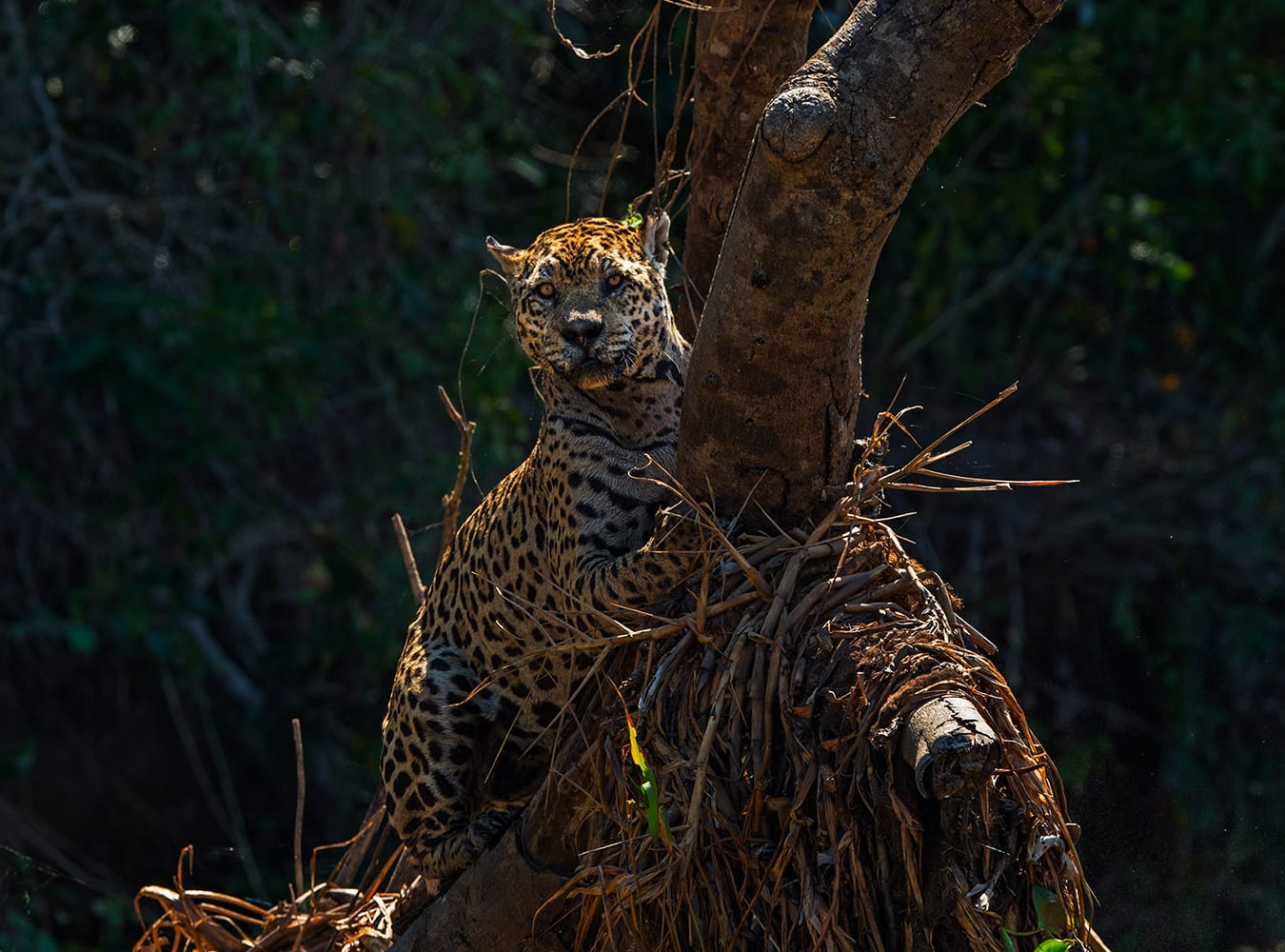
The giant anteater mother is extremely protective of her offspring. During the period when the offspring is on her back, she becomes even more cautious and defensive. The powerful front claws, which are her main tools for excavating anthills and termite mounds, are also formidable defensive weapons. In case of a threat, the mother can stand on her hind legs, using her tail as support, and strike with her front claws. Predators such as jaguars (Panthera onca) and pumas (Puma concolor) are the main natural enemies of the giant anteater and its offspring in the Pantanal. The mother’s active defense is, therefore, a critical factor for the young’s survival. There are reports of giant anteaters that, when cornered, managed to seriously injure or even kill predators with their claws.
Weaning and Independence
The weaning of the giant anteater offspring is a gradual process. Initially, the offspring feeds exclusively on breast milk. As it grows, it begins to explore the environment and experiment with the mother’s myrmecophagous diet. It is observed that the offspring begin to climb down from the mother’s back to forage on their own, but always under her watchful eye. They learn to locate anthills and termite mounds, to excavate, and to use their tongue to capture insects. The transition to independence is slow and progressive, ensuring that the young acquires all the necessary skills to survive on its own. Final separation usually occurs when the offspring is between 10 and 12 months old, although it can vary. After this period, the young giant anteater disperses to establish its own territory.
Distribution and Occurrence in the Pantanal
The giant anteater is widely distributed throughout the Pantanal, a biome that offers an ideal habitat for the species.
Preferred Habitat
In the Pantanal, the giant anteater is found in a variety of habitats, including open fields, savannas, cerrado areas, and gallery forest edges. The presence of termite mounds and anthills is the most determining factor for its occurrence, as they are its main food source. The Pantanal landscape, with its alternations of flood and drought, influences the seasonal distribution of the species, which may move to higher areas during floods. The availability of water and the presence of dense vegetation for shelter and rest are also important.
Population Density
The population density of the giant anteater in the Pantanal varies depending on the region and the availability of resources. Studies indicate that in well-preserved areas, the density can be relatively high. However, habitat fragmentation and anthropogenic pressure have led to a reduction in some areas. Slow reproduction and prolonged parental care mean that the species’ population recovery is intrinsically slow, making it particularly vulnerable to population losses.
Ecological Importance
As a specialized predator of social insects, the giant anteater plays a fundamental ecological role in the Pantanal.
Control of Insect Populations
By consuming large quantities of ants and termites, the giant anteater acts as a natural regulator of these insect populations. Although ants and termites are vital components of the ecosystem, their excess can have impacts on vegetation and soil structure. The giant anteater helps maintain ecological balance, influencing nutrient cycling and the structure of invertebrate communities.
Ecosystem Engineer
The giant anteater’s excavation activity to access its prey also has a significant effect on the environment. The burrows and holes created by them can be used by other species for shelter, and the soil aeration resulting from the excavation contributes to the health of the ecosystem. Thus, the giant anteater can be considered an “ecosystem engineer,” modifying the environment in ways that benefit other species.
Conservation and Threats
The slow reproduction and intensive parental care of the giant anteater, although effective for individual survival, make the species particularly sensitive to threats.
Habitat Loss and Fragmentation
The main threat to the giant anteater in the Pantanal, and throughout its range, is habitat loss and fragmentation. The expansion of agriculture, cattle ranching, forest fires, and infrastructure (roads, hydroelectric plants) reduce the areas available for the species and isolate populations, making it difficult for young to disperse in search of new territories and partners. The reproduction of a single offspring per gestation means that the loss of an individual has a proportionally greater impact on the population.
Forest Fires
Forest fires, which have intensified in the Pantanal in recent years, represent a devastating threat to the giant anteater. Their slow locomotion and inability to hide in deep burrows make them vulnerable to fire. Offspring, which depend on the mother for locomotion, are even more susceptible. Fires not only kill animals directly but also destroy habitat and food sources, impacting reproductive capacity and long-term survival.
Roadkills and Hunting
Roadkills on highways are a significant cause of mortality for the giant anteater, especially in areas where roads cut through its natural habitat. Hunting, although illegal, still occurs in some regions, either out of retaliation (belief that they attack cattle) or for consumption. The combination of a low reproductive rate with high non-natural mortality rates is a recipe for population decline.
Diseases and Predation
Offspring are particularly vulnerable to diseases and predation, especially in the first months of life. Although the mother is a fierce defender, predation by jaguars and pumas is a natural cause of mortality, which becomes more critical in populations already weakened by other threats.
Conservation Strategies
Conservation of the giant anteater in the Pantanal requires a multifaceted approach. The protection and restoration of habitats, the creation of ecological corridors to connect isolated populations, environmental education to reduce conflicts with humans, and inspection against hunting and fires are essential measures. Population monitoring programs and studies on the species’ reproductive ecology are crucial to inform conservation strategies and ensure the survival of this charismatic and ecologically important species.
References
[1] EISENBERG, J. F., & REDFORD, K. H. (1999). Mammals of the Neotropics, Volume 3: Ecuador, Bolivia, Brazil. The University of Chicago Press. Available at: https://press.uchicago.edu/ucp/books/book/chicago/M/bo3616656.html
[2] MIRANDA, F., et al. (2014). Myrmecophaga tridactyla. The IUCN Red List of Threatened Species 2014: e.T14252A47443196. Available at: https://www.iucnredlist.org/species/14252/47443196
[3] MEDRI, I. M., & MOULTON, T. P. (2005). Diet and habitat use of the giant anteater (Myrmecophaga tridactyla) in the Pantanal of Mato Grosso do Sul, Brazil. Biota Neotropica, 5(1). Available at: https://www.biotaneotropica.org.br/BN/article/view/bn00105012005
[4] PANTANAL CONSERVATION. (2023). Giant Anteater. Available at: https://www.pantanalconservation.org/wildlife/giant-anteater/