

Introduction
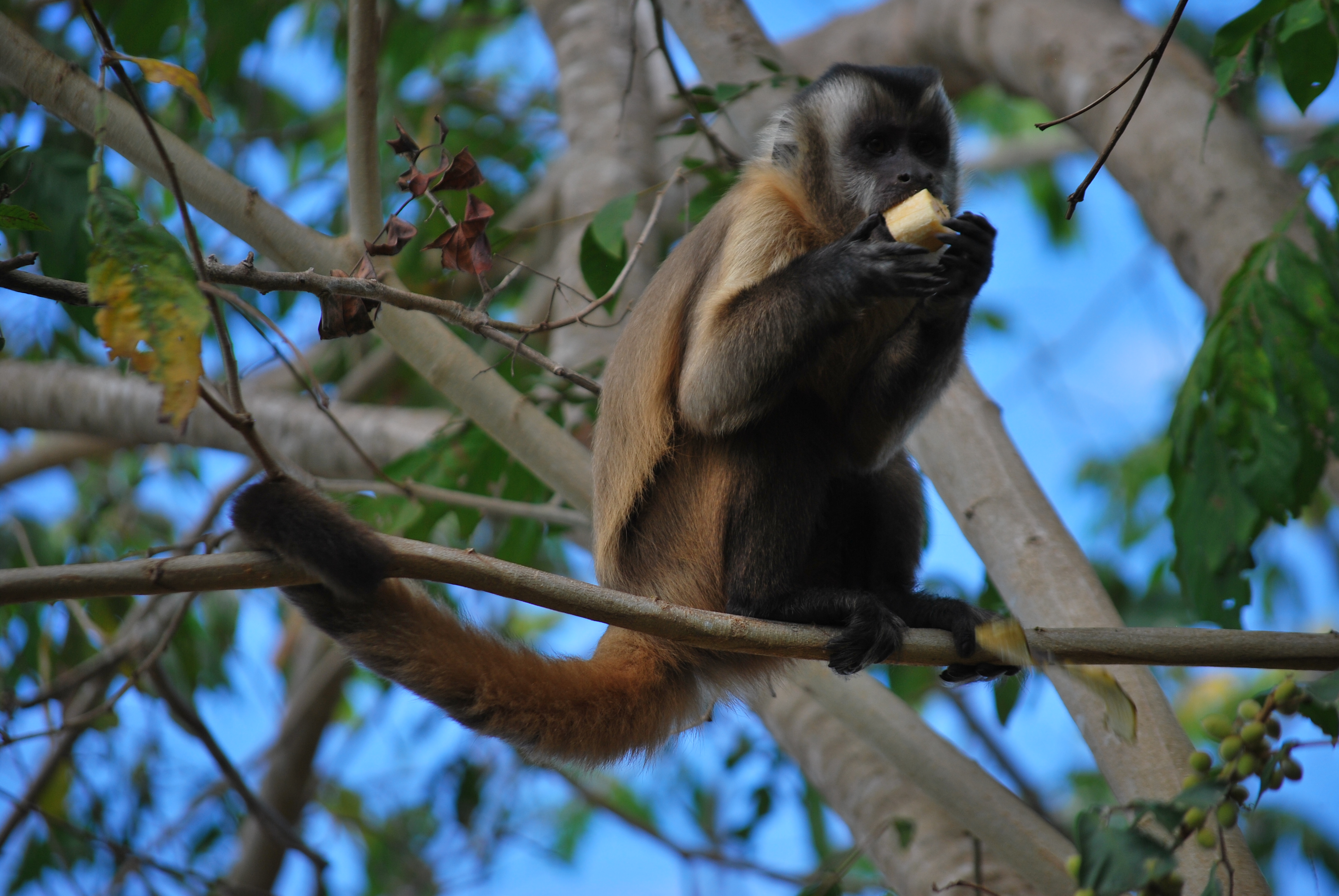
The Azara's capuchin (Sapajus cay), also known regionally as the yellow-breasted capuchin, is one of the most emblematic and intelligent primates of South American fauna. Belonging to the family Cebidae and the genus Sapajus, which groups the so-called "robust capuchin monkeys," this species plays a fundamental ecological role in the Pantanal biome. Its presence is a vital indicator of the health of riparian forests and Pantanal ridges (cordilheiras), where it acts as one of the main seed dispersers, directly contributing to forest regeneration and the maintenance of local biodiversity [1] [2].
Scientific Classification
| Kingdom | Animalia |
| Phylum | Chordata |
| Class | Mammalia |
| Order | Primates |
| Family | Cebidae |
| Genus | Sapajus |
| Species | Sapajus cay |
| Common name | Azara's Capuchin, Hooded Capuchin |
Unlike other primates, Sapajus cay stands out for its extraordinary cognitive capacity and behavioral flexibility. In the context of the Pantanal, these animals have masterfully adapted to seasonal variations in flooding and drought, exploring resources both in the tree canopy and on the ground. Their intelligence is frequently demonstrated through the sophisticated use of tools, a characteristic that fascinates researchers and tourists traveling along the Transpantaneira highway in search of wildlife sightings [3] [4].
The conservation of this species is of paramount importance, not only for its intrinsic value but also for its relevance to regional ecotourism. The capuchin monkey is frequently spotted in areas near the Paraguay River, interacting dynamically with the environment. Although classified globally as "Least Concern" by the IUCN, in Brazil the scenario is more critical, being considered "Vulnerable" by ICMBio due to the increasing fragmentation of its natural habitat [2] [5].
Physical Description
Sapajus cay is characterized by its robust build and the distinctive presence of "tufts" or "hoods" of dark hair on top of the head, which give it the common name capuchin monkey. Its fur coloration is predominantly brown or grayish-brown, with the extremities of the limbs and tail tending toward darker tones, almost black. A striking feature is the variation in the shade of the ventral region and neck, which in many individuals presents a yellowish or cream tone, justifying the epithet "yellow-breasted" [2] [6].
In terms of dimensions, the species presents slight sexual dimorphism, with males generally being larger and heavier than females. Average biometric data for the species are organized in the table below:
| Characteristic | Males (Average) | Females (Average) |
|---|---|---|
| Body Weight | 2.0 to 2.9 kg (max. 4.8 kg) | 2.4 to 2.5 kg (max. 3.4 kg) |
| Body Length | 45.1 cm | 43.6 cm |
| Karyotype (2n) | 52 chromosomes | 52 chromosomes |
The capuchin monkey's tail is prehensile, functioning as a "fifth limb" that assists in arboreal locomotion and offers stability during feeding on thin branches. Its dentition is remarkably strong, with molars and premolars endowed with thick enamel, an evolutionary adaptation that allows for the breaking of extremely hard seeds and fruits, resources abundant in the forests of the Pantanal [2] [7].
Habitat and Distribution in the Pantanal
The geographical distribution of Sapajus cay covers central-western Brazil, extending through eastern Bolivia, Paraguay, and northern Argentina. In Brazilian territory, its occurrence is concentrated in the states of Mato Grosso and Mato Grosso do Sul, with records also in southwestern Goiás. In the Pantanal biome, the species is widely distributed, occupying areas from the influence of the Paraguay River to the slopes of the Maracaju and Bodoquena ranges [2] [8].
The preferred habitat of this primate includes a variety of forest formations, demonstrating its great ecological plasticity. In the Pantanal, they are frequently found in:
- Riparian and Gallery Forests: Forest corridors along rivers that offer shelter and constant food.
- Cordilheiras: Slightly elevated portions of land that do not flood, covered by dense woody vegetation.
- Cerradões: Transition areas with taller and denser trees, rich in fruit resources.
- Seasonal Forests: Forests that lose part of their leaves in the dry season but maintain a supply of hard seeds.
The species is resilient and can survive in relatively small forest fragments, provided there is minimum connectivity between them. However, the disconnection of habitats caused by the expansion of cattle ranching and agriculture on the edges of the Pantanal represents a growing challenge for maintaining gene flow between populations [2] [9].
Behavior
The social behavior of Sapajus cay is complex and highly organized. They live in multi-male and multi-female groups, which can vary from 7 to 35 individuals, although the average in the Pantanal revolves around 9 to 25 members. The social structure is hierarchical, generally led by a dominant alpha male who coordinates the group's movements and has priority access to food resources and reproductive partners [2] [10].
These primates are strictly diurnal and spend most of their time in foraging, movement, and social interaction activities, such as grooming, which strengthens bonds between individuals. Although primarily arboreal, capuchin monkeys in the Pantanal descend to the ground frequently, especially during the dry season, to seek water or collect fallen fruits. This characteristic makes them more vulnerable to terrestrial predators, such as the jaguar, but also allows for the exploration of a wider range of resources [4] [11].
The species' intelligence is one of its most notable traits. They are known for using stones as hammers and anvils to break nuts and hard seeds, as well as using sticks to extract insects from crevices in trunks. In the Pantanal, the use of natural containers to transport or drink water has even been observed, evidencing a problem-solving capacity superior to that of many other Neotropical primates [3] [12].
Diet
The diet of Sapajus cay is omnivorous and generalist, which gives it a significant adaptive advantage in the dynamic environment of the Pantanal. They consume a wide range of food items, adjusting their preference according to the seasonal availability imposed by the flood cycle. Their diet is based on:
- Fruits and Seeds: Constitute the bulk of the diet, including palm fruits like acuri and bocaiuva, whose hard seeds are accessed thanks to their powerful dentition and tool use.
- Invertebrates: Larvae, ants, termites, and spiders are essential protein sources.
- Small Vertebrates: Occasionally prey on bird nests to consume eggs or chicks, as well as small lizards and rodents.
- Plant Parts: Flowers, shoots, gums, and even the tender base of bromeliads and gravatás.
Ecologically, the capuchin monkey acts as a "gardener of the Pantanal." By consuming fruits and defecating seeds in locations far from the parent plant, they facilitate the dispersal of numerous plant species. Furthermore, their destructive foraging technique — by opening rotten trunks or removing tree bark — creates microhabitats that are subsequently used by other smaller animals, such as insects and small reptiles [2] [13].
Reproduction
The mating system of Sapajus cay is polygamous, with females frequently demonstrating a preference for the alpha male, although copulations with other males in the group also occur. Sexual maturity is late, especially in males, who reach reproductive age around 8 years, while females can begin to reproduce between 4 and 5 years of age [2] [14].
Gestation lasts an average of 149 to 158 days, almost always resulting in the birth of a single offspring. Parental care is intensive and primarily performed by the mother, although other group members may exhibit "allocare" behaviors, carrying or protecting the newborn. In the first months, the offspring remains constantly clung to the mother's back or belly. The interval between births is approximately two years, which makes the species' population recovery relatively slow in the face of environmental pressures [2] [15].
In the Pantanal, births tend to concentrate in periods of greater food supply, ensuring that the lactating female has enough energy and that the offspring finds abundant resources when starting weaning. The species' longevity is notable, potentially exceeding 50 years in controlled conditions, although in nature this time is reduced due to predation and disease [2] [16].
Conservation Status
The conservation situation of Sapajus cay presents an important duality. Globally, the IUCN classifies the species as "Least Concern" (LC), due to its wide distribution area. However, the national assessment conducted by ICMBio classifies the taxon as Vulnerable (VU) in Brazil. It is estimated that the Brazilian population has suffered a decline of over 30% in the last three generations (approximately 48 years) [2] [5].
The main threats impacting the species in the Pantanal and adjacent regions include:
- Habitat Loss and Fragmentation: The conversion of native forests into pastures and monocultures reduces available home ranges.
- Forest Fires: The large fires that plague the Pantanal destroy food sources and shelter, besides causing direct mortality.
- Inbreeding: In isolated fragments, the lack of gene flow has led to the emergence of genetic anomalies, such as polydactyly (individuals with six fingers), observed in some populations in Mato Grosso do Sul [2].
- Roadkills and Hunting: The increase in the road network and opportunistic hunting in rural areas contribute to the loss of mature individuals.
Conservation actions include the maintenance of Conservation Units, such as the Pantanal Matogrossense National Park, and the incentive for creating RPPNs (Private Natural Heritage Reserves), which protect critical areas of riparian forests [2].
Curiosities
The Azara's capuchin is one of the stars of ecoturismo in the region. Its curious and bold nature makes it frequently spotted by tourists, especially in lodges along the Transpantaneira. Unlike the elusive giant otter or the solitary jaguar, the capuchin monkey is often seen in groups, providing excellent photographic opportunities. Its intelligence and use of tools make Sapajus cay a fundamental ambassador for environmental education and the appreciation of the Pantanal's natural heritage.
References:
[1] Rylands, A. B. (2012). Taxonomia e distribuição dos primatas brasileiros. ICMBio.
[2] Rímoli, J., et al. (2018). Ficha de Avaliação de Risco de Extinção de Sapajus cay. ICMBio/CPB.
[3] Waga, I. C., et al. (2006). Tool use by wild capuchin monkeys (Sapajus spp.). American Journal of Primatology.
[4] Alho, C. J. R. (2008). Biodiversidade do Pantanal. Editora UNIDERP.
[5] IUCN (2022). The IUCN Red List of Threatened Species: Sapajus cay.
[6] Silva Júnior, J. S. (2001). Revisão taxonômica dos macacos-prego. Tese de Doutorado.
[7] Fleagle, J. G. (1988). Primate Adaptation and Evolution. Academic Press.
[8] Wallace, R. B. (2008). Sapajus cay distribution in the Pantanal and Chaco. Neotropical Primates.
[9] Pinto, M. C. M. (2006). Padrão comportamental de Sapajus cay em fragmentos urbanos. UFMS.
[10] Fragaszy, D. M., et al. (2004). The Complete Capuchin. Cambridge University Press.
[11] Di Bitetti, M. S. (2001). Home range use by tufted capuchin monkeys. International Journal of Primatology.
[12] Steinberg, D. L. (2018). Object Manipulation and Tool Use in Sapajus. UCLA.
[13] Fernandes Júnior, O. (2013). Comportamento alimentar de Sapajus cay em fragmento de Cerrado. UFMS.
[14] Rylands, A. B. & Mittermeier, R. A. (2013). Family Cebidae. Handbook of the Mammals of the World.
[15] Lynch, J. W. & Rímoli, J. (2000). Demography of tufted capuchin monkeys. Neotropical Primates.
[16] Shiozawa, et al. (2006). Biometria de Sapajus cay em vida livre.