

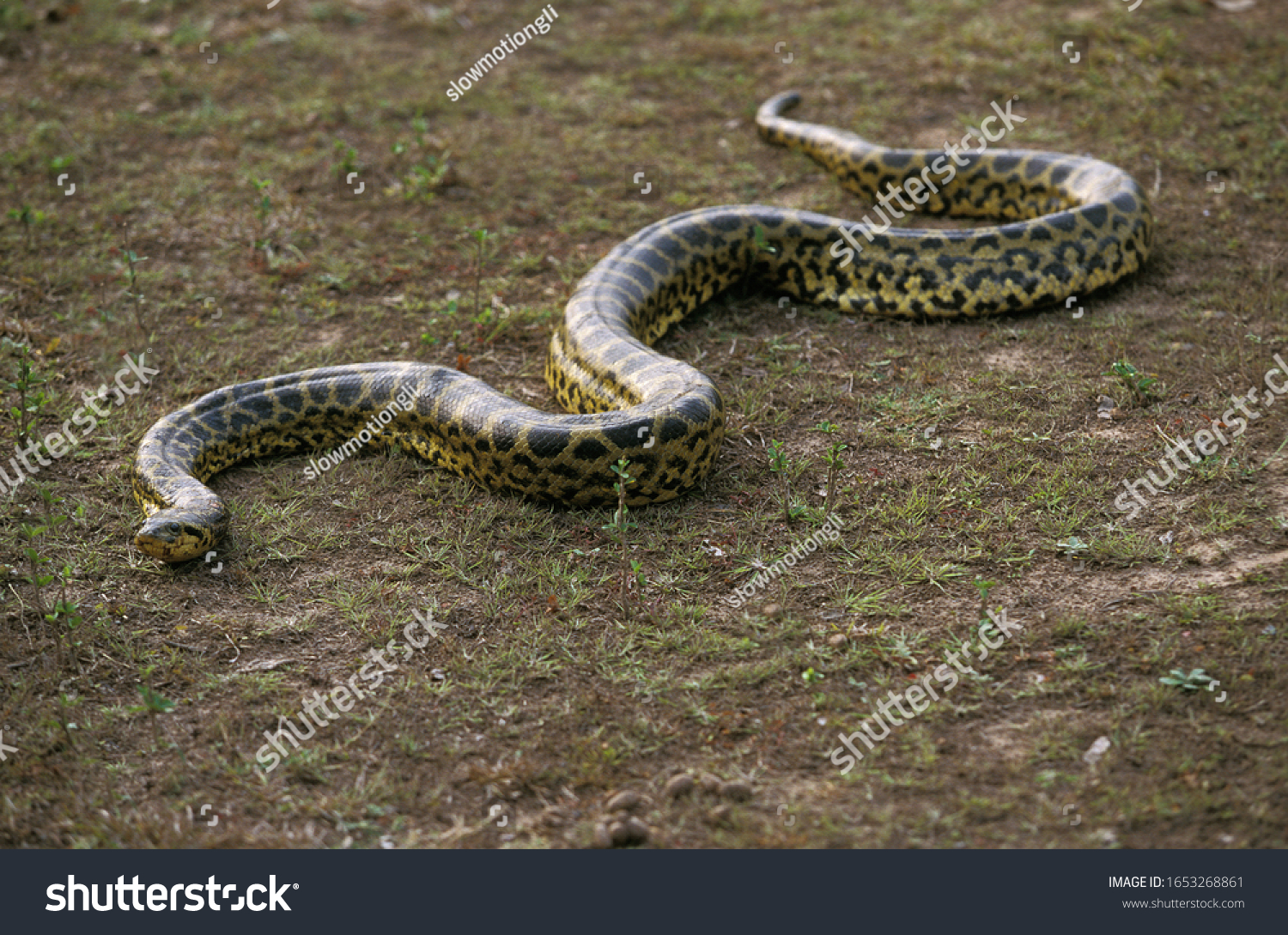
Eunectes murinus (Green Anaconda)
Introduction
The Eunectes murinus, popularly known as the green anaconda, is one of the most emblematic and imposing species of South American fauna, holding the title of the largest snake in the world in terms of body mass. In the Pantanal ecosystem, this snake plays a fundamental role as a top predator, predominantly inhabiting aquatic and semi-aquatic environments, such as rivers, lagoons, and seasonally flooded areas. Its presence is a vital indicator of the biome’s environmental health, reflecting the abundance of prey and the integrity of the water resources that sustain Pantanal biodiversity.
The scientific name Eunectes murinus derives from the Greek eu-nektes, which means “good swimmer,” a precise description for an animal that spends most of its life submerged. In the Pantanal, the green anaconda is surrounded by legends and fascination, frequently sighted resting on riverbanks or camouflaged among floating vegetation. Despite its intimidating reputation, it is an essential species for ecological balance, controlling the populations of various vertebrates and actively participating in the trophic dynamics of one of the largest wetland complexes on the planet.
Scientific Classification
| Category | Classification |
|---|---|
| Kingdom | Animalia |
| Phylum | Chordata |
| Class | Reptilia |
| Order | Squamata |
| Family | Boidae |
| Genus | Eunectes |
| Species | Eunectes murinus |
| Common Name | Green Anaconda, Anaconda, Boiaçu |
Description
The morphology of Eunectes murinus is perfectly adapted to its semi-aquatic lifestyle. Its body is extremely robust and muscular, presenting an olive-green or brownish coloration, adorned with oval black dorsal spots and smaller lateral spots with yellowish centers. This pattern provides exceptional camouflage in both murky water and dense vegetation along Pantanal riverbanks. A distinctive feature is the position of the eyes and nostrils, located on the top of the head, which allows the snake to see and breathe while keeping the rest of its body submerged, facilitating the ambush of prey.
In terms of dimensions, the green anaconda exhibits marked sexual dimorphism, with females being significantly larger and heavier than males. Although historical and legendary accounts exist of specimens exceeding ten meters, modern science records average lengths between 3 and 5 meters for healthy adults. However, exceptional individuals can reach more than 7 meters in length and weigh more than 200 kilograms, consolidating its position as the heaviest snake on Earth. Its dentition is of the aglyphous type, meaning it does not have venom-inoculating fangs; instead, it uses rows of curved, backward-pointing teeth to firmly hold prey during the constriction process.
| Characteristic | Value |
|---|---|
| Average Length (Females) | 4.5 to 6.0 meters |
| Average Length (Males) | 2.5 to 3.5 meters |
| Average Weight | 30 to 90 kg |
| Maximum Recorded Weight | > 200 kg |
| Longevity (Wild) | 10 to 15 years |
| Longevity (Captivity) | Up to 30 years |
Distribution and Habitat
The geographic distribution of Eunectes murinus covers much of South America, extending east of the Andes Mountains, from the Orinoco basin in Venezuela and Colombia to the Río de la Plata basin, including Brazil, the Guianas, Ecuador, Peru, and Bolivia. In Brazilian territory, the species is found in various biomes but reaches notable population densities in the Amazon and, specifically, in the Pantanal of the states of Mato Grosso and Mato Grosso do Sul. Its presence is intrinsically linked to the availability of permanent or seasonal water bodies, being rarely found far from humid environments.
In the Pantanal, the green anaconda selects habitats that offer both refuge and hunting opportunities. It prefers slow-moving rivers, corixos, baías, swamps, and gallery forest areas. During the flood season, the species disperses across the vast flooded plains, taking advantage of the expansion of the aquatic environment. In the dry season, it tends to concentrate in remaining channels and deep pools, where moisture is preserved. Aquatic vegetation, such as water hyacinth mats (Eichhornia spp.), serves as an ideal location for thermoregulation and ambush, allowing the snake to remain hidden while monitoring the movement of animals approaching to drink water.
Behavior
The behavior of Eunectes murinus is marked by a predominantly solitary and discreet life. Being an ectothermic animal, it dedicates a considerable part of its time to thermoregulation, alternating between sunbathing on the banks or on fallen logs and immersion in cooler waters to avoid overheating. In the Pantanal, it is common to observe them motionless during the day, taking advantage of solar radiation to accelerate metabolism and digestion. Despite its slow and heavy appearance on firm ground, where friction and gravity hinder its movement, the anaconda transforms into an agile and graceful swimmer once it enters the water, using lateral undulatory movements to propel itself rapidly.
The communication and sensory perception of this species are highly developed. Like other snakes, the green anaconda uses its forked tongue to collect chemical particles from the air and water, carrying them to the Jacobson’s organ in the roof of the mouth to process information about prey, predators, or reproductive partners. Although they are not territorial in the strict sense of defending an area against other individuals, they tend to maintain home ranges where resources are abundant. In threat situations, the first strategy is escape to deep water; if cornered, the snake can deliver powerful defensive strikes and coil its body into a compact sphere to protect its head, its most vulnerable part.
Feeding / Nutrition
The diet of Eunectes murinus is strictly carnivorous and extremely varied, reflecting its position as a generalist and opportunistic predator. In the Pantanal, its feeding is based on a wide range of vertebrates that share the aquatic environment or approach it. The hunting strategy is ambush: the snake remains submerged, with only its nostrils and eyes above the surface, waiting patiently for prey to come within reach of its strike. Once the attack is delivered, the anaconda uses constriction, coiling its powerful muscular spirals around the victim’s chest, preventing breathing and blood circulation, leading to rapid death by cardiorespiratory arrest or, in many cases, by drowning, as the snake frequently drags the prey into the water.
The ingestion capacity of the green anaconda is impressive, allowing it to consume animals with a diameter greater than its own body, thanks to the elasticity of its skin and the mobile articulation of its cranial bones. After a large meal, such as an adult capybara or a caiman, the snake can spend weeks or even months without feeding again, while the digestion process occurs slowly in its digestive tract. Interestingly, cases of cannibalism have been documented, especially during the reproductive season, where larger females may feed on smaller males, possibly to ensure energy reserves necessary for the long gestation.
| Food Type | Importance in Diet |
|---|---|
| Capybaras (Hydrochoerus hydrochaeris) | High |
| Caimans (Caiman yacare) | High |
| Fish (various species) | Medium |
| Aquatic Birds (Herons, Jabirus) | Medium |
| Deer and Brocket Deer | Low |
| Small Mammals and Rodents | Medium (Juveniles) |
Reproduction
The reproductive cycle of Eunectes murinus in the Pantanal is closely linked to the biome’s seasonal variations, generally occurring between the end of the dry season and the beginning of the rainy season (April to May). The mating system is one of the most fascinating phenomena in herpetology, known as a breeding ball. A sexually mature female releases pheromones that attract multiple males from neighboring areas. These males, which can number twelve or more for a single female, coil around her in a writhing mass that can last several weeks. During this period, the males compete with each other for access to the female’s cloaca, using their pelvic spurs (evolutionary vestiges of hind limbs) to stimulate her and try to push away competitors.
Unlike many other snakes, the green anaconda is viviparous, meaning that embryos develop inside the mother’s body, receiving nutrients through a structure analogous to the placenta. Gestation lasts approximately six to seven months, culminating in the birth of fully formed and independent offspring. A single litter can range from 20 to 40 individuals, although records of exceptionally large females indicate the possibility of up to 80 to 100 offspring. At birth, small anacondas measure about 60 to 80 centimeters and already possess the instinct for hunting and swimming, although they are vulnerable to a wide range of predators, such as birds of prey, larger caimans, and carnivorous fish, until they reach a size that protects them.
Ecological Importance
The ecological importance of Eunectes murinus in the Pantanal ecosystem cannot be underestimated. As a top predator, it exerts critical population control over species that, if not managed, could cause imbalances in vegetation and community structure. By preying on large rodents like capybaras, the anaconda helps regulate grazing pressure in field and gallery forest areas. Furthermore, its interaction with caimans establishes a complex dynamic of mutual predation (where larger individuals of one species prey on smaller ones of the other), which contributes to the maintenance of biological diversity and biome resilience.
In addition to its direct role in the food chain, the green anaconda acts as a link in nutrient cycling between aquatic and terrestrial environments. By consuming terrestrial prey and excreting or dying in the aquatic environment (or vice versa), it facilitates the transfer of biomass and energy between these compartments. The species is also considered an environmental bioindicator; healthy anaconda populations indicate the presence of a functional water ecosystem, with low contamination by heavy metals or pesticides and a robust prey base. The preservation of this snake is, therefore, inseparable from the conservation of the waters and wetlands of the Pantanal.
Conservation Status
Currently, Eunectes murinus is classified by the International Union for Conservation of Nature (IUCN) in the Least Concern (LC) category. This classification is due to its wide geographic distribution and occurrence in several protected areas throughout South America. However, this apparent stability does not mean the species is free from risks, especially on regional scales. In the Pantanal, the main threats include habitat degradation due to the conversion of natural areas into exotic pastures, river pollution from mining residues and agricultural activities, and large-scale forest fires that have plagued the biome in recent years.
Another concerning factor is direct persecution by humans. Due to atavistic fear and unfounded myths about its dangerousness, many anacondas are killed when found near human settlements or roads. Roadkills on highways crossing the Pantanal also represent a significant source of mortality for dispersing individuals. Effective conservation measures should focus on environmental education to demystify the species, the implementation of wildlife crossings on highways, and the maintenance of ecological corridors that ensure connectivity between populations. The protection of gallery forests and springs is fundamental to ensuring that the “queen of the waters” continues to thrive in the Pantanal plains.
Curiosities
- The green anaconda can remain submerged for up to 10 minutes without breathing, using its lung capacity and reduced metabolism to wait for prey or hide.
- Unlike what Hollywood movies show, anacondas rarely attack humans; most incidents occur when the animal is provoked or feels cornered.
- The term “anaconda” has uncertain origins, but one of the most accepted theories is that it derives from the Tamil word anaikkonda, which means “elephant killer,” although the species does not occur in Asia.
- During the digestion of large prey, the anaconda’s heart and other internal organs can significantly increase in size to support the metabolic demand.
- The anaconda’s tongue is not just for smell; it is a complex sensory organ that detects vibrations and minimal thermal variations in the environment around it.
References
[1] RIVAS, J. A. (2000). The life history of the green anaconda (Eunectes murinus), with emphasis on its reproductive biology. University of Tennessee, Knoxville. [2] STRÜSSMANN, C.; SAZIMA, I. (1993). The snake assemblage of the Pantanal at Poconé, western Brazil: abundance and habitat use. Herpetological Natural History. [3] MURPHY, J. C.; HENDERSON, R. W. (1997). Tales of Giant Snakes: A Historical Natural History of Anacondas and Pythons. Krieger Publishing Company.