

Introduction
The Tityus serrulatus, commonly known as the yellow scorpion, is one of the most notorious arachnid species of medical importance in Brazil, and its presence in the Brazilian Pantanal is a significant aspect of the local ecology. This scorpion, belonging to the family Buthidae, is widely distributed throughout the national territory and is recognized for its toxicity and its capacity for parthenogenetic reproduction, which contributes to its rapid proliferation and adaptive success in diverse environments, including the wetland and transitional areas of the Pantanal. Its sting can cause severe symptoms in humans, especially in children and the elderly, making it a public health concern in the region.
In the Pantanal context, Tityus serrulatus plays an ecological role as a predator of insects and other small invertebrates, contributing to population control of these species. Its adaptability to altered environments and ability to shelter in cracks and under debris make it a common inhabitant of urban and peri-urban areas of the Pantanal, as well as wilder regions. Understanding its biology, behavior, and distribution is fundamental for risk management and biodiversity conservation in the biome.
The presence of the yellow scorpion in the Pantanal reflects the complexity and resilience of this ecosystem. Although it is a species of medical interest, its existence is an integral part of the food web and natural processes of the region. Thorough study of Tityus serrulatus in the Pantanal provides valuable insights into species adaptation to environments with intense seasonal fluctuations, such as the characteristic floods and droughts of the biome, and about the interaction between wildlife and human communities inhabiting this vast floodplain.
Scientific Classification
| Category | Classification |
|---|---|
| Kingdom | Animalia |
| Phylum | Arthropoda |
| Class | Arachnida |
| Order | Scorpiones |
| Family | Buthidae |
| Genus | Tityus |
| Species | Tityus serrulatus |
| Common Name | Yellow Scorpion |
Description
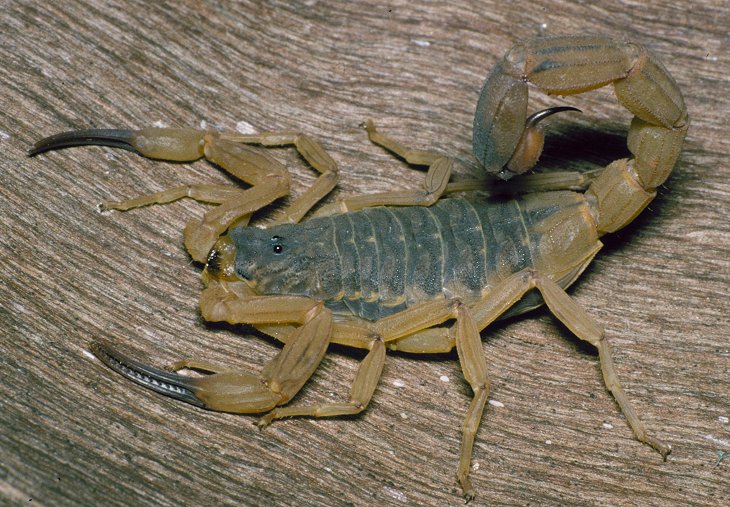
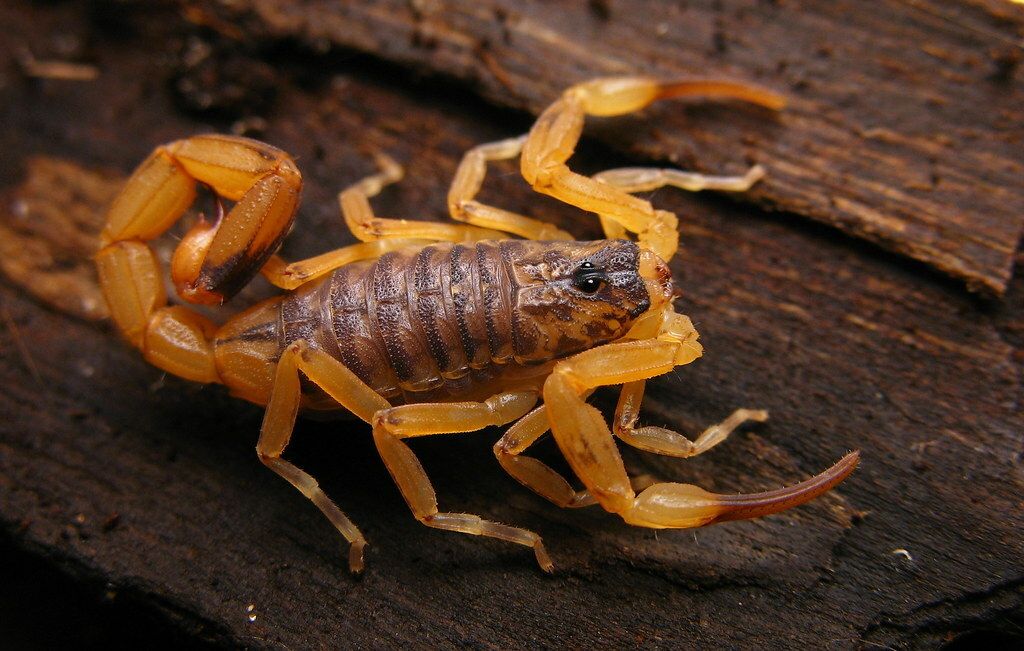
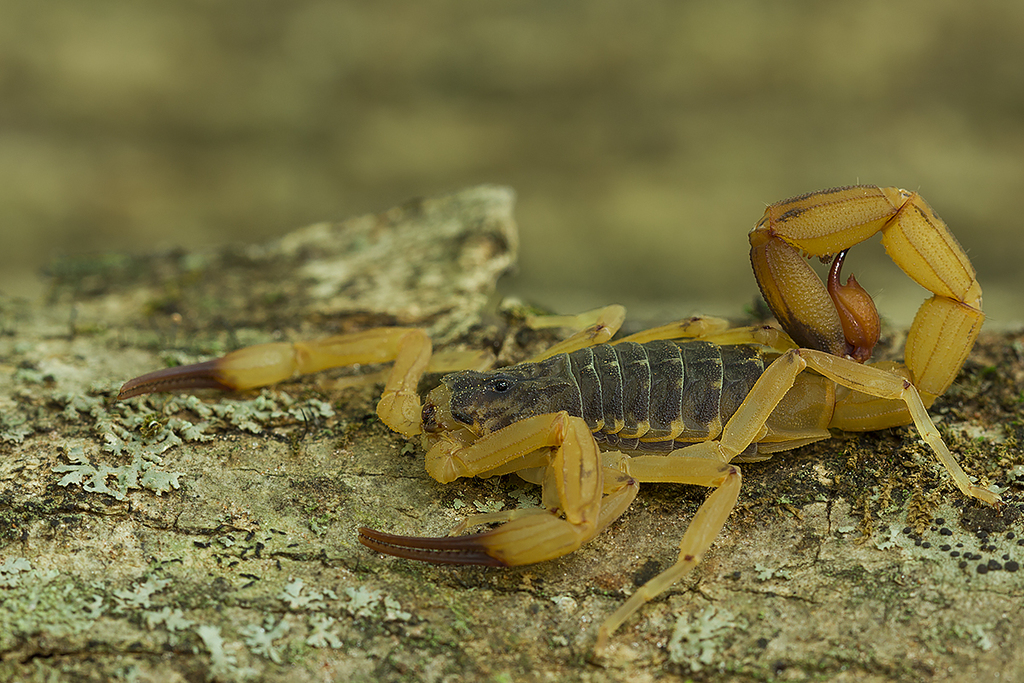
The Tityus serrulatus is a medium-sized scorpion, usually measuring between 5 and 7 centimeters in length, reaching up to 8 cm in some cases. Its coloration is predominantly yellow or pale yellow, with some tonal variations that may include darker spots on the mesosoma (trunk) and legs, although the uniform yellow color is a striking characteristic. The cephalothorax (prosoma) is robust, featuring two median eyes and a cluster of lateral eyes.
One of the most distinctive morphological traits, which gives the species its name, is the presence of a ventral serration on the tail (metasoma), specifically on the fourth and fifth segments. This serration is more prominent in males but can also be observed in females, albeit less accentuated. The telson, the last portion of the tail containing the sting (aculeus) and venom glands, is well developed and yellowish in color, contrasting with the sting, which may be darker.
The chelicerae (mouth appendages) are small and chelate, while the pedipalps (pincers) are relatively slender and elongated, with granular fingers. The legs are yellowish and robust, adapted for rapid locomotion and digging. Sexual dimorphism in Tityus serrulatus is subtle, and besides the serration on the tail, it may be observed in overall size (females tend to be slightly larger) and in metasomal segment proportions. However, the main reproductive feature distinguishing it from many other species is parthenogenesis, where females reproduce without males, making sex identification in the field less critical for understanding population dynamics.
Geographic Distribution
Tityus serrulatus has one of the widest geographic distributions among scorpion species in Brazil, being found in virtually all states except some southernmost regions. Its occurrence extends across much of South America, although its presence is most notable and studied within Brazil.
In the Brazilian Pantanal, the yellow scorpion is widely distributed, adapting to the diverse physiognomies of the biome. It is found in the Pantanal subregions of Mato Grosso and Mato Grosso do Sul, such as the Pantanal of Cáceres, Poconé, Barão de Melgaço, Aquidauana, Miranda, and Corumbá. Its presence is documented both in floodplain areas and in hills and transitional zones with other biomes, such as the Cerrado. The ability to adapt to environments with extreme seasonal variations, including periodic floods and dry periods, contributes to its broad distribution in the region. Urban expansion and habitat alteration have also facilitated its dispersion into peri-urban and rural areas of the Pantanal.
Habitat
In the Pantanal, Tityus serrulatus exhibits notable ecological plasticity, occupying a variety of habitats. It is frequently found in peridomestic and intradomestic environments, especially in urban and rural areas near human settlements, where it shelters in debris, wood piles, roof tiles, bricks, crevices in walls, and under stones. This preference for shelters that provide protection from predators and thermal fluctuations is a key factor for its survival.
In natural environments of the Pantanal, the yellow scorpion can be found in:
- Riparian forests: Areas of dense vegetation along rivers and streams, offering humidity and abundant shelter.
- Islands of higher ground and hills: Elevated patches of land with denser vegetation that are not completely inundated during floods, serving as refuges.
- Grasslands and pastures: Under stones, fallen logs, and in soil burrows.
- Cerrado areas: In transitional regions between the Pantanal and the Cerrado, where it finds shelter beneath tree bark and rock crevices.
During flood periods, Tityus serrulatus seeks refuge in higher places such as trees and buildings, demonstrating its adaptability to the hydrological conditions of the Pantanal. The availability of food sources, such as insects, also influences habitat selection.
Behavior
Tityus serrulatus is predominantly nocturnal, meaning its highest activity occurs during the night when it searches for food and mates (although parthenogenesis reduces the need for mate search by females). During the day, it remains sheltered in crevices, under stones, logs, debris, or other dark, humid places to avoid desiccation and predation.
It is not a flying species, as scorpions do not possess wings. Its movement is terrestrial, using its eight legs to move swiftly. In terms of defense, when threatened, it can adopt a characteristic posture, raising its metasoma (tail) over its body and pointing the sting toward the aggressor. Although it is not naturally aggressive toward humans, it will sting if touched or stepped on. Its venom is neurotoxic and can cause intense pain, sweating, nausea, and in severe cases, cardiac and pulmonary complications. The species is known for its resilience, being able to survive long periods without food or water, which is an advantage in the fluctuating environment of the Pantanal.
Feeding
Tityus serrulatus is a carnivorous predator, with a diet consisting mainly of insects and other small invertebrates. In the Pantanal, its prey includes:
- Insects: Cockroaches, crickets, grasshoppers, beetles, and flies.
- Other arachnids: Smaller spiders and even other scorpions (cannibalism can occur, although it is less common than in other species).
- Small invertebrates: Earthworms and small mollusks in humid areas.
Hunting is typically done by ambush or active search during the night. The scorpion uses its pedipalps (pincers) to capture and hold the prey, and if necessary, uses its sting to inoculate venom and paralyze it. Digestion is partially external; the scorpion regurgitates digestive enzymes onto the prey and then sucks up the liquefied tissues. Its role in the Pantanal ecosystem is important for controlling insect populations, especially in areas where human activity has altered the natural balance.
Reproduction
The reproduction of Tityus serrulatus is one of its most remarkable biological characteristics. While most scorpion species reproduce sexually, the yellow scorpion is primarily parthenogenetic. This means that females can produce offspring without mating with a male. The embryos develop inside the female’s body (viviparity), and after a gestation period that can vary from a few months to nearly a year, depending on environmental conditions, the young are born.
A single female can give birth to dozens of young (scorplings) in a single litter. Upon birth, the scorplings climb onto the mother’s back, where they remain until their first molt, receiving protection and maintaining humidity. After the first molt, they become independent and begin to hunt. This reproductive strategy allows for rapid population growth and the colonization of new areas, as a single individual can start a new colony. In the Pantanal, this ability is particularly advantageous for re-establishing populations after seasonal floods.
Conservation Status
Tityus serrulatus does not have a specific conservation status on the IUCN Red List, as it is a common and widely distributed species, often considered a pest in urban areas. In the context of the Pantanal, it is not a species of conservation concern; on the contrary, its management is often focused on preventing human accidents. However, its presence is a natural part of the biome’s biodiversity.
The main challenges related to this species in the Pantanal are associated with public health and the need for education on how to avoid stings. Environmental changes, such as deforestation and urban sprawl, can increase the frequency of human-scorpion encounters. Conservation efforts in the Pantanal that focus on maintaining the natural balance of predators (such as certain birds, lizards, and small mammals that feed on scorpions) are important for keeping Tityus serrulatus populations at natural levels.
References
[1] LOURENÇO, W. R. (2002). Scorpions of Brazil. Les Éditions de l’If. [2] MINISTÉRIO DA SAÚDE. (2021). Manual de Diagnóstico e Tratamento de Acidentes por Animais Peçonhentos. Fundação Nacional de Saúde. [3] BUZAS, A. F., et al. (2015). Scorpion fauna of the Pantanal wetland, Brazil. Journal of Venomous Animals and Toxins including Tropical Diseases. [4] EMBRAPA PANTANAL. (2010). Fauna do Pantanal. Disponível em: https://www.embrapa.br/pantanal/fauna [5] SOS PANTANAL. (2023). Animais peçonhentos do Pantanal: prevenção e cuidados. Disponível em: https://sospantanal.org.br/animais-peconhentos-do-pantanal [6] PINTO-DA-ROCHA, R., et al. (2007). Scorpions 2007: Ecology, Evolution and Bio-geography. Johns Hopkins University Press.