

Overview
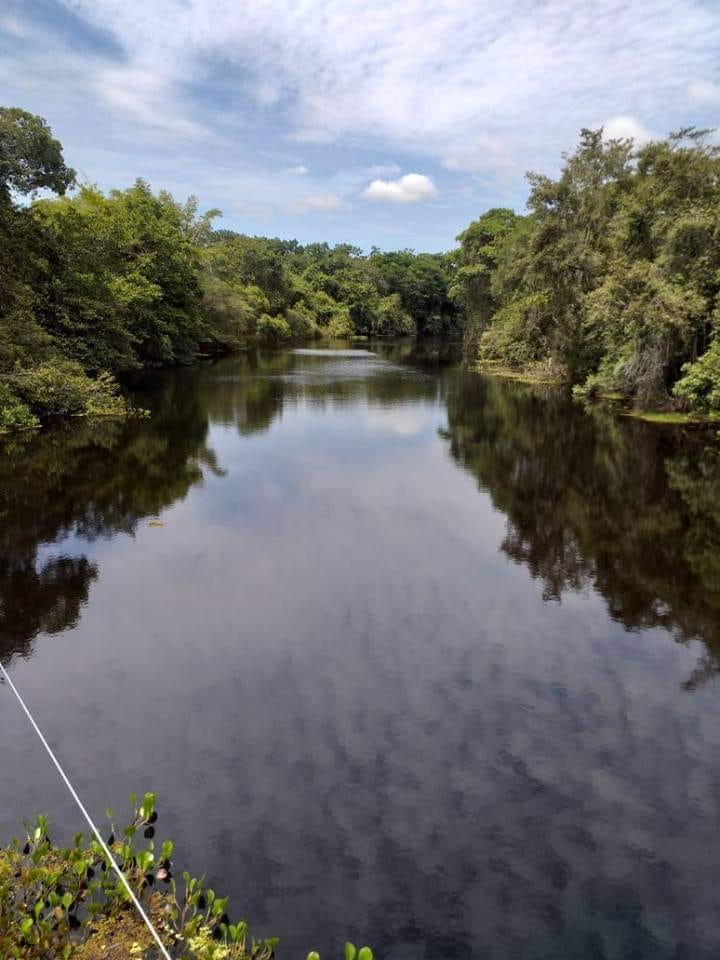
The Alegre River is a watercourse of fundamental strategic and ecological importance, located in the Northern Pantanal, in the state of Mato Grosso. Situated predominantly in the municipality of Poconé, this river is a vital component of the Cuiabá River basin, serving as an essential biological corridor for wildlife. The Alegre River crosses one of the most famous conservation areas on the planet: the Encontro das Águas State Park. This conservation unit is world-renowned for harboring the highest population density of jaguars (Panthera onca) in the world, making the river a prominent setting for nature documentaries and scientific research.
As a tributary of the Caçanje River, which flows into the Cuiabá River, the Alegre River acts as a natural regulator of the seasonal floods that define the biome. The landscape along its banks is composed of gallery forests, 'cordilheiras' (sandy ridges), and floodplains, which change drastically between the dry and wet seasons. For ecotourism and nature photography enthusiasts, the Alegre River represents the essence of the wild Pantanal, where the interaction between predators and prey occurs visibly to visitors. In addition to its biological importance, the river holds cultural and economic value for local communities, being a privileged destination for sport fishing and photographic safaris.
Geography and Course
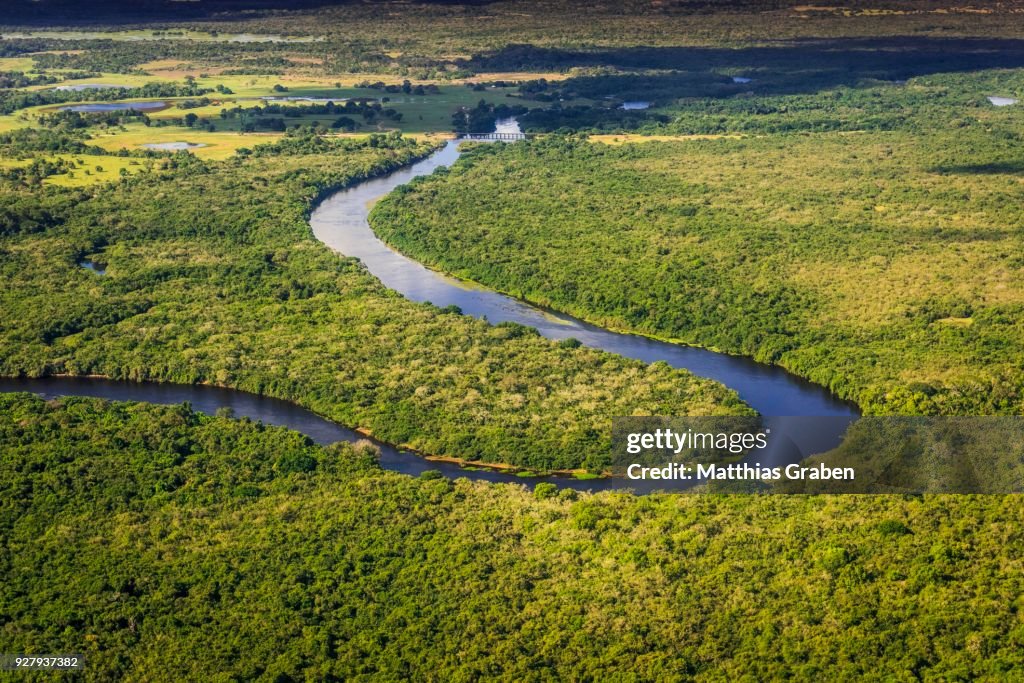
The course of the Alegre River is characterized by its sinuosity typical of lowland rivers, winding through low-gradient terrains that favor the formation of meanders and 'baías' (lakes). Its headwaters are located in transition areas between the plateau and the Pantanal plain. The river flows predominantly in a northeasterly direction, crossing the eastern sector of the Encontro das Águas State Park. Throughout much of its journey, the Alegre River runs parallel to the Caçanje River, creating a complex system of channels and wetlands fundamental for the reproduction of various species.
The mouth of the Alegre River occurs at its junction with the Caçanje River, shortly before it delivers its waters to the Cuiabá River. This network of confluences gives the 'Encontro das Águas' (Meeting of Waters) State Park its name, referring to the point where the Cuiabá, Piquiri, Três Irmãos, São Lourenço rivers and their tributaries intertwine. The river's length is compensated by the richness of its microhabitats. The banks are lined with dense riparian forest vegetation, which protects the soil against erosion and provides shelter and food for terrestrial fauna.
Geologically, the Alegre River rests on quaternary sediments of the Pantanal Basin. During the rainy season, the riverbed often becomes indistinguishable from the surrounding plain as the waters overflow and connect the river to a myriad of 'corixos' (natural channels) and temporary lagoons. This geographical phenomenon allows for the dispersal of nutrients and fish migration, processes vital for the ecological health of the entire Northern Pantanal.
Hydrological Role in the Pantanal
The Alegre River actively participates in the Pantanal's 'flood pulse,' the hydrological phenomenon that dictates the rhythm of life in the biome. During the period of intense rains (November to March), the water volume increases exponentially. Due to the very low gradient, the river overflows, flooding adjacent areas. This role is crucial because the flood brings nutrient-rich sediments that fertilize the Pantanal soil as the waters recede.
The Alegre River acts as a natural reservoir, retaining water that is slowly released into the Cuiabá River system during the dry season. This regulation is vital for maintaining the water levels necessary for aquatic fauna and navigation. Furthermore, the hydrological dynamics create refuge and breeding zones. During the flood, the waters connect to 'baías,' allowing fish such as the pacu and pintado to enter these areas to feed. When the waters recede, the river serves as a path back to the main bed, a movement known as 'vazante.'
Fauna and Ecology
The biodiversity of the Alegre River represents a microcosm of the Pantanal fauna. The highlight is the jaguar. Due to the abundance of prey and the protection of the Encontro das Águas State Park, jaguars are frequently seen hunting caimans and capybaras in broad daylight. The presence of these felines indicates a healthy ecosystem where the food chain remains intact.
In the waters, the Alegre River is home to fish such as the Dourado, the Pacu, the Pintado, and the Piranha. These fish sustain populations of piscivorous birds and aquatic mammals. The Giant Otter (Pteronura brasiliensis), an endangered species, is frequently sighted in family groups using the banks for dens and rest. The avifauna is another pillar of the Alegre River's ecology, with highlights including the following species:
- Jabiru Stork (Jabiru mycteria): Symbol of the Pantanal, it nests in tall trees near the river.
- Kingfisher: Frequently seen diving to capture small fish.
- Cocoi Heron and Roseate Spoonbill: Common in shallow areas and 'baías' connected to the river.
- Black-collared Hawk: An aerial predator that patrols the banks in search of prey.
Tourism and Experiences
Tourism on the Alegre River focuses on observation ecotourism and sport fishing. The Porto Jofre region is the main logistical hub. The main tourist activities include:
- River Safari: Navigation in fast boats for observing jaguars in their natural habitat.
- Birdwatching: Expeditions focused on observing and photographing rare birds of the Northern Pantanal.
- Sport Fishing: Practice of 'catch and release' for species such as the Dourado and Pintado, between March and October.
- Nature Photography: Taking advantage of the scenic light of the Pantanal to capture wildlife and river landscapes.
For birdwatchers, the river allows access to remote areas to spot rare species. Wildlife photography is central, taking advantage of the Pantanal's light. Sport fishing occurs from March to October, following the 'catch and release' policy to preserve species like the Dourado. Local lodges offer authentic Pantanal hospitality, combining comfort with immersion in nature. Tourism generates economic value for wildlife preservation and encourages habitat protection.
Connection with Other Rivers
The Alegre River is part of a larger hydrological system. Its immediate connection is with the Caçanje River, feeding the Cuiabá River, one of the main formers of the Pantanal. Through the Cuiabá, the waters reach the Paraguay River, the backbone of the Pantanal system. The river also integrates into the network formed by the São Lourenço River and the Piquiri River in the Encontro das Águas complex. To the west, it connects indirectly to the dynamics of the Pixaim River. These connections are essential for fish migration and the movement of animals like the jaguar, ensuring the biological health of the entire biome.
References
[1] IUCN. (2018). *Panthera onca*. The IUCN Red List of Threatened Species. Available at: https://www.iucnredlist.org/species/15953/123791436
[2] ICMBIO. (2018). *Management Plan of the Encontro das Águas State Park*. ICMBio. Available at: https://www.icmbio.gov.br
[3] ALHO, C. J. R. (2008). *Biodiversity of the Pantanal*. UNIDERP Publishing.
[4] EMBRAPA PANTANAL. (2010). *Hydrography of the Pantanal*. Embrapa Pantanal. Available at: https://www.embrapa.br/pantanal/publicacoes
[5] POTT, A.; POTT, V. J. (1994). *Plants of the Pantanal*. Embrapa-SPI.
[6] SOS PANTANAL. (2024). *Encontro das Águas State Park*. SOS Pantanal. Available at: https://sospantanal.org.br/parque-estadual-encontro-das-aguas/
[7] JUNK, W. J.; DA SILVA, C. J. (1999). *The Pantanal of Mato Grosso: Brazil. World's Largest Wetland*. Kluwer Academic Publishers.