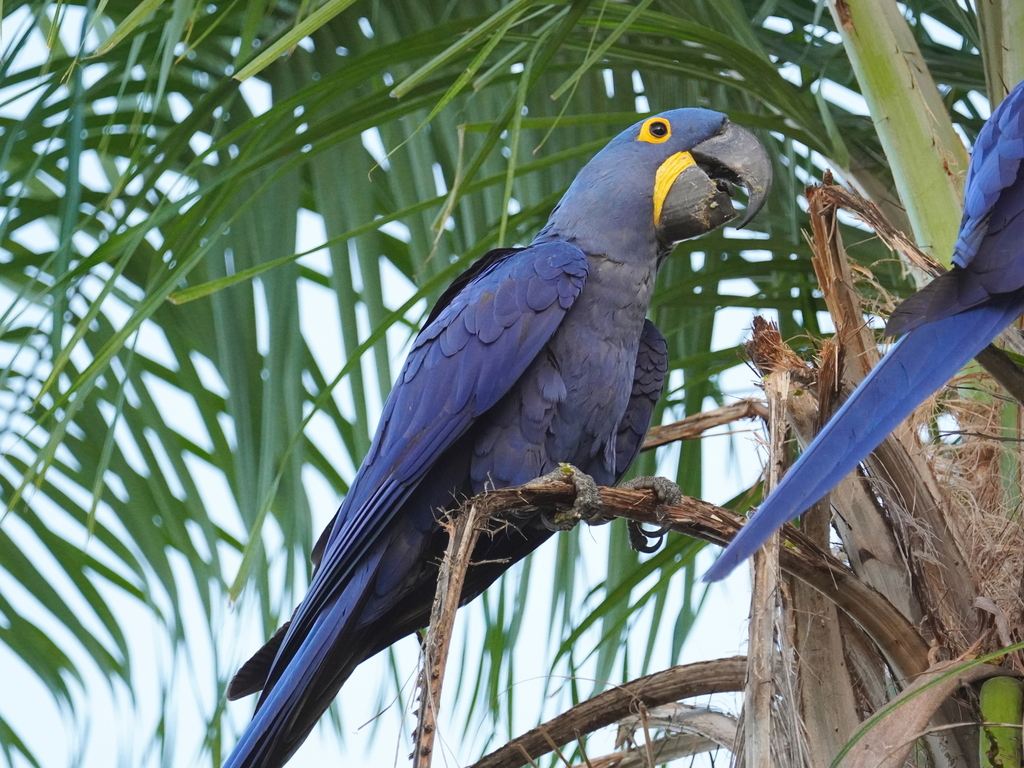


Ara chloropterus (Red-and-green Macaw): The Largest Macaw in the World
Introduction
The red-and-green macaw (Ara chloropterus) is the largest macaw in the world and one of the most imposing birds of the Pantanal. With predominantly red plumage and green and blue details, this species impresses both with its beauty and size — reaching up to 90 cm in length. Its loud screeches echo through the gallery forests and Pantanal forest patches, announcing its presence from a great distance [1] [2].
Scientific Classification
| Category | Classification |
|---|---|
| Kingdom | Animalia |
| Phylum | Chordata |
| Class | Aves |
| Order | Psittaciformes |
| Family | Psittacidae |
| Genus | Ara |
| Species | Ara chloropterus |
| Common Name | Red-and-green Macaw, Green-winged Macaw |
Description
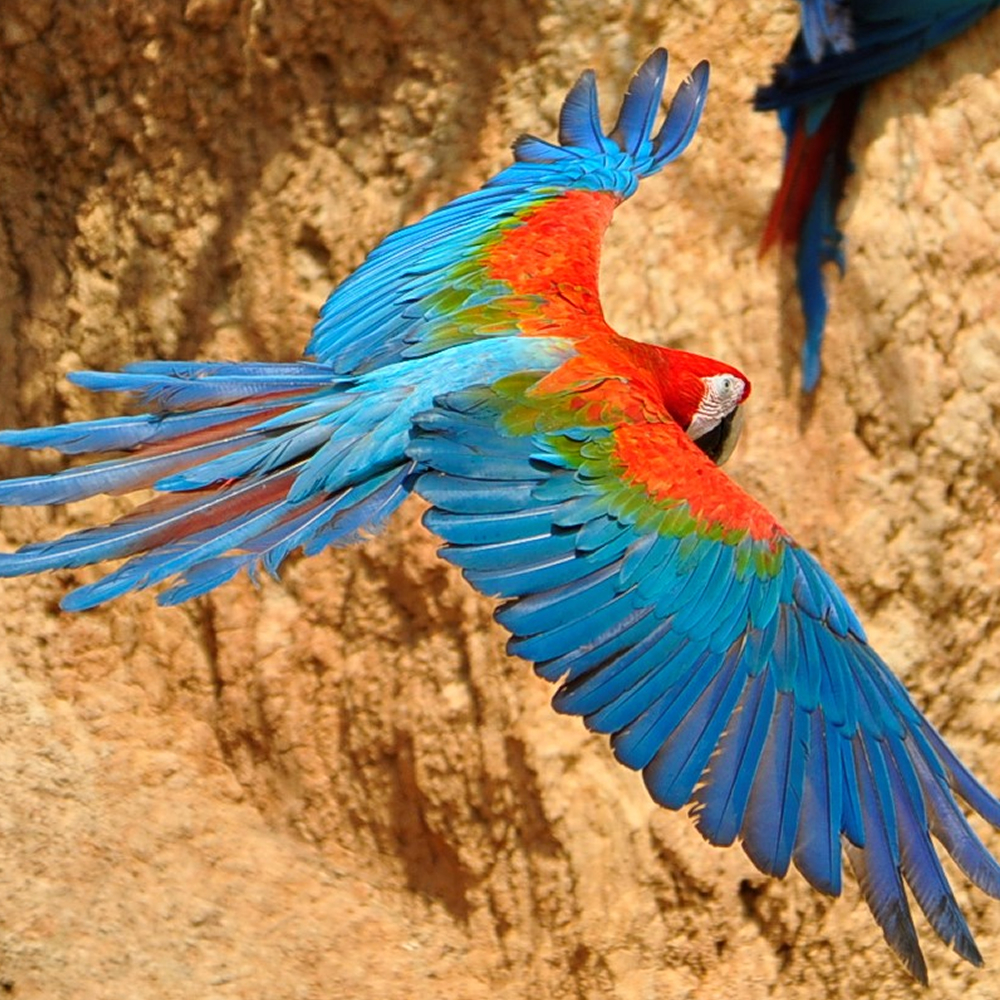
The red-and-green macaw is the largest extant macaw, measuring between 85 and 96 cm in length and weighing between 1.0 and 1.7 kg. The plumage is predominantly red, with dark green wing coverts and turquoise-blue flight feathers. The face is white with red feather stripes and yellow eyes. The bill is robust, with a light-colored upper mandible and a dark lower one [1] [3].
Geographic Distribution
It has the widest geographic distribution among macaws, occurring from Mexico to northern Argentina. In Brazil, it is found in practically all biomes, being particularly common in the Pantanal, Cerrado, and Amazon [1] [4].
Habitat
Frequents gallery forests, cerradão, forest patches (capões), and gallery forests. In the Pantanal, it is more common at forest edges near open fields, where it finds both nesting sites and feeding areas [2] [3].
Behavior
Similar to the blue-and-yellow macaw, it is monogamous and forms permanent pairs. It is highly territorial during the breeding season, actively defending the area around the nest. Outside this period, it can be seen in groups of up to 30 individuals [1] [2].
Feeding
Feeds on seeds, fruits, nuts, and flowers. In the Pantanal, it consumes fruits from bocaiuva, acuri, fig trees, and various other species. Occasionally, it visits mineral clays (salt licks) to ingest minerals that neutralize toxins present in some seeds [3] [4].
Reproduction
Nests in cavities of large trees, especially standing dead trees. The female lays 2 to 3 white eggs. Incubation lasts about 28 days. The chicks remain in the nest for approximately 105 days [1] [3].
Conservation Status
Classified as Least Concern (LC) by the IUCN. Like the blue-and-yellow macaw, it faces pressure from the illegal wildlife trade and habitat loss [1] [5].
References
[1] SICK, H. (1997). Ornitologia Brasileira. Nova Fronteira. [2] TUBELIS, D.P.; TOMAS, W.M. (2003). Bird species of the Pantanal wetland, Brazil. Ararajuba, v.11, n.1. [3] DEL HOYO, J. et al. (1992). Handbook of the Birds of the World. Lynx Edicions. [4] IUCN. (2023). Ara chloropterus. The IUCN Red List of Threatened Species. [5] COLLAR, N.J. et al. (1992). Threatened Birds of the Americas. ICBP.