Introduction
The prehensile-tailed porcupine (Coendou prehensilis), also known in Brazil as the ouriço-cacheiro or porco-espinho, is one of the most unique and specialized rodents of the Neotropical fauna. In the Pantanal, this animal represents a fascinating example of arboreal adaptation, spending most of its life in the treetops. Its most striking feature is its body covered in sharp quills, which serve as a highly effective defense mechanism against predators. Despite its "thorny" appearance, the prehensile-tailed porcupine is a peaceful animal with essential ecological functions, particularly in seed dispersal and as an indicator of forest quality.
Scientific Classification
| Kingdom | Animalia |
| Phylum | Chordata |
| Class | Mammalia |
| Order | Rodentia |
| Family | Erethizontidae |
| Genus | Coendou |
| Species | Coendou prehensilis |
| Common Name | Prehensile-tailed Porcupine |
In the Pantanal ecosystem, the Coendou prehensilis finds an ideal environment in the gallery forests and forest patches (capões), where the arboreal connectivity allows it to move safely. Although it is widely distributed across South America, its presence in the Pantanal is particularly interesting due to the seasonal dynamics of the waters, which forces the animal to be even more dependent on the forest canopy during flood periods. Its slow and cautious behavior makes it a difficult animal to spot, contributing to the aura of mystery that surrounds it in the Pantaneiro nights.
This article explores in detail the biology, behavior, and ecology of the prehensile-tailed porcupine, highlighting its specific adaptations for life in the Pantanal. By understanding the importance of this rodent, we can better appreciate the complexity of the interactions that sustain the biodiversity of the world's largest floodplain and the need for conservation of the forest habitats it calls home.
Physical Description
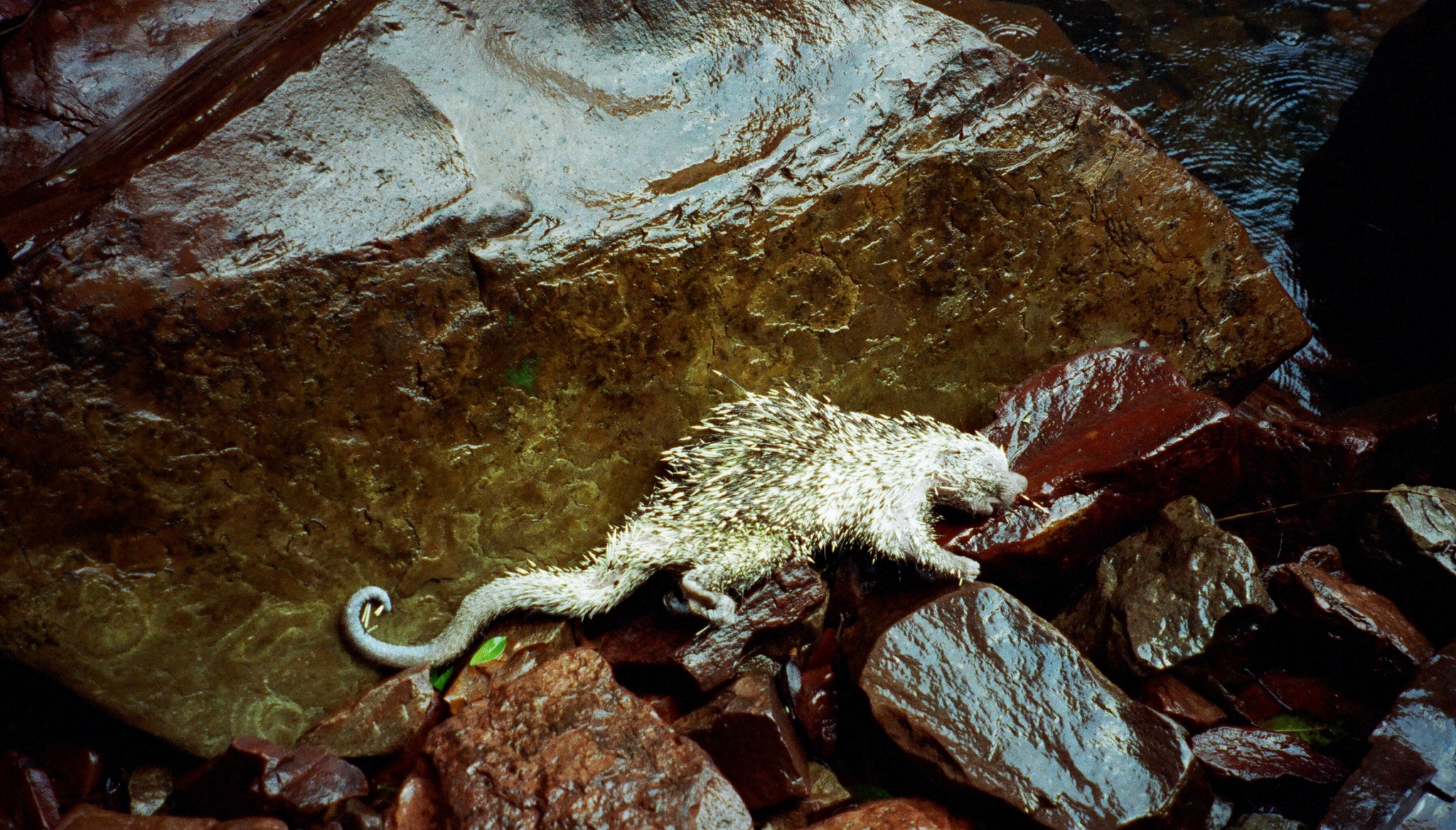
The prehensile-tailed porcupine is a medium-sized rodent, with adults weighing between 2 and 5 kg and measuring from 30 to 60 cm in body length. Its most notable feature is its coat of modified hairs into sharp quills (spines), which cover the entire dorsal part of the body, from the head to the base of the tail. These quills are tricolored—usually white or yellowish at the base and tip, with a dark band in the middle—and are loosely attached to the skin, detaching easily upon contact with a predator. Contrary to popular belief, the porcupine does not "shoot" its quills; they are only embedded in the attacker through direct contact.
Another essential adaptation is its prehensile tail, which is long and strong, functioning as a "fifth limb." The tail is used to grip branches, providing stability while the animal moves or feeds high in the trees. Its feet have four toes with long, curved claws, ideal for climbing. The head is rounded, with a large, bulbous, and sensitive nose, small eyes, and short ears. Its teeth are typical of rodents, with powerful incisors that grow continuously, adapted for gnawing on bark and hard seeds.
Habitat and Distribution in the Pantanal
In the Pantanal, the Coendou prehensilis is found in areas with significant forest cover. Its preferred habitats include gallery forests, which follow the courses of rivers, and cordilheiras, which are slightly elevated areas that do not flood and are covered by dense vegetation. Arboreal connectivity is a crucial factor for the species, as it rarely descends to the ground, where it is more vulnerable to predators like the jaguar and the maned wolf. During the flood season, these forest areas become true islands of refuge, where the porcupine finds both shelter and food.
Geographically, the species is distributed throughout the Pantanal biome, although its density may vary according to the integrity of the forest. They are solitary animals and maintain relatively small territories, which they mark with scent. During the day, they seek refuge in tree hollows, dense foliage, or even in the crowns of palm trees like the acuri and bocaiuva, where they remain motionless and well-camouflaged until nightfall.
Behavior
The prehensile-tailed porcupine is strictly nocturnal. Its activity begins at dusk and continues throughout the night. It is a slow-moving animal, relying on its camouflage and its armor of quills for protection rather than speed. When threatened, it adopts a defensive posture, tucking its head between its front legs and arching its back to expose the quills. It may also emit a series of growls and clicks, and shake its body to produce a warning sound with the quills.
Socially, Coendou prehensilis is primarily solitary, except during the mating season or when a female is with her young. Communication is largely olfactory, using secretions from glands to mark territory and signal reproductive status. They have a keen sense of smell, which they use to locate food in the dark. Despite their slow pace, they are excellent climbers, capable of performing complex maneuvers among the thinnest branches of the canopy, always using their prehensile tail as a safety anchor.
Diet
The diet of the prehensile-tailed porcupine is essentially herbivorous. In the Pantanal, it feeds on a wide variety of plant items found in the canopy, including leaves, tender stems, flowers, and especially fruits and seeds. They have a preference for the fruits of native trees such as the figueira (fig tree), ingazeiro, and various palms. Their ability to gnaw allows them to access the interior of hard fruits that other animals cannot consume.
By consuming fruits and moving between different forest areas, the porcupine acts as an occasional seed disperser, contributing to the forest's regeneration. Furthermore, by gnawing on bark and branches, it can create small lesions in trees that serve as sap sources for other animals, such as small primates and insects. Its presence in the canopy also influences the structure of the vegetation, although its impact is much smaller than that of larger herbivores. In the Pantanal food chain, despite its spines, it can be predated by large cats like the jaguar (Panthera onca), which have learned techniques to flip the animal and access its unprotected belly.
Reproduction
The reproductive cycle of Coendou prehensilis is relatively slow. Females usually give birth to only one young per gestation, after a period that can vary between 150 and 200 days. In the Pantanal, births can occur at different times of the year, but there is a tendency for them to coincide with periods of greater fruit availability. The young are born in an advanced state of development, with their eyes open and already covered in soft hair that quickly hardens into quills within a few days.
The young are very active from birth and can climb shortly after being born. Parental care is provided exclusively by the female, who carries the young or keeps it hidden in a safe place while she forages. The young remain near the mother for an extended period before attaining full independence. Females reach sexual maturity at around 19 months of age. This reproductive strategy—characterized by "low numerical investment and high individual investment" (few offspring with high initial survival rate)—is typical of animals living in stable environments but results in slow population recovery following environmental disasters, such as the large wildfires that periodically affect the Pantanal.
Conservation Status
Globally, Coendou prehensilis is classified by the IUCN Red List as a species of Least Concern. This classification reflects its extensive geographic distribution and its ability to tolerate certain levels of habitat modification. However, in the Brazilian regional context and specifically within the Pantanal, the species faces increasing threats that should not be underestimated. The principal threat is habitat loss and fragmentation due to conversion of native forests to pastures and agricultural areas.
Forest fragmentation is particularly hazardous for the prehensile-tailed porcupine because it disrupts arboreal corridors, forcing the animal to descend to the ground for movement. On the ground, it becomes highly vulnerable to domestic dog attacks and collisions on roads. Additionally, large-scale wildfires, which have become more frequent in recent years in the Pantanal, represent a devastating threat, as the animal’s slow locomotion and tendency to seek refuge high in trees often prevent escape from the flames.
Hunting, although not a common practice specifically targeting this species in the Pantanal, occurs occasionally for subsistence or retaliation due to damage to small crops. Conservation of the prehensile-tailed porcupine directly depends on maintaining the integrity of gallery forests and creating ecological corridors to allow free movement. Faunal monitoring projects and the implementation of wildlife crossings on roads are essential measures to ensure the long-term stability of Pantanal populations of Coendou prehensilis.
Trivia
One of the most fascinating facts about the prehensile-tailed porcupine is the functionality of its prehensile tail. Unlike many primates that use the tail for swinging, this species uses it as a safety anchor, wrapping it around branches while stretching to reach distant food. Another interesting fact is that, despite being rodents, they exhibit longevity rivaling many large mammals, living over two decades. This longevity reflects their relatively slow metabolism and efficient defensive armor.
In the Pantanal’s ecology, the prehensile-tailed porcupine also serves as a natural host for various parasites, including the protozoan Trypanosoma cruzi, the causative agent of Chagas disease. Although the animal acts as a reservoir of the parasite in the wild, it does not directly transmit the disease to humans; transmission depends on the vector insect, the triatomine bug. This complex relationship underscores the importance of maintaining natural ecosystem balance to avoid pathogen spillover into urban areas.
Finally, the relationship of the prehensile-tailed porcupine with the Pantanal ecosystem exemplifies interdependence. While it relies on trees for protection and sustenance, the trees depend on it for seed dispersal. Even its quills, once shed or left in carcasses, can serve as shelter for small invertebrates. Thus, Coendou prehensilis is far more than a "spiny animal"; it is a silent architect of the Pantanal forests, whose presence indicates environmental health and ecological balance.
References
[1] IUCN. (2016). *Coendou prehensilis*. The IUCN Red List of Threatened Species. Available at: https://www.iucnredlist.org/species/5086/22214486
[2] ALHO, C. J. R. (2008). *Biodiversity of the Pantanal*. UNIDERP Publishing.
[3] ICMBIO. (2018). *Red Book of Brazilian Threatened Fauna*. ICMBio. Available at: https://www.icmbio.gov.br
[4] REIS, N. R.; PERACCHI, A. L.; PEDRO, W. A.; LIMA, I. P. (Eds.). (2006). *Mammals of Brazil*. Londrina: State University of Londrina Press.
[5] EMBRAPA PANTANAL. (2024). *Fauna of the Pantanal: Mammals*. Embrapa Pantanal. Available at: https://www.embrapa.br/pantanal/fauna/mamiferos
[6] SICK, H. (1997). *Brazilian Ornithology*. Nova Fronteira.
[7] SOS PANTANAL. (2024). *Mammals of the Pantanal*. SOS Pantanal. Available at: https://sospantanal.org.br/mamiferos-do-pantanal/