Introduction
The paca (Cuniculus paca) is one of the most emblematic and fascinating mammals of the Neotropical fauna, holding a prominent position as the second largest rodent in South America, surpassed only by the capybara. Within the Pantanal ecosystem, this species plays a vital ecological role, functioning both as an important seed disperser and as a key link in the complex food web of the world’s largest floodplain. Its name, derived from the Tupi word "paka," meaning "alert" or "watchful," aptly reflects its wary nature and keen senses—traits essential for survival in an environment teeming with formidable predators.
Scientific Classification
| Kingdom | Animalia |
| Phylum | Chordata |
| Class | Mammalia |
| Order | Rodentia |
| Family | Cuniculidae |
| Genus | Cuniculus |
| Species | Cuniculus paca |
| Common Name | Paca |
Within the Pantanal context, the paca is frequently associated with dense vegetation areas and the banks of water bodies, where its presence serves as an indicator of environmental health. Although broadly distributed across the Americas—from Mexico to southern Brazil—it is in the Pantanal that the species finds a mosaic of habitats ideal for its development. Its importance extends beyond biology, permeating local culture and the regional economy, despite suffering from constant pressure from illegal hunting due to the high appreciation of its meat, regarded as a delicacy in various regions.
This article provides a detailed examination of the biology, behavior, and ecology of Cuniculus paca, with a particular focus on its existence within the Brazilian Pantanal. Understanding the nuances of this nocturnal rodent’s life underscores the urgent need for robust conservation strategies to ensure the preservation not only of the species itself but also of the dynamic ecological balance it helps maintain in Brazil’s floodplain savannas.
Physical Description
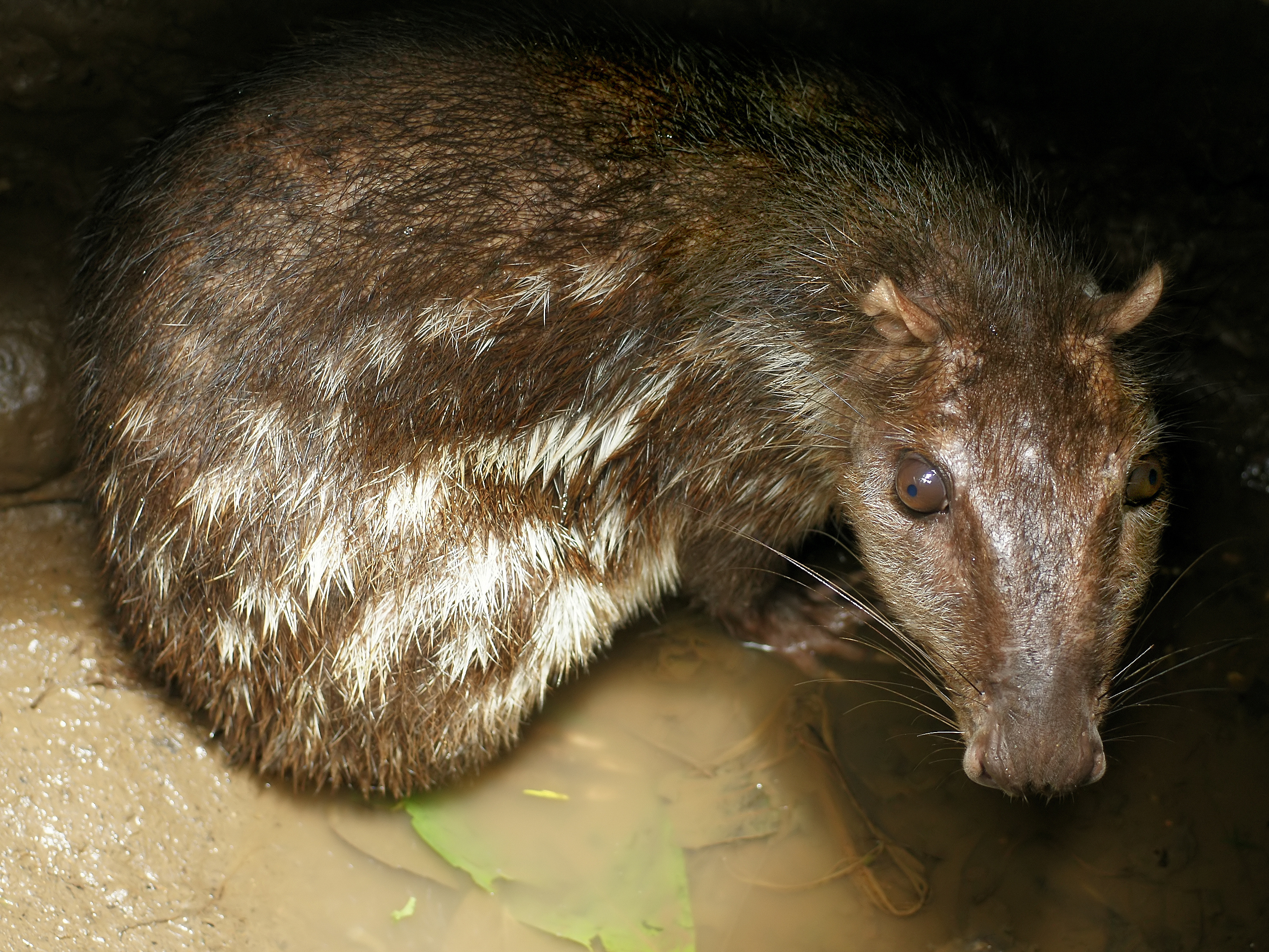
The paca is a rodent of robust and muscular build, adapted both for rapid terrestrial locomotion and efficient swimming. An adult typically weighs between 6 and 12 kilograms, although exceptionally large males may reach up to 15 kilograms. Its body length ranges from 60 to 80 centimeters, with a vestigial tail that is almost imperceptible. Among the species’ most distinctive features is its pelage: short, coarse, and bristly hairs, ranging from reddish-brown to dark gray on the dorsal side, with three to five longitudinal rows of white spots on each flank. These markings provide effective camouflage under moonlight or within dense vegetation.
The head is large, with prominently swollen cheeks due to expanded zygomatic arches that act as resonance chambers to amplify sounds, enabling unique acoustic communication among individuals. The eyes are large and adapted for nocturnal vision, while the ears are small and rounded. As with all rodents, the paca possesses continuously growing incisors, which are extremely strong and sharp, capable of breaking hard fruit and seed shells. Its limbs are short, with the forefeet having four toes and the hind feet five; all end in strong nails resembling small hooves, suitable for digging and navigating varied terrains.
Habitat and Distribution in the Pantanal
In the Pantanal, the distribution of Cuniculus paca is directly influenced by the water cycle and the availability of vegetation cover. It preferentially inhabits gallery forests (forests lining rivers), cordilheiras (slightly elevated areas that do not flood), and forest patches known as capões. Proximity to water is almost mandatory, as the paca uses rivers, oxbow lakes, and flood channels as escape routes from terrestrial predators. During the flooding season, pacas tend to concentrate in higher areas such as cordilheiras, where they find refuge and food while the lower plains remain submerged.
Geographically, the species occurs throughout the Pantanal biome, both in the Northern Pantanal (Mato Grosso) and the Southern Pantanal (Mato Grosso do Sul). They construct complex burrows in riverbanks or beneath large tree roots, often with multiple camouflaged exits to ensure rapid escape. These burrows serve not only as protection against predators but also as shelter from the region’s extreme thermal variations. The paca is territorial, and its population density in the Pantanal can vary significantly depending on habitat integrity and local hunting pressure.
Behavior
The paca is a strictly nocturnal and solitary animal, rarely seen during the day unless disturbed in its refuge. Its main activity begins at dusk and extends throughout the night, with activity peaks influenced by the lunar phase; studies indicate that they tend to be more cautious during full moon nights to avoid detection by visually oriented predators. These animals are highly wary and possess well-developed auditory and olfactory senses, allowing detection of threats over long distances.
A notable behavior of the paca in the Pantanal is its interaction with water. At the slightest sign of danger, it dives and can remain submerged for several minutes or swim long distances to evade pursuers. Social encounters between adults are generally limited to the mating season. Communication among individuals occurs through vocalizations (such as growls and clicks produced by the cheeks) and territorial marking using anal gland secretions. Despite their heavy appearance, pacas are agile runners capable of sudden leaps to escape attacks within dense vegetation.
Diet
The paca’s diet is essentially herbivorous and frugivorous, playing a crucial role as the "gardener of the Pantanal." It feeds on a wide variety of native fruits, seeds, leaves, roots, and tubers. In the Pantanal, its diet varies seasonally according to the fruiting of local trees. Pacas prefer fallen fruits from palms (such as acuri and bocaiuva), fig trees, and various species of gallery forest trees. By consuming fruits and caching seeds (a behavior known as scatter-hoarding), or by defecating viable seeds away from the parent plant, the paca significantly contributes to forest regeneration in the biome.
Beyond its role as a disperser, the paca occupies a central position in the Pantanal food chain as a prey species with high energetic value. It is a principal prey item for large cats such as the jaguar (Panthera onca) and the puma (Puma concolor), as well as for predators like boas and caimans. This predation pressure has shaped its cautious and nocturnal behavior. The abundance of pacas in a given Pantanal area frequently determines the presence and reproductive success of its apex predators, underscoring the species’ importance in maintaining regional biodiversity.
Reproduction
The reproductive cycle of the paca in the Pantanal is characterized by a low birth rate, rendering the species particularly vulnerable to overhunting. Typically, females produce only one offspring per gestation, rarely two. The gestation period is long for a rodent, averaging 114 to 119 days. Although reproduction may occur throughout the year in the Pantanal, there is evidence that births coincide with periods of higher food availability, thereby increasing offspring survival chances.
Newborns are precocial, born with open eyes, a full coat of fur, and visible white spots. They can consume solid food within days of birth, although they continue nursing for about three months. Sexual maturity is reached at approximately one year of age. Parental care is provided exclusively by the female, who keeps the young protected within the burrow during the first weeks, venturing out only to forage nearby. This reproductive strategy of producing few offspring with high parental investment demands a stable environment for population equilibrium.
Conservation Status
Globally, Cuniculus paca is classified by the International Union for Conservation of Nature (IUCN) as Least Concern (LC), owing to its broad geographic distribution. However, this classification may obscure critical situations at regional levels. In Brazil, particularly in the Pantanal, the species faces severe threats that may lead to localized population declines. The primary threat is persistent illegal hunting; paca meat is highly prized, fueling an illicit market and subsistence as well as sport hunting pressures that often exceed the species' recovery capacity.
In addition to hunting, habitat loss and fragmentation pose growing risks. The expansion of exotic pastures, uncontrolled wildfires that have ravaged the Pantanal in recent years, and deforestation of riparian forests reduce shelter and food sources. The paca depends on preserved forests and clean water bodies for survival. Conservation projects in the Pantanal, developed by NGOs and ecotourism farms, focus on protecting forest areas and raising awareness against hunting, demonstrating that the presence of live pacas generates greater value through wildlife observation tourism than through predatory exploitation.
Curiosities
One of the most intriguing aspects of the paca is its ability to produce sounds through its cheeks. Its hollow zygomatic bones function as natural resonating chambers, allowing the animal to emit clicks and growls audible over considerable distances, serving to alert conspecifics or intimidate rivals. Another fascinating trait is its aquatic skill: the paca is so adapted to water that it can use its feet to walk along the bottoms of shallow rivers while foraging or evading predators, a tactic that confounds many terrestrial pursuers.
Within the Pantanal ecosystem, the paca is considered an indirect "ecosystem engineer," as its abandoned burrows are frequently reused by other small mammals, reptiles, and amphibians, creating essential microhabitats for local fauna. Additionally, pacas exhibit remarkable hygiene; they often defecate in water, a behavior that helps conceal their scent trail from predators such as the jaguar. These complex adaptations and deep integration with the environment make the paca a symbol of resilience and mystery in the Pantanal’s nocturnal landscape.
References
[1] IUCN. (2016). *Cuniculus paca*. The IUCN Red List of Threatened Species. Available at: https://www.iucnredlist.org/species/699/22197226
[2] ICMBio. (2018). *Livro Vermelho da Fauna Brasileira Ameaçada de Extinção*. ICMBio. Available at: https://www.icmbio.gov.br
[3] ALHO, C. J. R. (2008). *Biodiversity of the Pantanal*. Editora UNIDERP.
[4] POTT, A.; POTT, V. J. (1994). *Plants of the Pantanal*. Embrapa-SPI.
[5] EMBRAPA PANTANAL. (2010). *Mammals of the Pantanal: Field Guide*. Embrapa Pantanal.
[6] REIS, N. R.; PERACCHI, A. L.; PEDRO, W. A.; LIMA, I. P. (2006). *Mammals of Brazil*. Londrina: State University of Londrina Press.
[7] SOS PANTANAL. (2024). *The Fauna of the Pantanal*. SOS Pantanal. Available at: https://sospantanal.org.br/a-fauna-do-pantanal/