
Cyperus giganteus (Pirí / Brazilian Papyrus): An Aquatic Giant of the Pantanal
Taxonomic Classification
| Category | Classification |
|---|---|
| Kingdom | Plantae |
| Phylum | Tracheophyta |
| Class | Liliopsida |
| Order | Poales |
| Family | Cyperaceae |
| Genus | Cyperus |
| Species | C. giganteus |
Description
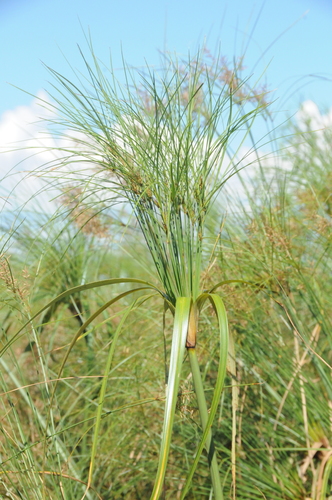
Cyperus giganteus, popularly known as Pirí or Brazilian Papyrus, is a large perennial aquatic plant, notable for its imposing presence in humid environments. It is characterized by having triangular, erect, and robust culms (stems) that can reach impressive heights of 2 to 5 meters, and in some cases, up to 7 meters. The base of these culms is generally submerged in water or waterlogged soil, and their coloration varies from light green to dark green, depending on age and light conditions.
The true leaves are reduced to basal sheaths that wrap around the base of the culm. At the apex of the culm, a complex and showy inflorescence emerges, resembling an inverted umbrella. This inflorescence is composed of numerous long and narrow leaf bracts (modified leaves) that radiate in all directions, giving the plant its characteristic “papyrus” appearance. In the center of these bracts, densely grouped spikelets develop, containing the small flowers.
The flowers are discreet and hermaphroditic, grouped in spikelets which, in turn, form more complex inflorescences, generally in shades of greenish-brown to chestnut. After pollination, the flowers give rise to small achenes (dry indehiscent fruits) of trigonal shape, which are efficiently dispersed by water. The robust structure and height of C. giganteus make it an easily identifiable species in its natural habitat, standing out among the surrounding aquatic vegetation.
Geographic Distribution
Cyperus giganteus has a wide geographic distribution in the tropical and subtropical regions of the Americas, ranging from the southern United States to Argentina. In Brazil, its occurrence is widespread in biomes with the presence of water bodies, such as the Amazon, the Atlantic Forest, and, prominently, the Pantanal. It is a species adapted to humid and flooded environments, being a fundamental component of the flora of floodplains, riverbanks, and lagoons.
In the Pantanal, the Pirí is a ubiquitous species, present in practically all sub-regions, from the Pantanal of Cáceres and Poconé in Mato Grosso, to the Pantanal of Nabileque and Nhecolândia in Mato Grosso do Sul. Its presence is especially notable in areas of bays, corixos, vazantes (seasonal drainage channels), and floodable fields, where it forms dense populations that can cover extensive areas. The ability to tolerate seasonal fluctuations in water level is crucial for its survival and dominance in this dynamic biome.
The density of C. giganteus in the Pantanal varies according to the water regime and local topography. In areas of more prolonged flooding and with more clayey soils, the species tends to form pure “pirizais” or “papeirais,” which are plant communities dominated by this sedge. These formations are characteristic of the Pantanal landscape, serving as indicators of wetlands and playing a vital ecological role.
Habitat and Ecology
Cyperus giganteus is an emergent hydrophyte, meaning it grows in aquatic environments but with most of its aerial structure above the water surface. Its preferred habitat is areas of shallow water, riverbanks, streams, lakes, lagoons, bays, and swamps, where the soil is constantly waterlogged or submerged. The species demonstrates high tolerance to clayey soils rich in organic matter, which are common in flooded environments.
Regarding light conditions, the Pirí is a heliophyte plant, requiring full solar exposure for vigorous development. Although it can tolerate some shade, its growth is optimized in open and sunny locations. Water depth can vary, but it generally thrives in water depths of a few centimeters to up to one meter, with its roots well anchored in the substrate. Its ecology is intrinsically linked to the flood and drought cycles of the Pantanal, adapting to seasonal variations in water level.
Ecologically, C. giganteus plays a crucial role in stabilizing the banks of water bodies, preventing erosion and contributing to the formation of sediment banks. Its dense populations create important microhabitats, providing shelter and food for various species of aquatic and terrestrial fauna. It also acts as a natural filter, assisting in the removal of nutrients and pollutants from the water, contributing to the maintenance of the water quality of Pantanal ecosystems.
Ecological Importance
The ecological importance of Cyperus giganteus in the Pantanal is multifaceted. Its dense clusters form true “nurseries” for fish, insect larvae, and amphibians, offering protection against predators and an environment rich in food resources. The complex structure of the submerged culms and leaves serves as a substrate for the growth of algae and microorganisms, which are the base of the aquatic food chain.
In addition to its function as a refuge, the Pirí is a source of food for various herbivores. Aquatic birds, such as teals and ducks, feed on its seeds and young shoots. Mammals such as the capybara (Hydrochoerus hydrochaeris) and the marsh deer (Blastocerus dichotomus) forage on its stalks and leaves, especially during flood periods when other food sources may be submerged. The plant also contributes to nutrient cycling, incorporating biomass and releasing it back into the ecosystem when it decomposes.
Uses and Economic Importance
Historically, Cyperus giganteus has been used by traditional communities in various parts of its distribution, including the Pantanal. Its robust and flexible culms are used in the making of basketry, mats, hats, and other handcrafted artifacts. The resistance and durability of the material, after proper treatment, make it suitable for these purposes, generating a small local economy for artisans.
Although not widely used for human consumption, young rhizomes can be consumed in some cultures, and the culms can be used as forage for cattle in certain circumstances, especially in times of scarcity of other pastures. However, its main economic importance lies in its potential for bioengineering and phytoremediation. Its ability to stabilize soils and absorb nutrients makes it a promising species for projects to recover degraded areas and treat effluents in wetlands.
Reproduction and Phenology
The reproduction of Cyperus giganteus occurs both sexually, through seed production, and vegetatively, by means of rhizomes. Vegetative reproduction is particularly efficient, allowing the plant to form large colonies and spread rapidly in favorable environments. The underground rhizomes are robust and can survive periods of drought or extreme flooding, resprouting when conditions become favorable.
The flowering and fruiting of Pirí in the Pantanal are influenced by the seasonal water regime. Generally, flowering occurs during the warmest and most humid months, peaking in the rainy season and the beginning of the vazante, when conditions are ideal for the development of inflorescences and pollen dispersal. The small flowers are pollinated mainly by the wind (anemophily). After pollination, the fruits (achenes) mature and are dispersed mainly by water (hydrochory), floating and being carried by currents to new areas, where they can germinate and establish new plants.
Conservation Status
Currently, Cyperus giganteus is not considered an endangered species and does not appear on the red lists of threatened species at global or national levels. Its wide distribution, high reproductive capacity, and adaptability to aquatic environments contribute to its resilience. In the
References
[1] IUCN. (2016). Cyperus giganteus. The IUCN Red List of Threatened Species. Available at: https://www.iucnredlist.org/species/177063/67770857 [2] POTT, A.; POTT, V. J. (1994). Plantas do Pantanal. Embrapa-SPI. [3] ALHO, C. J. R. (2008). Biodiversidade do Pantanal. Editora UNIDERP. [4] EMBRAPA PANTANAL. (2010). Guia de plantas aquáticas do Pantanal. Embrapa Pantanal. Available at: https://www.embrapa.br/pantanal/publicacoes [5] LORENZI, H. (2000). Plantas daninhas do Brasil: terrestres, aquáticas, parasitas e tóxicas. Instituto Plantarum de Estudos da Flora. [6] SOS PANTANAL. (2024). Flora do Pantanal. SOS Pantanal. Available at: https://sospantanal.org.br/flora-do-pantanal/