
Pontederia cordata (Aguapé-roxo / Pickerelweed)
Taxonomic Classification
| Category | Classification |
|---|---|
| Kingdom | Plantae |
| Phylum | Tracheophyta |
| Class | Liliopsida |
| Order | Commelinales |
| Family | Pontederiaceae |
| Genus | Pontederia |
| Species | P. cordata |
Description
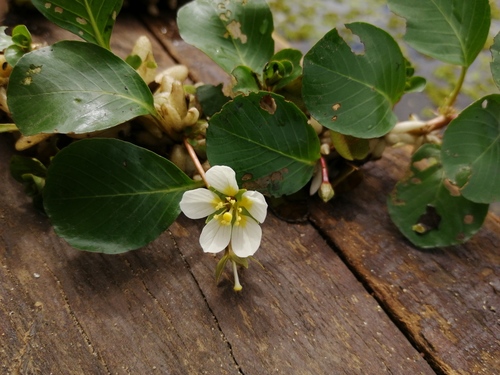
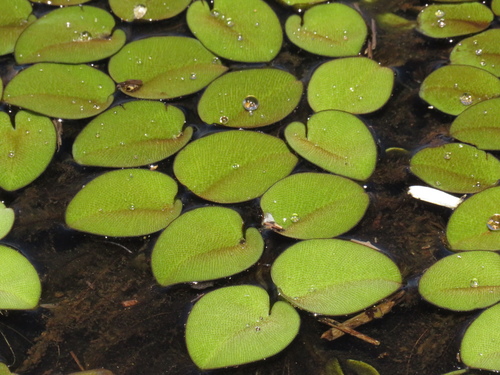
Pontederia cordata, popularly known as aguapé-roxo or pickerelweed, is a perennial herbaceous aquatic plant that stands out for its ornamental beauty and its adaptability to humid environments. Its morphology is characterized by basal, erect, and petiolate leaves, with blades ranging from ovate to lanceolate, often with a heart-shaped (cordate) base, which gave rise to its specific epithet. The coloration of the leaves is a vibrant green, and their texture can be slightly leathery.
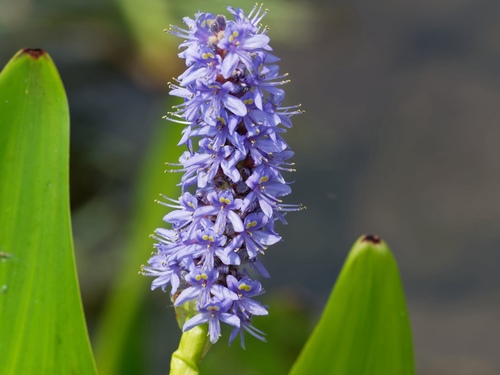
The inflorescences are one of its most striking features. They emerge above the foliage in dense, cylindrical spikes, filled with small tubular flowers ranging in color from violet-blue to intense purple, sometimes with a distinctive yellow spot on the upper lip of some flowers. Each flower has six tepals fused at the base, forming a tube. The size of the plant can vary considerably, generally reaching between 30 cm to 1.2 meters in height, depending on environmental conditions and water depth.
The stems are robust and erect, supporting both the leaves and the inflorescences. The root system is fibrous and well-developed, anchoring the plant in the submerged substrate and contributing to soil stability in wetlands. After pollination, the flowers give way to small achene-type fruits, containing a single seed. The beauty of its flowers and its ability to form dense colonies make it an easily recognizable species in its natural habitat.
Geographic Distribution
Pontederia cordata has a vast natural distribution, covering much of the Americas. It is found from eastern Canada and the United States, through Central America and the Caribbean, to South America. In Brazil, its occurrence is wide, being recorded in various regions and biomes, always associated with aquatic environments.
In the Pantanal, Pontederia cordata is a common and conspicuous species, especially during the flood period and subsequent months. It can be observed in practically all Pantanal sub-regions, from the Pantanal of Cáceres, Poconé, and Barão de Melgaço in Mato Grosso, to the Pantanal of Nabileque, Miranda, and Aquidauana in Mato Grosso do Sul. Its presence is an indicator of the health of the plain’s aquatic ecosystems.
It is particularly abundant in marginal lagoons, bays, corixos, and flooded field areas, where it forms large masses that beautify the landscape and provide shelter and food for local fauna. Its ability to adapt to different flood levels makes it a resilient and widely distributed species throughout the complex mosaic of aquatic and semi-aquatic habitats of the Pantanal.
Habitat and Ecology
Pontederia cordata is an emergent aquatic plant, meaning its roots and part of the stem are submerged, but its leaves and inflorescences rise above the water surface. It thrives in shallow freshwater environments, such as riverbanks, lakes, lagoons, marshes, swamps, and ditches. It prefers soils rich in organic matter and clayey, which provide the necessary support for its roots and nutrients for its development.
Regarding light conditions, P. cordata is a heliophyte species, meaning it requires full solar exposure for vigorous growth and abundant flowering. Although it tolerates some partial shade, its density and flowering are significantly reduced in low-light locations. Water quality is another important factor; it develops best in waters with neutral to slightly acidic pH and good nutrient availability.
Ecologically, Pontederia cordata plays a crucial role in stabilizing the banks of water bodies, preventing erosion with its dense root system. It also contributes to phytoremediation, absorbing excess nutrients from the water, such as nitrogen and phosphorus, and helping to maintain water quality. Its leaves and stems provide a substrate for the attachment of algae and microorganisms, which serve as food for aquatic invertebrates, forming the base of many food chains.
Ecological Importance
Pontederia cordata is a vital component of the Pantanal aquatic ecosystems, serving as an important resource for various fauna species. Its dense colonies offer shelter and nesting sites for aquatic birds, such as teals, ducks, and herons, which use the foliage to hide their nests and protect their chicks from predators. Small fish and invertebrates also find refuge among its submerged stems and roots, protecting themselves from larger predators.
The flowers of Pontederia cordata are an essential source of nectar and pollen for a wide variety of pollinators. Bees, butterflies, and other insects are attracted by the vibrant coloration and abundance of floral resources, contributing to cross-pollination and the maintenance of the plant’s genetic diversity. The seeds, in turn, are consumed by aquatic birds and small mammals, which act as dispersers, helping to propagate the species to new areas.
Uses and Economic Importance
Although Pontederia cordata does not have extensive economic use in the Pantanal, it is valued for its ornamental properties. It is frequently used in landscaping projects in aquatic gardens and ornamental ponds, due to the beauty of its purple flowers and its ability to create an exuberant look. Its rusticity and ease of cultivation make it a popular choice for creating aesthetically pleasing aquatic environments.
In some indigenous and traditional cultures, parts of the plant may have been used for medicinal or food purposes, although these uses are less documented and widespread compared to other species. The seeds, for example, are edible and can be ground to make flour, while young shoots and leaves can be consumed cooked. However, in the Pantanal context, its value lies mainly in its ecological role and its contribution to the scenic beauty of the region.
Reproduction and Phenology
The reproduction of Pontederia cordata occurs both sexually, through seeds, and asexually, by means of rhizomes. Flowering is a striking event, generally occurring during the warmest and most humid months, which in the Pantanal coincide with the flood and initial vazante period, typically between spring and summer. The purple inflorescences emerge in profusion, attracting a wide variety of pollinators, such as bees and butterflies.
After pollination, the achene-type fruits develop and mature, containing a single seed. Seed dispersal is facilitated by water (hydrochory), which transports them to new areas, and also by aquatic birds that consume them and disperse them through their feces (ornithochory). Vegetative reproduction by rhizomes is equally important, allowing the plant to form dense colonies and spread rapidly in its habitat. The underground rhizomes produce new shoots, ensuring the persistence of the species and its ability to colonize new areas after flood or drought events.
Conservation Status
Currently, Pontederia cordata is not considered an endangered species and does not appear on the IUCN red lists of threatened species or on Brazilian national lists. Its wide geographic distribution and its ability to adapt to different water and soil conditions contribute to its resilience. In the Pantanal, its population is robust and well-established, being a common species in its preferred habitats.
However, like all Pantanal species, Pontederia cordata can be indirectly affected by broader environmental threats, such as the alteration of water regimes due to dams and hydroelectric plants, water pollution by pesticides and effluents, and the suppression of vegetation for agricultural activities. The conservation of Pantanal aquatic ecosystems as a whole is fundamental to ensuring the maintenance
References
[1] IUCN. (2016). Pontederia cordata. The IUCN Red List of Threatened Species. Available at: https://www.iucnredlist.org/species/64323281/67729605 [2] POTT, A.; POTT, V. J. (1994). Plantas do Pantanal. Embrapa-SPI. [3] LORENZI, H. (2000). Plantas Daninhas do Brasil: Terrestres, Aquáticas, Parasitas e Tóxicas. Instituto Plantarum de Estudos da Flora. [4] EMBRAPA PANTANAL. (2010). Flora do Pantanal: Guia de Campo. Embrapa Pantanal. [5] ALHO, C. J. R. (2008). Biodiversidade do Pantanal. Editora UNIDERP. [6] POTT, V. J.; POTT, A. (2000). Plantas Aquáticas do Pantanal. Embrapa Comunicação para Transferência de Tecnologia.