
Typha domingensis (Southern Cattail / Water Spike): An Aquatic Icon of the Pantanal
Taxonomic Classification
| Category | Classification |
|---|---|
| Kingdom | Plantae |
| Phylum | Tracheophyta |
| Class | Liliopsida |
| Order | Poales |
| Family | Typhaceae |
| Genus | Typha |
| Species | T. domingensis |
Description
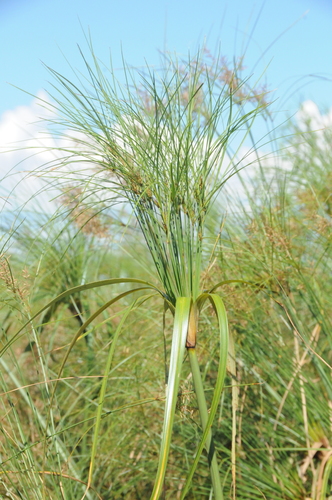
Typha domingensis, popularly known as Southern Cattail or Water Spike, is a perennial, aquatic or semi-aquatic herbaceous plant that stands out for its robust and unmistakable morphology. It is characterized by having a thick and fleshy underground rhizome, from which emerge erect and cylindrical stems that can reach considerable heights, generally ranging from 1 to 3 meters, but occasionally exceeding 4 meters in ideal conditions. The leaves are long, linear, narrow, bluish-green in color, with smooth margins and arranged in two rows along the stem, giving the plant an elegant and vertical appearance.
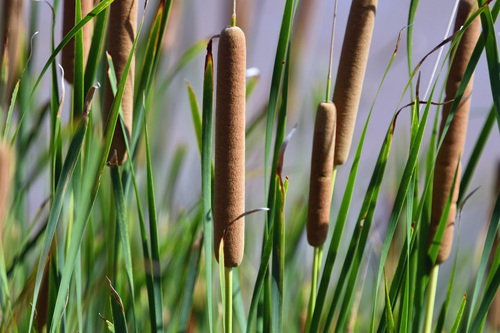
The most distinctive feature of Typha domingensis is its inflorescence, which resembles a dense cylindrical spike, hence the popular name “Water Spike.” This inflorescence is composed of two distinct portions: the upper part, thinner and yellowish, is the male (staminate) portion, while the lower part, thicker and dark brown, is the female (pistillate) portion. The two portions are generally contiguous or separated by a small space, a characteristic that distinguishes it from other Typha species.
After pollination, the female portion of the inflorescence becomes a dense mass of tiny fruits, wrapped in silky hairs, which give the spike a velvety texture and an intense reddish-brown color. These fruits, when mature, disintegrate easily, releasing the seeds that are dispersed by the wind. The presence of T. domingensis in large groupings forms dense clumps that dominate the aquatic landscape, creating a characteristic look in wetlands.
Geographic Distribution
Typha domingensis has a pantropical and subtropical geographic distribution, being found in various regions of the world with warm and temperate climates. In the American continent, its occurrence is vast, ranging from the southern United States to Argentina, including the Caribbean islands. Its adaptability to different environmental conditions contributes to its wide dispersal.
In Brazil, the Southern Cattail is a common and widely distributed species, occurring in practically all biomes that have wetlands. However, it is in the Pantanal that it manifests with particular exuberance and ecological importance. The vast floodplain of the Pantanal, with its rivers, corixos, bays, and lagoons, offers the ideal environment for its development.
Within the Pantanal, Typha domingensis can be found in all sub-regions, from the lower plain areas subject to prolonged flooding, such as the Pantanal of Nabileque and Paiaguás, to the transition areas with the cerrado, where it occupies the banks of rivers and streams. Its presence is a visual indicator of aquatic or semi-aquatic environments, being a ubiquitous component of the Pantanal landscape.
Habitat and Ecology
Typha domingensis is an emergent hydrophyte plant, meaning its roots and part of the base of the stem are submerged, while most of the plant emerges from the water. It thrives in freshwater or slightly brackish aquatic environments, preferring shallow, calm waters with little current. Lakes, lagoons, bays, riverbanks and streams, irrigation canals, ditches, and swampy areas are its preferred habitats.
This species demonstrates a remarkable tolerance to variations in water levels, being able to withstand both periods of prolonged flooding and periods of drought, when the soil may be only humid. The ideal soil for its growth is rich in organic matter, muddy, and with good nutrient availability. T. domingensis is a heliophyte, requiring full solar exposure for vigorous development, although it can tolerate some partial shade.
Ecologically, the Southern Cattail plays a crucial role in aquatic ecosystems. Its dense clumps act as natural filters, helping to retain sediments and excess nutrients, contributing to the improvement of water quality. Additionally, its roots stabilize the banks of water bodies, preventing erosion. It also creates important micro-habitats, providing shelter and breeding sites for various animal species.
Ecological Importance
Typha domingensis is a fundamental pillar of the food web and the structure of Pantanal aquatic ecosystems. Its dense plant formations serve as shelter and nursery for a wide range of fauna. Fish, amphibians, and reptiles, such as caimans and water snakes, find protection from predators and sites for spawning and raising offspring among the robust stems of the Southern Cattail.
The foliage and rhizomes of the Southern Cattail are a food source for various herbivorous species. Capybaras, marsh deer, and other mammals feed on its tender parts, while aquatic birds, such as teals and ducks, consume its seeds and shoots. Aquatic and terrestrial insects also benefit from the plant, using it for food and as a substrate for egg-laying. The structure of the Southern Cattail is also used by birds for nest construction, especially in areas difficult for predators to access.
Although the pollination of Typha domingensis is predominantly anemophilous (by wind), the plant still interacts with some insects that may visit its inflorescences in search of pollen. Seed dispersal, as mentioned, is primarily eolian, but the buoyancy of the small fruits with silky hairs also allows for water dispersal, contributing to the colonization of new areas. Its ability to form extensive colonies through rhizomes is also vital for the rapid recovery of disturbed areas.
Uses and Economic Importance
Typha domingensis has a long history of uses by human communities, especially in regions where it is abundant, such as the Pantanal. Its rhizomes are edible, rich in starch, and can be consumed cooked or roasted. The tender bases of young stems are also palatable and can be used in salads or stews, resembling the taste of asparagus. The pollen from the male inflorescences can also be collected and used as a nutritious food supplement.
In addition to food use, the Southern Cattail is a versatile raw material for handicrafts. Its long and resistant leaves are widely used in the making of baskets, mats, hats, bags, and other artifacts. In the Pantanal, Southern Cattail handicraft is a traditional and important activity for the local economy, generating income for many families. The leaf fibers can also be used to manufacture paper or as filling material.
Historically, the Southern Cattail was also employed in construction, being used to cover roofs of rustic houses or to build wattle and daub walls. In some cultures, the plant’s fibers were used to make ropes and twines. Although its medicinal use is not as prominent as that of other plants, some traditional communities use parts of the Southern Cattail in folk remedies to treat inflammation or as a diuretic, but scientific confirmation of these uses is limited.
Reproduction and Phenology
The reproduction of Typha domingensis occurs both sexually, through seeds, and asexually, by means of its underground rhizomes. Vegetative reproduction via rhizomes is extremely efficient, allowing the plant to form dense and extensive colonies, which are genetic clones of the mother plant. This method contributes significantly to the rapid colonization of new areas and for recovery after disturbances.
The flowering of the Southern Cattail in the Pantanal generally occurs during the warmest and most humid months, coinciding with the flood period or shortly after the peak of the waters, when there is an abundance of moisture in the soil. The inflorescences emerge from the stems and, once mature, release the pollen from the male flowers, which is transported by the wind to the female flowers.
References
[1] IUCN. (2016). Typha domingensis. The IUCN Red List of Threatened Species. Available at: https://www.iucnredlist.org/species/164052/68074900 [2] POTT, A.; POTT, V. J. (1994). Plantas do Pantanal. Embrapa-SPI. [3] EMBRAPA PANTANAL. (2010). Guia de plantas aquáticas do Pantanal. Embrapa Pantanal. [4] ALHO, C. J. R. (2008). Biodiversidade do Pantanal. Editora UNIDERP. [5] LORENZI, H. (2000). Plantas daninhas do Brasil: terrestres, aquáticas, parasitas e tóxicas. Instituto Plantarum de Estudos da Flora. [6] SOS PANTANAL. (2024). Flora do Pantanal. SOS Pantanal. Available at: https://sospantanal.org.br/flora-do-pantanal/