Introduction
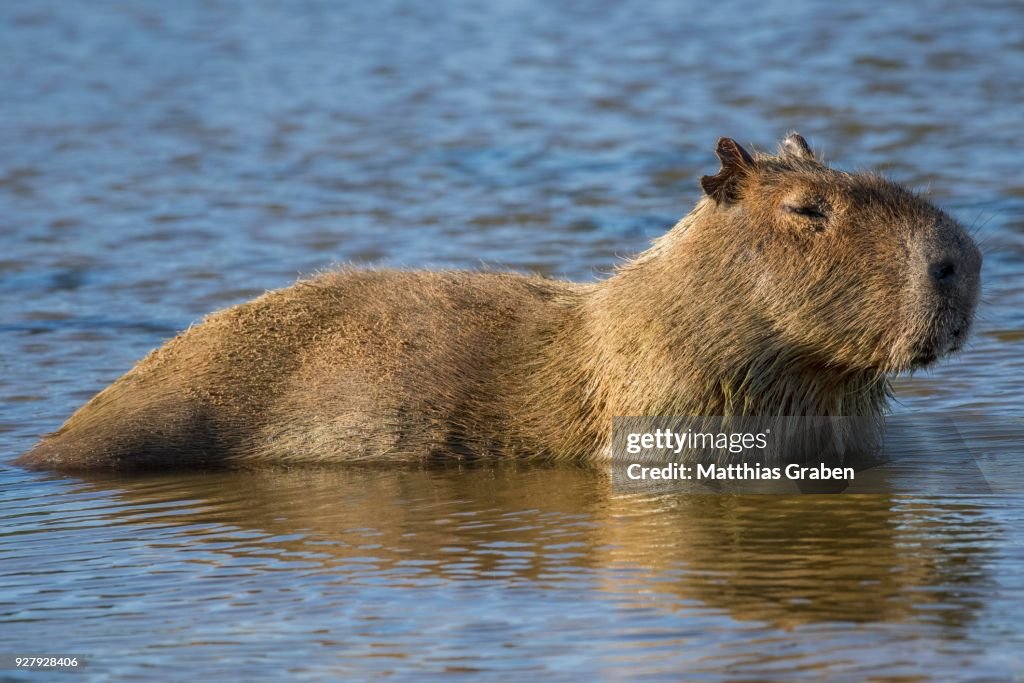
The nutria (Myocastor coypus), also known internationally as the coypu, is one of the most emblematic semi-aquatic rodents of South American wetlands. In the Pantanal ecosystem, this species plays a fundamental ecological role, acting as an "ecosystem engineer" that shapes the aquatic landscape through its feeding and burrowing habits. Although often confused with the capybara due to its considerable size, the nutria possesses unique morphological and behavioral characteristics that distinguish it as a specialist in transition environments between land and water.
Scientific Classification
| Kingdom | Animalia |
| Phylum | Chordata |
| Class | Mammalia |
| Order | Rodentia |
| Family | Myocastoridae |
| Genus | Myocastor |
| Species | Myocastor coypus |
| Common name | Nutria, Coypu |
The presence of Myocastor coypus in the Pantanal is an indicator of the health of water bodies, as the species depends on stable banks and abundant aquatic vegetation to thrive. Contrary to its reputation as an invasive species on other continents, where it was introduced for the fur industry, in the Pantanal it is a native and vital component of local biodiversity. Its interaction with the Pantanal flora and fauna establishes a dynamic balance, influencing everything from plant succession in bays and floodplains to the maintenance of populations of large predators that depend on it as a protein source.
Historically, the nutria was a target of commercial hunting due to its dense and waterproof fur, but currently, in the Brazilian context and specifically in the Pantanal, the greatest threats lie in the alteration of hydrological regimes and the degradation of riparian habitats. Understanding the biology and ecology of this species is essential for the conservation strategies of the biome, ensuring that the ecosystem functions performed by this rodent continue to sustain the complex web of Pantanal life.
Physical Description
Myocastor coypus is a large rodent, featuring a robust and cylindrical body, perfectly adapted to semi-aquatic life. A typical adult weighs between 4 and 9 kilograms, although exceptional individuals can reach up to 17 kilograms under ideal feeding conditions. The body length varies from 40 to 60 centimeters, complemented by a long, cylindrical, and scaly tail of 30 to 45 centimeters. This tail is one of the main characteristics that differentiates it from the beaver (which has a flat tail) and the capybara (which has no visible tail).
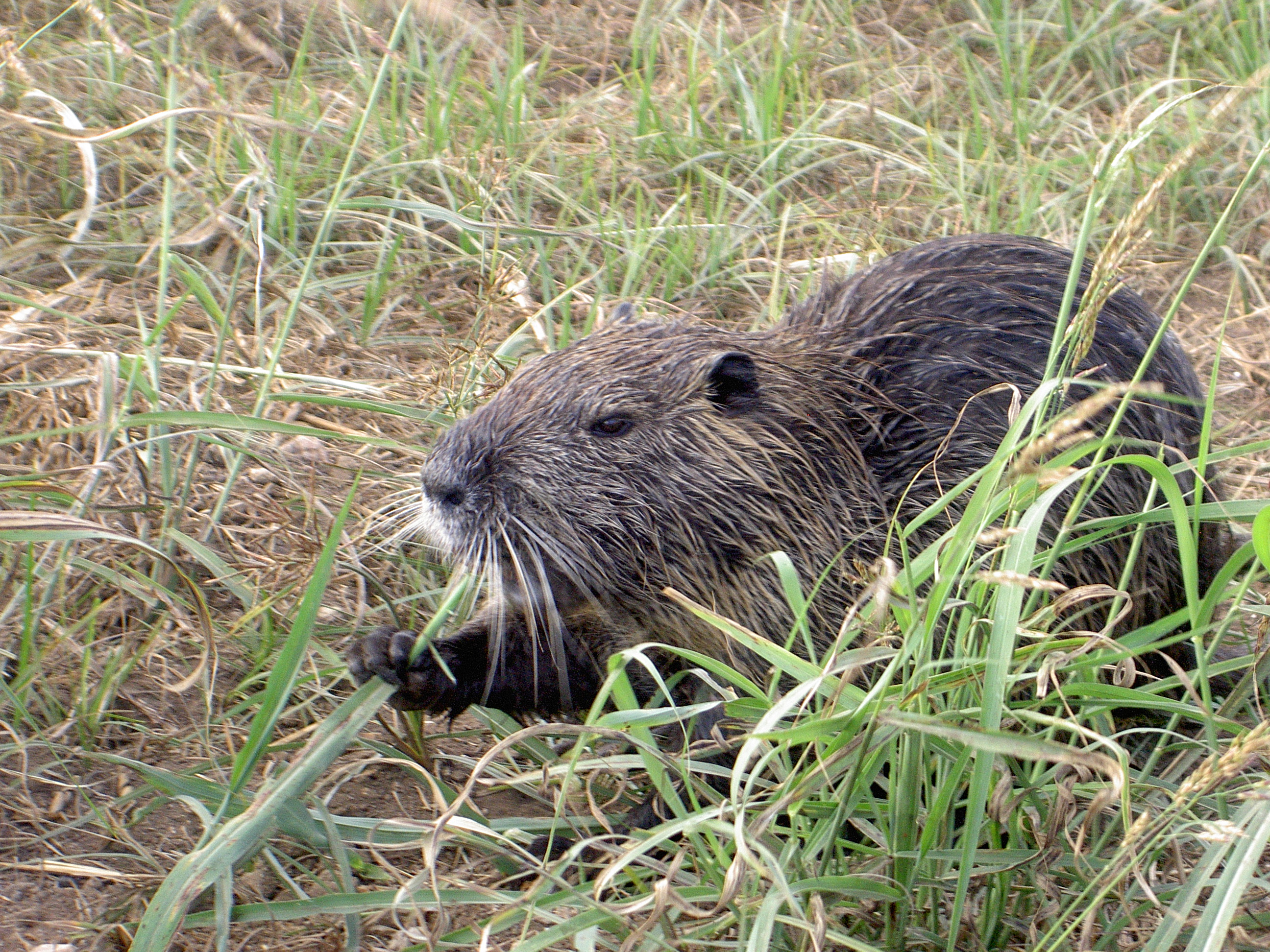
The nutria's fur is composed of three distinct layers, an evolutionary adaptation for thermal insulation and waterproofing. The outer layer consists of long, coarse hairs, known as "guard hairs," which can reach about 7.6 centimeters. Below this is an intermediate layer of brown hairs and, finally, an extremely dense, soft, and grayish underfur that traps air bubbles to keep the skin dry while the animal swims in the rivers and wetlands of the Pantanal. A striking facial feature is the presence of a patch of white hairs around the snout and whiskers.
Another crucial anatomical detail is its large, bright orange incisors. This coloration is not the result of dirt, but rather the presence of iron pigments in the enamel, which confer extraordinary hardness to the teeth, allowing the animal to cut woody stems and tough roots. Its hind feet are significantly larger than the front ones and have interdigital membranes (webbing) between the first four toes, functioning as efficient fins, while the fifth toe remains free to assist in food manipulation and fur cleaning.
Habitat and Distribution in the Pantanal
In the Pantanal biome, Myocastor coypus finds one of its most productive habitats. It is widely distributed in both the Northern Pantanal (Mato Grosso) and the Southern Pantanal (Mato Grosso do Sul), preferably occupying areas of wetlands, slow-moving riverbanks, lagoons (bays), and drainage channels. The species demonstrates a strong preference for locations with emergent and floating aquatic vegetation, which serves as both food and refuge from predators.
The distribution of the nutria is strongly influenced by the Pantanal water cycle. During the flood season, the animals expand their home range into newly inundated areas, taking advantage of the explosion of plant biomass. In the dry season, they tend to concentrate in permanent water bodies, where they excavate complex burrow systems in the clayey banks. These burrows can have several entrances, some submerged, providing a stable microclimate and protection against the extreme temperature variations common in the region.
Geographically, although the species occurs from southern Bolivia and Brazil to Tierra del Fuego, in the Pantanal it reaches significant population densities due to the vast availability of resources. The Pantanal's mosaic of habitats, which includes floodable fields and gallery forests, offers the environmental gradient necessary for the nutria to perform its full life cycle, integrating perfectly into the hydrological dynamics of the world's largest continuous wetland system.
Behavior
The behavior of the nutria is predominantly crepuscular and nocturnal, with activity peaks occurring at dusk and during the early hours of the night. However, in the Pantanal, it is not uncommon to observe them foraging during the day, especially in areas with low predation pressure or during the winter months, when they seek the sun's heat for thermoregulation. They are social animals that live in family groups or pairs, although adult males may exhibit solitary and territorial behavior.
Swimming is the primary form of locomotion and escape. Myocastor coypus is a vigorous swimmer, capable of remaining submerged for several minutes. When swimming, it keeps only the upper part of its head and back out of the water, creating a characteristic "V" wake on the surface of the Pantanal bays. On land, its walk is somewhat clumsy due to the adaptations of the hind feet for swimming, but they are capable of running short distances quickly if threatened.
Communication between individuals involves a series of vocalizations, including whistles, squeaks, and crying-like sounds, which are used to maintain group cohesion and warn of danger. In addition, territorial marking is performed through scent glands located near the anus and on the snout. Fur maintenance is an important daily behavioral activity; they spend hours cleaning themselves and spreading natural oils to ensure the underfur remains waterproof, a vital behavior for survival in aquatic environments.
Diet
The nutria is a generalist herbivore with an extremely varied diet, adapted to the seasonal offerings of the Pantanal. It consumes large quantities of aquatic macrophytes, including roots, rhizomes, stems, and leaves. Among its preferred plants are water hyacinths (Eichhornia spp.), water lettuce (Pistia stratiotes), and various species of rushes and grasses that grow on riverbanks. It is estimated that an adult individual can consume daily about 25% of its body weight in vegetation.
Its ecological role in the food chain is twofold and extremely important. As a primary consumer, it acts in controlling the excessive growth of aquatic plants that, if unmanaged, could clog channels and reduce water oxygenation. By digging for roots and rhizomes, the nutria also promotes nutrient cycling in the sediment and creates microhabitats for small invertebrates and fish. However, its habit of "wasting" part of the plant by eating only the succulent base is what earns it the title of engineer, as this cut vegetation floats and decomposes, feeding other trophic levels.
In the complex food web of the Pantanal, Myocastor coypus is a fundamental prey. It serves as a rich source of energy for top predators, such as the jaguar (Panthera onca) and the yellow anaconda (Eunectes notaeus). In addition, it is a frequent item in the diet of the Pantanal caiman (Caiman yacare) and large birds of prey, such as the savanna hawk. This intermediate position in the food chain ensures that the energy captured from aquatic vegetation is efficiently transferred to the biome's carnivores, sustaining the high predator biomass for which the Pantanal is famous.
Reproduction
The reproductive strategy of Myocastor coypus is characterized by a high fecundity rate, allowing populations to recover quickly after mortality events, such as extreme droughts or disease outbreaks. In the Pantanal, reproduction can occur throughout the year, although there are peaks associated with food availability after the onset of rains. Females reach sexual maturity early, between 3 and 4 months of age, while males mature around 4 months.
The gestation period is relatively long for a rodent, lasting about 130 days. A unique biological feature is the location of the female's mammary glands, which are positioned laterally on the back, rather than on the belly. This allows the young to nurse while the mother is in the water or partially submerged, a perfect adaptation for the floodable environment of the Pantanal. Litter size varies from 1 to 13 pups, with an average of 4 to 6 individuals per birth.
The pups are precocial, meaning they are born fully covered in fur, with eyes open and incisor teeth already visible. A few hours after birth, they are already capable of swimming and beginning to ingest solid vegetation, although they continue to nurse for about 7 to 8 weeks. This early independence is a crucial evolutionary advantage in an environment full of predators. A healthy female can produce up to three litters per year, ensuring the continuity of the species even under strong environmental pressure.
Conservation Status
Globally, Myocastor coypus is classified by the IUCN Red List as a species of Least Concern (LC). In Brazil, and specifically in the Pantanal, the situation follows this trend of stability. Unlike other regions of the world where it is fought as an invasive pest, in the Pantanal it is protected as an integral part of the native fauna. However, the stability of its populations depends directly on the integrity of aquatic ecosystems.
The main threats to the species in the Pantanal include habitat loss due to the conversion of wetlands into exotic pastures and river pollution by pesticides and heavy metals from agricultural and mining activities surrounding the biome. In addition, climate changes that alter the flood and drought regime can impact food availability and nesting sites. Hunting, which in the past was a significant pressure for the fur trade, is now prohibited by law and does not represent a primary threat, although subsistence hunting may occur in isolated areas.
The conservation of the nutria is intrinsically linked to the preservation of Permanent Preservation Areas (APPs) along water bodies. The maintenance of gallery forests and natural banks is fundamental for these animals to excavate their burrows and find refuge. As the species is a vital link in the food chain, its protection indirectly benefits the large cats and reptiles of the Pantanal, reinforcing the need for a conservation approach based on the ecosystem as a whole.
Curiosities
One of the most fascinating curiosities about the nutria is the origin of its common names. The term "nutria" is the Spanish word for "otter," a misidentification by early European settlers who confused the rodent with the mustelid due to its aquatic habits. Another notable fact is its diving ability: they can close their nostrils and lips behind their incisors, allowing them to gnaw on submerged plants without swallowing water.
In the Pantanal, the nutria is often seen in a commensal relationship with aquatic birds. By stirring up the vegetation and the bottom of the bays, it ends up making small invertebrates and fish available for herons and spoonbills that follow it closely. In addition, its abandoned burrows serve as shelter for a multitude of other species, from small marsupials to snakes, demonstrating that its importance goes far beyond its own survival, being a pillar of the Pantanal's biological architecture.
References
[1] IUCN Red List of Threatened Species. *Myocastor coypus*. Available at: https://www.iucnredlist.org
[2] MAMMALS OF THE PANTANAL. Field Identification Guide. Embrapa Pantanal.
[3] ECOLOGY OF SEMI-AQUATIC RODENTS. Brazilian Journal of Zoology.
[4] BIODIVERSITY OF THE PANTANAL. Ministry of the Environment (MMA).