

Introduction
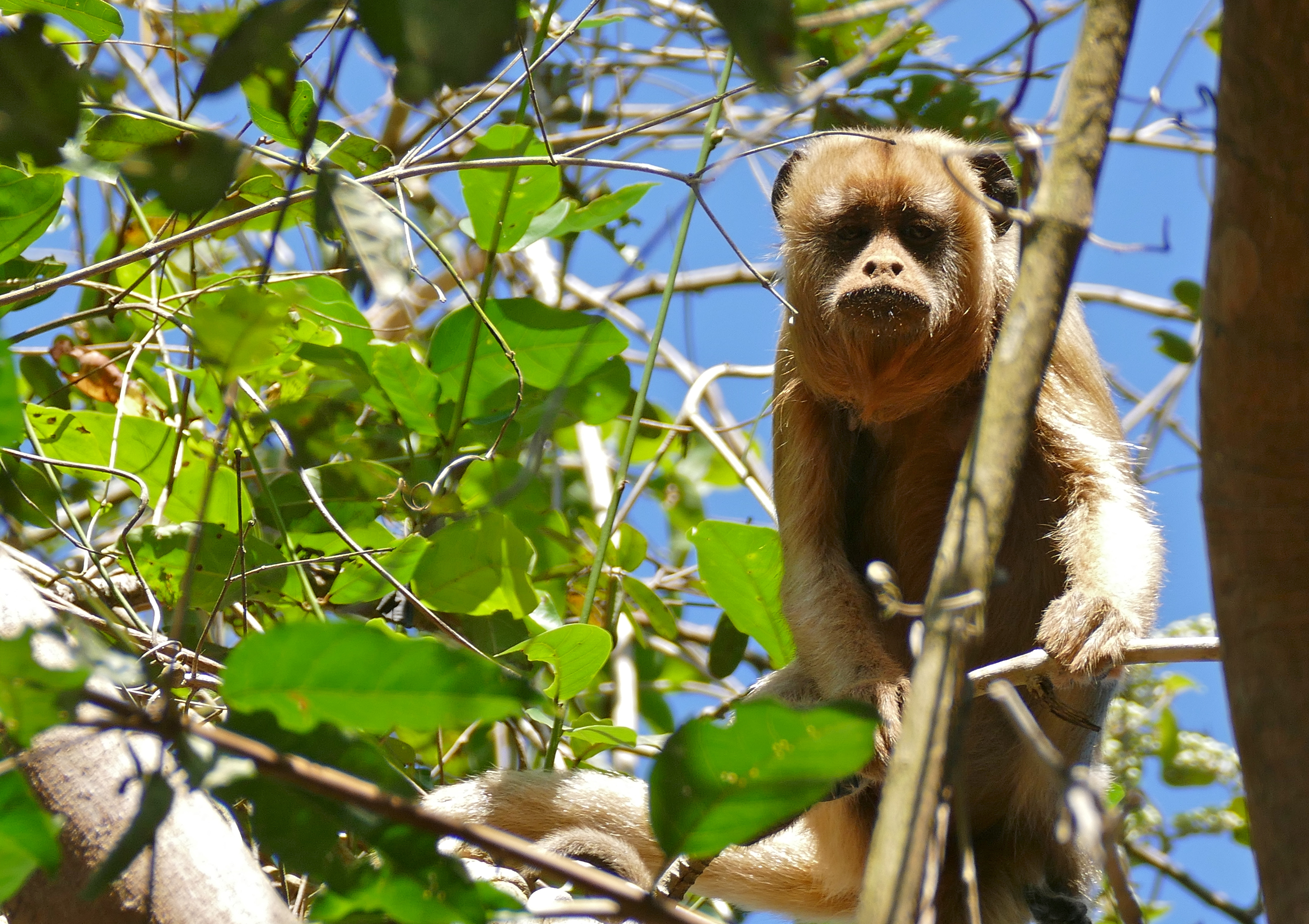
The Alouatta caraya, popularly known as the black howler monkey, guariba, or carajá, is one of the most emblematic and resilient primates of South America. In the Pantanal ecosystem, this species plays a fundamental role as a sentinel of environmental health and an important seed disperser. Its presence is often announced long before it is seen, thanks to its powerful roar, which can be heard kilometers away, serving as a natural soundtrack to the riparian forests that border the Paraguay River.
Scientific Classification
| Kingdom | Animalia |
| Phylum | Chordata |
| Class | Mammalia |
| Order | Primates |
| Family | Atelidae |
| Genus | Alouatta |
| Species | Alouatta caraya |
| Common name | Black Howler Monkey, Guariba |
This primate belongs to the family Atelidae and is recognized for having the loudest roar among all terrestrial animals in the Americas. In the Pantanal, the black howler monkey masterfully adapts to seasonal flood variations, using tree canopies as refuge and an inexhaustible food source. Its ecology is intrinsically linked to the dynamics of gallery forests and ridges (cordilheiras), making it a key species for maintaining local biodiversity and one of the main targets of interest for ecotourism in the region, especially along the Transpantaneira highway.
Despite its wide distribution, the black howler monkey faces growing challenges related to habitat fragmentation and vulnerability to epidemiological outbreaks, such as yellow fever. In the Pantanal context, the conservation of this species is vital not only for ecological balance but also as an indicator of the integrity of the forests that protect the water resources of the world's largest floodplain.
Physical Description
The Alouatta caraya presents one of the most striking examples of dichromatic sexual dimorphism among Neotropical primates. While adult males exhibit a dense and completely black coat, females and juveniles have a coloration ranging from yellowish-brown to light olive. This visual distinction is so pronounced that, to a lay observer, males and females could be mistaken for different species. Males are significantly larger, weighing between 6 and 10 kg, while females generally range from 4 to 6 kg.
A unique anatomical feature of howler monkeys is the extraordinary development of the hyoid bone, located in the throat. This bone functions as a resonance chamber, allowing the animal to produce very low-frequency and high-intensity vocalizations. Furthermore, they possess a highly specialized prehensile tail, which acts as a "fifth limb." The underside of the tail's tip is hairless and has skin ridges similar to fingerprints, providing exceptional grip to branches during locomotion and feeding in tree canopies.
The black howler monkey's dentition is adapted for a predominantly folivorous diet, with molars that have sharp ridges for grinding tough plant fibers. Its eyes are forward-facing, providing excellent stereoscopic vision, essential for calculating distances between branches in its arboreal environment. The robust structure of its body, combined with limited agility compared to other primates like capuchin monkeys, reflects a life strategy focused on energy conservation, necessary for processing a leaf-rich diet.
Habitat and Distribution in the Pantanal
The black howler monkey has the largest geographical distribution among all species of the genus Alouatta, occurring from central Brazil to northern Argentina and Paraguay. In the Pantanal, its presence is ubiquitous in areas offering continuous or fragmented forest cover. They prefer habitats of riparian forests, gallery forests, and the so-called "cordilheiras" — slightly elevated portions of land that do not flood and house dense arboreal vegetation.
The species demonstrates remarkable environmental plasticity, being able to survive in relatively small forest fragments and even in areas altered by human activity, provided there is availability of fruit trees and foliage. In the Southern Pantanal, they are frequently sighted near the Paraguay River and its tributaries, where vegetation is more exuberant. In the Northern Pantanal, the Transpantaneira highway offers numerous observation opportunities, as howler monkeys use the trees bordering the road to move and feed.
The distribution of Alouatta caraya in the biome is directly influenced by the flood regime. During floods, groups are restricted to tree canopies in higher areas, while in the dry season they can explore a wider variety of microhabitats. This dependence on forest connectivity makes the preservation of ecological corridors between ridges and riparian forests fundamental for the long-term survival of Pantanal populations.
Behavior
The social behavior of the black howler monkey is structured in groups ranging generally from 5 to 15 individuals, although larger groups may form in high-quality habitats. Each troop is typically led by an alpha male, accompanied by one or more adult females, their offspring, and sometimes subadult males. The hierarchy is well-defined, and group cohesion is maintained through social interactions like grooming, although this is less frequent than in other more active primates.
The most famous behavioral characteristic is undoubtedly the morning vocalization. At dawn, males initiate a chorus of roars that serves to announce the group's location and delimit territory, avoiding direct physical confrontations with neighboring troops. This behavior is an efficient energy-saving strategy, allowing groups to maintain safe distances without the need for constant patrols. In the Pantanal, these roars are often heard in conjunction with the sounds of other species, such as the giant otter or water birds.
Howler monkeys are diurnal animals and spend a large part of the day (about 70% to 80%) resting. This sedentary lifestyle is a physiological adaptation to their folivorous diet, which has low energy value and requires long periods of digestion. Their movement and feeding activities occur in peaks during early morning and late afternoon. Despite being arboreal primates, in the Pantanal it is not rare to observe howler monkeys descending to the ground to cross open areas between forest fragments or to drink water during the dry season.
Diet
The Alouatta caraya is classified as a folivore-frugivore, meaning its diet is composed mainly of leaves, but significantly supplemented by fruits, flowers, and shoots according to seasonal availability. In the Pantanal, this dietary flexibility is crucial. During the growing season, they preferentially select young leaves and shoots, which are easier to digest and have higher protein content and lower concentration of secondary toxins compared to mature leaves.
Fruits play a vital role in the diet, providing rapidly absorbed sugars. Species like the wild fig (Ficus spp.), ingá, and various palms are important food sources in the biome. By consuming fruits and defecating seeds in locations far from the parent plant, the howler monkey acts as a natural gardener of the Pantanal, assisting in forest regeneration. Its ability to consume leaves allows it to survive in periods of fruit scarcity, a competitive advantage over strictly frugivorous primates.
The ecological role of the black howler monkey also extends to its interaction with other animals. Their food remains falling from trees often feed terrestrial animals, such as the capybara or the collared peccary. Furthermore, as one of the region's largest primates, it is part of the food chain of large predators, occasionally being preyed upon by the jaguar or large birds of prey, such as the harpy eagle, although the latter is rare in the Pantanal.
Reproduction
The reproduction of the black howler monkey does not have strict seasonality, occurring throughout the year, although birth peaks are often observed coinciding with periods of greater food supply in the Pantanal. The estrous cycle of females lasts about 16 to 20 days, and gestation extends for approximately 185 to 195 days (about 6 months). In the vast majority of cases, only a single offspring is born, which has a light coloration, similar to that of adult females, regardless of sex.
Parental care is predominantly exercised by the mother, who carries the offspring against her belly in the first months and later on her back. Weaning occurs around 10 to 12 months of age, but the young remains dependent on the group for protection and social learning for longer. Interestingly, in groups of Alouatta caraya, it has been observed that other group members, including males, may exhibit tolerance and protection behaviors toward offspring, although direct care is maternal.
Sexual maturity is reached around 3 to 4 years for females and 5 years for males. Upon reaching maturity, both males and females usually disperse from their natal groups to form new troops or integrate into existing groups, a strategy that ensures the genetic variability of populations. In the dynamic environment of the Pantanal, the species' reproductive success is linked to the stability of social groups and the integrity of refuge areas during large floods.
Conservation Status
Globally, Alouatta caraya is classified by the International Union for Conservation of Nature (IUCN) as "Least Concern" (LC), due to its vast occurrence area and adaptability. However, the national assessment conducted by ICMBio classifies the species as "Near Threatened" (NT) in Brazil. This more rigorous classification reflects concern over the sharp population decline in certain regions, caused by habitat loss, forest fires, and, primarily, high sensitivity to the yellow fever virus.
In the Pantanal, the main threats include the conversion of native forests into exotic pastures and the catastrophic fires that have plagued the biome in recent years. Fire not only kills individuals directly but destroys food sources and arboreal corridors essential for the species' locomotion. Furthermore, habitat fragmentation increases the risk of roadkills on highways like the Transpantaneira and facilitates disease transmission between isolated groups.
Conservation measures focus on protecting riparian forests and creating Private Natural Heritage Reserves (RPPNs), which are abundant in the Pantanal. Health monitoring of howler monkey populations is also a public health tool, as they function as "sentinels": the death of howler monkeys in a region is often the first sign of yellow fever virus circulation, allowing health authorities to initiate preventive human vaccination campaigns.
Curiosities
One of the most fascinating curiosities about the black howler monkey is its relationship with local Pantanal culture. The sound of its roar is often associated with weather forecasting by traditional residents; it is said that when howler monkeys "snore" at unusual times, it is a sign that rain is near. This popular perception, although lacking strict scientific rigor, demonstrates the deep connection between fauna and the traditional knowledge of the Pantanal man.
In the field of ecotourism, the howler monkey is a star. Its calm nature and habit of staying in the same trees for long periods allow for detailed observations of its social behavior and feeding. They are often called the "sloth monkeys of primates" due to their slow and peaceful pace of life.
Another notable fact is their physical resilience. Howler monkeys have already been observed surviving in extremely degraded areas where other primates disappeared. Furthermore, their prehensile tail is so strong that, even after death (in rare cases of predation or disease), the animal can remain hanging from the branch for some time before falling. This morphological adaptation is a testament to primate evolution in the tropical forests of the Americas.
References
[1] IUCN. (2020). *Alouatta caraya*. The IUCN Red List of Threatened Species. Available at: https://www.iucnredlist.org/species/39916/17924823
[2] ICMBIO. (2018). *Livro Vermelho da Fauna Brasileira Ameaçada de Extinção*. ICMBio. Available at: https://www.icmbio.gov.br
[3] ALHO, C. J. R. (2008). *Biodiversidade do Pantanal*. Editora UNIDERP.
[4] SOS PANTANAL. (2024). *Primatas do Pantanal*. SOS Pantanal. Available at: https://sospantanal.org.br/primatas-do-pantanal/
[5] EMBRAPA PANTANAL. (2010). *Primatas do Pantanal: Guia de Campo*. Embrapa Pantanal. Available at: https://www.embrapa.br/pantanal/publicacoes
[6] CHIARELLO, A. G. (2000). *Conservation of the Atlantic Forest primates: an analysis of the effects of habitat fragmentation on population viability*. Neotropical Primates, 8(2), 55-60.
[7] PEREIRA, L. C.; MENDES, S. L. (2009). *Ecologia e conservação de primatas no Brasil*. Editora da Universidade Federal do Espírito Santo.