

Introduction
The water opossum (Chironectes minimus), also popularly known as the yapok, is one of the most unique and fascinating species of South American mastofauna. Belonging to the family Didelphidae, this small mammal holds the title of the world's only semi-aquatic marsupial, presenting extreme morphological adaptations for life in lotic and lentic environments. In the vast Pantanal ecosystem, the species plays a vital ecological role as an intermediate predator in river systems, although its shy nature and strictly nocturnal habits make it one of the least sighted animals by visitors to the region.
Scientific Classification
| Kingdom | Animalia |
| Phylum | Chordata |
| Class | Mammalia |
| Order | Didelphimorphia |
| Family | Didelphidae |
| Genus | Chironectes |
| Species | Chironectes minimus |
| Common Name | Water Opossum (Yapok) |
Unlike other marsupials that inhabit Pantanal gallery forests, the water opossum has established a relationship of absolute dependence on water bodies. Its presence is a biological indicator of water quality and the integrity of riverbanks, such as the Paraguay River and its numerous tributaries. In the context of the Pantanal, where the water cycle dictates the rhythm of life, Chironectes minimus evolved to navigate masterfully in both flood and dry periods, using flooded areas for foraging and elevated banks for the construction of its underground burrows.
The importance of the water opossum for Pantanal biodiversity lies in its niche specialization. While large predators like the giant otter dominate the main channels, the water opossum occupies small streams and areas of dense vegetation at the water's edge, where other mammals rarely venture. Its unique biology, which includes a waterproof marsupium, challenges traditional conceptions about marsupial evolution and reinforces the need for preservation of the aquatic ecological corridors that interconnect the different Pantanal sub-regions.
Physical Description
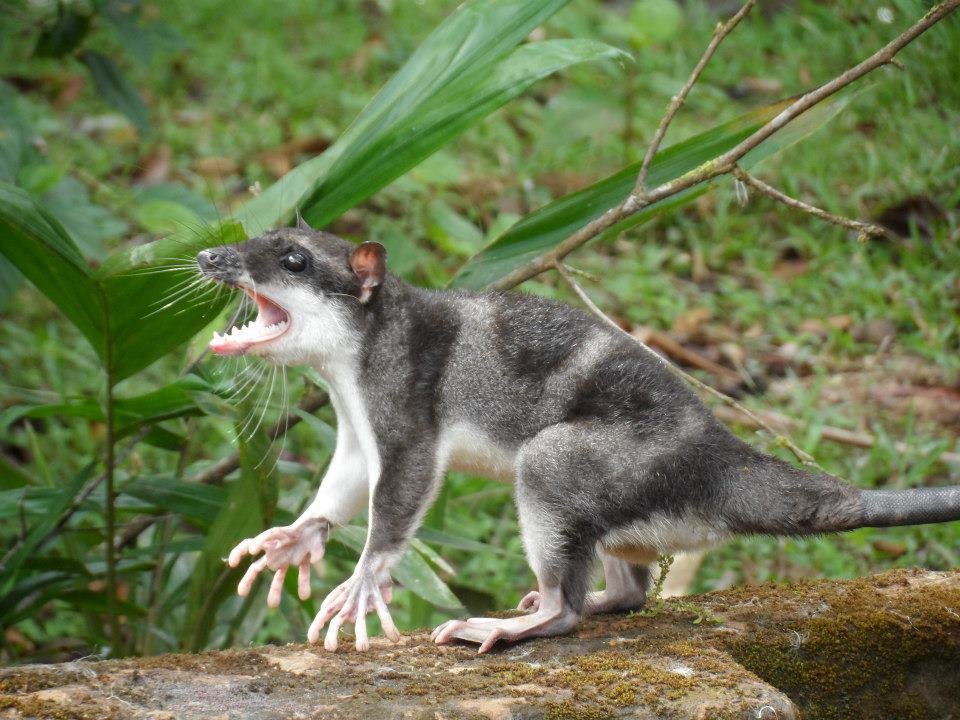
Morphologically, the water opossum is a remarkable example of evolutionary convergence with other aquatic mammals. The animal features a hydrodynamic body, with length ranging between 27 and 35 centimeters, plus a robust tail that can reach up to 40 centimeters. The weight of a healthy adult generally oscillates between 600 and 800 grams. The most striking visual feature is its fur pattern: a light gray background contrasted by four to five dark transverse bands (chocolate-brown or black) that cross the back, providing efficient camouflage against water reflection and the shadows of riparian vegetation at night.
The fur is short, extremely dense, and has hydrophobic properties, functioning as essential thermal insulation for an animal that spends much of its time submerged in waters that can undergo temperature variations. The hind paws are significantly larger than the front ones and have well-developed interdigital membranes (webbing), which serve as the main propulsion organs in swimming. In contrast, the front paws are devoid of membranes, maintaining tactile sensitivity and the dexterity necessary to manipulate prey and explore crevices under rocks or submerged logs.
Another unique anatomical detail is the presence of an elongated pisiform bone in the wrist, which acts as an accessory "sixth finger," aiding in grip on slippery surfaces. The tail is naked for most of its length, except for the base, and has a black coloration that ends in a white or yellowish tip. The eyes are prominent and adapted for scotopic (nocturnal) vision, showing a yellowish glow when hit by artificial light. Furthermore, the vibrissae (whiskers) are long and highly sensitive, allowing the animal to detect vibrations in the water and locate prey even in high turbidity conditions.
Habitat and Distribution in the Pantanal
The distribution of Chironectes minimus ranges from southern Mexico to northeastern Argentina, but it is in the complex of wetlands of the Pantanal that the species finds one of its most important refuges in Brazil. In the Pantanal biome, it preferably inhabits gallery forests and riparian forests bordering clean, moderate-flow rivers. Although it can be found in main channels, the water opossum demonstrates a preference for small tributaries, "corixos" (seasonal channels), and "vazantes" (drainage lines), where vegetation cover offers greater protection against aerial and terrestrial predators.
The species is highly dependent on the integrity of the banks. Its burrows are excavated just above the water level, usually protected by tree roots or rocks, with entrances that can be located both above and below the waterline. In the Pantanal, the flood pulse dynamics require these animals to be flexible; during extreme floods, they may move to higher areas (cordilheiras), although they never stray significantly from permanent water sources. Geographical distribution in the biome covers both the Northern Pantanal (Mato Grosso) and the Southern Pantanal (Mato Grosso do Sul), with frequent records in areas near the Transpantaneira highway and in the basins of the Miranda and Aquidauana rivers.
The ideal habitat for the water opossum in the Pantanal includes waters of varying depth, the presence of submerged organic debris (where its prey hides), and a dense canopy cover that minimizes direct moonlight incidence. The fragmentation of these riparian forests due to agricultural expansion at the edges of the biome represents a challenge for population connectivity, as the animal rarely crosses open areas or dry fields devoid of protective vegetation cover.
Behavior
The water opossum is a solitary animal with strictly nocturnal habits. Its activity period begins shortly after dusk and can extend until the early hours of the morning, alternating periods of intense foraging with moments of rest in its burrows. It is an exceptional swimmer, using alternating movements of its webbed hind paws for propulsion, while the tail acts as a hydrodynamic rudder. In the water, it is agile and silent, capable of performing quick dives to capture prey or escape threats.
Socially, individuals are territorial and avoid contact with other adults, except during the short reproductive period. Communication between specimens occurs mainly through olfactory signals, with territory marking via scent glands. Despite its aquatic adaptation, the water opossum is also capable of moving with agility on dry land and even climbing low branches, although it prefers the safety of the water. When threatened, its first reaction is to dive and seek refuge in submerged cavities or under the dense vegetation of the banks.
One of the most intriguing behaviors of the species is the maintenance of its burrows. They are kept clean and lined with dry leaves and plant material, which the animal transports using its prehensile tail. In the Pantanal, observing these animals in the wild is extremely difficult and requires specific monitoring techniques, such as camera traps positioned close to the water surface or silent nocturnal sightings from boats. Its discreet nature contributes to the mystery surrounding the species, often being confused with small rodents or other marsupials by less experienced observers.
Diet
The diet of Chironectes minimus is predominantly carnivorous and opportunistic, focused on resources available in the aquatic environment. In the Pantanal, its feeding is based on a wide variety of small fish, crustaceans (such as freshwater crabs and shrimp), amphibians, and aquatic insects. Occasionally, it may consume small reptiles or terrestrial invertebrates that fall into the water. Its ecological role is fundamental for the population control of various species of small vertebrates and invertebrates, aiding in the trophic balance of Pantanal streams.
The water opossum's hunting strategy involves the combined use of its senses. While swimming, it uses its sensitive front paws to feel the river bottom and crevices between rocks, locating hidden prey. Once prey is detected, the animal performs a quick attack, capturing it with its hands or mouth. Interestingly, the water opossum usually takes larger prey to the bank or onto fallen logs to consume them, avoiding the loss of food in the current and allowing for more efficient manipulation.
Unlike the capybara, which is herbivorous, or the maned wolf, which has a varied omnivorous diet, the water opossum is a specialist in aquatic proteins. This specialization makes it vulnerable to changes in fish and crustacean fauna caused by water pollution from pesticides or river silting. In the Pantanal ecosystem, it occupies an intermediate step in the food chain, also serving as food for larger predators such as the jaguar, caimans, and nocturnal birds of prey.
Reproduction
The reproductive system of the water opossum is one of the most extraordinary aspects of its biology. Like all marsupials, the initial development of the young occurs in the uterus, followed by a crucial period inside the marsupium (pouch). However, Chironectes minimus has a unique adaptation: the female's marsupium is equipped with a powerful muscular sphincter that closes it hermetically when she dives. This creates a waterproof air chamber, allowing the young to remain dry and breathe normally even while the mother swims or hunts underwater.
In the Pantanal, reproduction seems to be linked to resource availability, generally occurring during or shortly after the rainy season when the supply of aquatic prey is abundant. The litter usually varies from 1 to 5 young. After birth, the tiny young migrate to the pouch, where they attach to the teats. The period of stay in the marsupium is approximately 40 to 50 days. Even after leaving the pouch, the young may remain in the burrow while the mother forages, until they are large enough to accompany her and learn hunting techniques. Interestingly, males also possess a rudimentary pouch-like structure that helps protect their genitalia while swimming.
Conservation Status
Globally, the water opossum is classified by the International Union for Conservation of Nature (IUCN) as a species of "Least Concern" (LC). However, this classification masks concerning local realities. In Brazil, although it does not appear on the ICMBio national list of officially threatened species at a critical level, the species is considered rare and its populations are declining in several biomes, especially in the Atlantic Forest and in Cerrado areas surrounding the Pantanal. The main threat to its survival is the degradation of riparian habitats.
In the Pantanal, risks stem mainly from the deforestation of gallery forests for pasture creation, river silting caused by inadequate soil management in the headwaters, and water contamination by mercury (from mining) and pesticides. As the water opossum is at the top of an aquatic food chain of small streams, it suffers from the process of bioaccumulation of pollutants. Furthermore, climate changes that alter the flood and dry regime of the Pantanal can impact the availability of safe sites for burrow construction and reproduction.
Conservation of the species depends on the maintenance of Permanent Preservation Areas (APPs) along watercourses. Sustainable ecotourism projects in the Pantanal, which value wildlife observation, can act as allies in protecting the species, encouraging landowners to preserve riparian forests. The water opossum is a symbol of the health of Pantanal rivers, and its protection ensures the preservation of countless other species that share the same aquatic micro-habitat.
Curiosities
The water opossum is surrounded by legends and curiosities that enchant biologists and local residents. The name "yapok" derives from the Oyapock River, on the border between Brazil and French Guiana, where the species was first described. For traditional Pantanal communities, the animal is often seen as a mysterious, almost "magical" being, due to its ability to disappear under the water for long periods. Its ability to swim with young in the pouch without drowning them is one of the greatest wonders of natural engineering.
In the realm of ecotourism, the water opossum is considered a "trophy" for nature photographers and mammalwatchers. Due to its rarity and nocturnal habits, achieving a clear photographic record of this animal in the Pantanal is a noteworthy feat. It represents the lesser-known but equally fascinating face of Pantanal biodiversity, which goes far beyond the large and famous animals. Furthermore, the water opossum is the only living marsupial that has interdigital membranes on its paws, which makes it a valuable object of study for understanding the evolution and adaptation of mammals to the aquatic environment.
Another curiosity lies in its internal anatomy: unlike many other marsupials, the water opossum does not have a cloaca, presenting separate openings for the digestive and urogenital systems, a characteristic it shares with placental mammals and that intrigues taxonomists. Every encounter with a water opossum on the banks of a Pantanal corixo is a reminder of the complexity and resilience of life in the world's largest freshwater wetland.
References
[1] IUCN. (2016). *Chironectes minimus*. The IUCN Red List of Threatened Species. Available at: https://www.iucnredlist.org/species/4670/22170707
[2] ICMBIO. (2018). *Livro Vermelho da Fauna Brasileira Ameaçada de Extinção*. ICMBio. Available at: https://www.icmbio.gov.br
[3] ALHO, C. J. R. (2008). *Biodiversidade do Pantanal*. Editora UNIDERP.
[4] REIS, N. R.; PERACCHI, A. L.; PEDRO, W. A.; LIMA, I. P. (Eds.). (2006). *Mamíferos do Brasil*. Londrina: Editora da Universidade Estadual de Londrina.
[5] VIEIRA, E. M.; CAMARGO, N. F. (2005). Diet of the water opossum (Chironectes minimus) in southern Brazil. *Mammalian Biology - Zeitschrift für Säugetierkunde*, 70(6), 373-379.
[6] EMBRAPA PANTANAL. (2024). *Fauna do Pantanal*. Embrapa Pantanal. Available at: https://www.embrapa.br/pantanal/fauna
[7] SICK, H. (1997). *Ornitologia Brasileira*. Nova Fronteira.