

Introduction
The Didelphis marsupialis, popularly known as the common opossum or black-eared opossum, is one of the most emblematic and adaptable marsupials in South America. In the Pantanal ecosystem, this species plays a fundamental role as a biological regulator, acting in the control of invertebrate and small vertebrate populations. Although often confused with its close relatives, such as the white-eared opossum, D. marsupialis has distinct ecological and morphological characteristics that make it a vital component of Pantanal biodiversity, especially in the gallery forests and riparian forests bordering the Paraguay River.
Scientific Classification
| Kingdom | Animalia |
| Phylum | Chordata |
| Class | Mammalia |
| Order | Didelphimorphia |
| Family | Didelphidae |
| Genus | Didelphis |
| Species | Didelphis marsupialis |
| Common Name | Common Opossum |
The presence of this marsupial in the Northern Pantanal is an indicator of the environmental health of the region's forest formations. As a generalist and opportunistic animal, it manages to navigate between the different gradients of humidity and vegetation imposed by the water cycle. Its importance goes beyond simple predation; it is an effective seed disperser, aiding in the regeneration of forests that suffer from seasonal variations in flooding and drought. In a biome where large predators like the jaguar dominate the top of the food chain, the common opossum occupies an essential intermediate niche for maintaining trophic balance.
Historically, opossums have been targets of prejudice due to their defense mechanisms and nocturnal habits. However, modern scientific studies conducted in areas such as the Transpantaneira have revealed the complexity of their behavior and their resilience in the face of climate change and habitat fragmentation. As a species classified as "Least Concern" (LC) by the IUCN, the common opossum serves as a model of adaptation, surviving in both virgin areas and anthropized transition zones, always maintaining its primary ecological function.
Physical Description
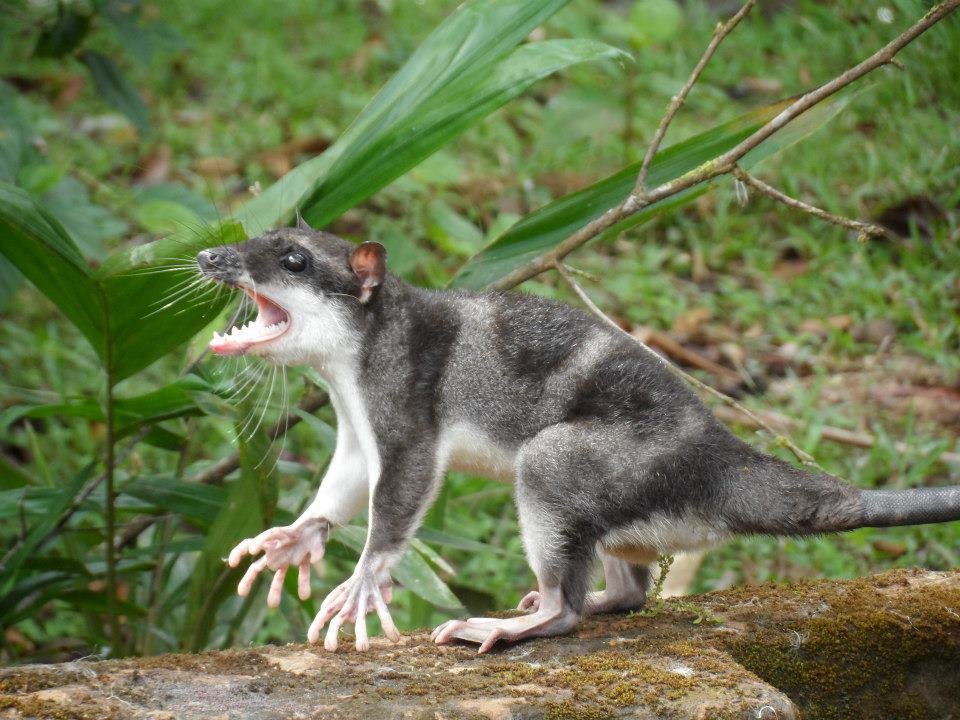
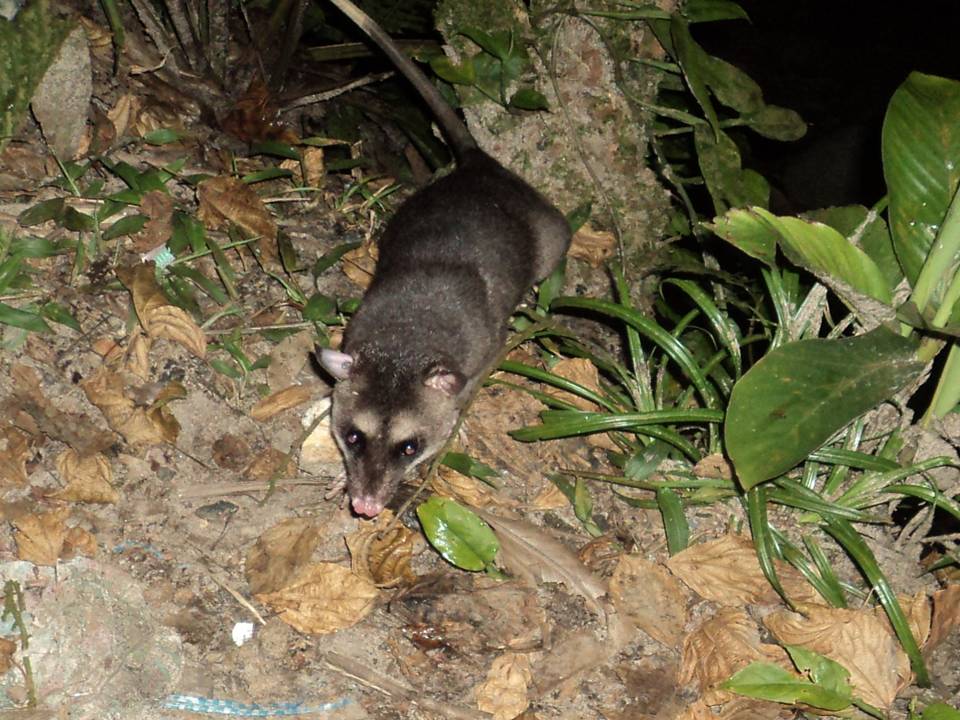
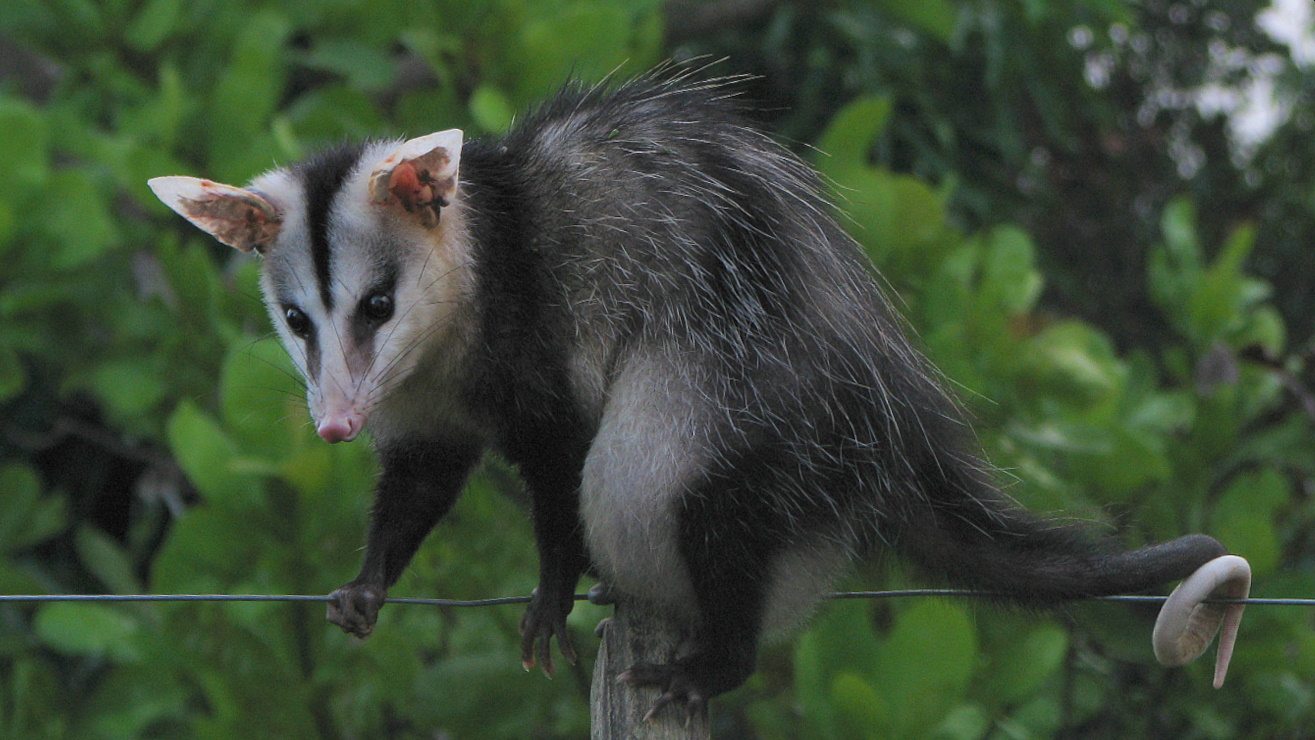
The common opossum is a medium-sized marsupial, featuring a robust body that can measure between 35 and 50 centimeters in length, not counting the tail. The weight of an adult varies significantly depending on resource availability, generally ranging between 1.5 kg and 3.0 kg. The most distinctive feature, which gives it its local name, is its large, rounded, and completely black ears, devoid of hair. This characteristic is crucial for differentiating it from Didelphis albiventris (white-eared opossum), which has ears with light edges or spots.
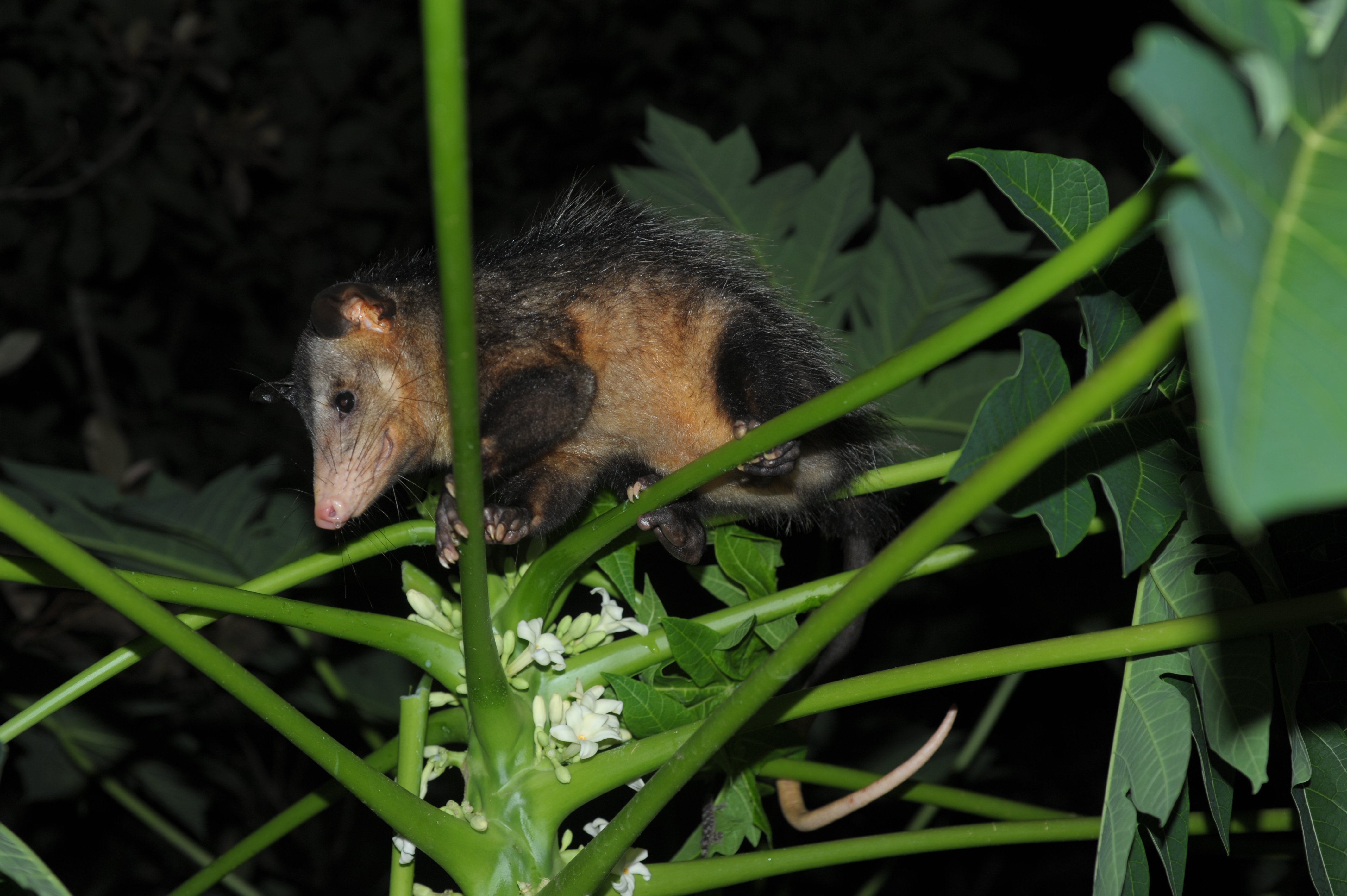
The fur of Didelphis marsupialis consists of two layers: a dense yellowish or whitish undercoat, covered by longer, coarser guard hairs that range from gray to black, giving the animal a "grizzled" appearance. On the face, it presents a characteristic mask pattern, with a dark stripe running across the top of the head to the snout and dark spots around the eyes. Its tail is prehensile, long (often longer than the body), and scaly; the base of the tail has fur similar to the body, while the rest is hairless, being black at the base and becoming lighter or pinkish toward the tip.
The opossum's paws are adapted for both arboreal and terrestrial life. The hind limbs have an opposable first toe (hallux) without a claw, functioning similarly to a human thumb, which facilitates climbing trees and manipulating food. Its claws on the other toes are sharp and efficient for digging and defense. Furthermore, like all marsupials of the genus Didelphis, females have a well-developed marsupium, an abdominal pouch where the young complete their development after premature birth.
Habitat and Distribution in the Pantanal
The geographical distribution of Didelphis marsupialis ranges from southern Mexico to northern Argentina. In Brazil, the species is widely found in the Amazon and transition areas. In the Pantanal biome, its occurrence is more significant in the Northern portion, in Mato Grosso, where the influences of the Amazon Rainforest are more pronounced. It prefers environments with dense forest cover, being frequently sighted in gallery forests, cordilheiras (elevations that do not flood), and forest patches.
Unlike other Pantanal mammals like the capybara, which prefers open areas near water, the common opossum utilizes the vertical stratification of forests. During the flood period, when much of the plain is submerged, these animals seek refuge in the treetops or on the highest parts of the cordilheiras. Connectivity between these forest fragments is vital for the species' dispersal. In the Southern Pantanal, although present, it often shares or yields space to Didelphis albiventris, which is better adapted to open and dry environments like the Cerrado and Chaco.
The opossum's adaptability allows it to also frequent areas of human occupation, such as farms and villages along the Transpantaneira highway. In these locations, it takes advantage of orchards and grain stores, demonstrating its ecological plasticity. However, its ideal habitat remains preserved native vegetation areas, where the abundance of tree hollows and dense foliage offers protection against aerial and terrestrial predators during the day.
Behavior
The common opossum is an animal of strictly nocturnal and solitary habits. Its activity begins shortly after sunset and extends until dawn, a period in which it uses its keen sense of smell and hearing to locate prey and partners. During the day, it remains hidden in shelters that may include tree hollows, abandoned bird nests, rock crevices, or even the ceilings of human constructions. It does not build complex nests but may line its shelter with dry leaves and twigs, transporting the material with the aid of its prehensile tail.
Socially, individuals are intolerant of each other, except during the mating season. Encounters between males can result in displays of aggression, including growls, teeth-chattering, and the release of a foul-smelling substance produced by anal glands. A famous defensive behavior of the species, although less frequent than in its North American relatives, is thanatosis (playing dead). When cornered by a predator and without an escape route, the opossum can enter a catatonic state, remaining motionless and exuding a fetid smell to discourage the attack.
Despite its slow appearance on the ground, the opossum is an excellent climber. Its prehensile tail functions as a fifth limb, providing stability while moving between branches in search of fruit or bird eggs. In the Pantanal, this arboreal behavior is a crucial survival strategy to avoid terrestrial predators like the maned wolf or the giant otter in riparian areas. It is a territorial animal, although its home ranges may overlap considerably, especially in areas with high food supply.
Diet
The diet of Didelphis marsupialis is classified as omnivorous and generalist, meaning it consumes a wide range of foods depending on seasonal availability. In the Pantanal, its feeding is strongly influenced by the flood cycle. During the dry season, the diet focuses on invertebrates such as beetles, grasshoppers, spiders, and scorpions. Interestingly, opossums have a natural resistance to the venom of various snakes, including those of the genus Bothrops (jararacas), making them occasional prey and giving the marsupial an important role in controlling these reptiles.
In addition to small animals, the opossum consumes a large amount of wild fruits. In the Pantanal, it feeds on fruits from palms such as acuri and buriti, as well as figs and other tree species. By ingesting the fruits and defecating the seeds in locations distant from the parent plant, D. marsupialis acts as one of the main seed dispersal agents of the biome, directly contributing to the maintenance of plant diversity. It is also known to consume bird eggs and chicks, small rodents, and occasionally carrion.
The ecological role of the opossum as an environmental "scavenger" is underestimated. By consuming carcasses and sick animals, it aids in cleaning the ecosystem and preventing the spread of diseases. In areas near human settlements in the Pantanal, it can become a frequent visitor to trash cans and pet feeders, which requires careful management to avoid conflicts. Its ability to digest chitin (from insects), bones, and plant fibers demonstrates a highly efficient digestive system adapted to an opportunistic life.
Reproduction
The reproductive system of the common opossum is typical of didelphid marsupials. In the Pantanal, reproduction generally occurs in two annual peaks, often synchronized with the start of the rainy season when the supply of insects and fruits increases drastically. The gestation period is extremely short, lasting about 13 to 15 days. After this period, the young are born in an embryonic state, being tiny (the size of a bean), blind, and hairless.
Immediately after birth, the newborns perform a Herculean journey, climbing the mother's abdomen until they reach the marsupium. Once inside the pouch, each young attaches to one of the teats (which can range in number from 9 to 13). The young that fails to find a functional teat does not survive, which acts as a natural form of selection. They remain attached to the teats for about 60 to 70 days, completing their physical and immunological development protected by the controlled environment of the marsupium.
After leaving the pouch, the young opossums are carried on the mother's back for a few more weeks. This period of parental care is essential for learning foraging and defense techniques. Sexual maturity is reached around 8 to 10 months of age. In the wild, the common opossum has a relatively short lifespan, usually between 2 and 4 years, a characteristic compensated by its high reproductive rate and ecological resilience.
Conservation Status
Currently, Didelphis marsupialis is classified by the International Union for Conservation of Nature (IUCN) as a species of "Least Concern" (LC). This classification is due to its wide geographical distribution, high capacity for adaptation to different habitats, and apparently stable populations. In Brazil, ICMBio follows the same line, not listing the species as threatened at the national level. However, the situation in the Pantanal requires attention due to increasing threats to the biome.
The main threats faced by the common opossum in the Pantanal include habitat loss due to deforestation for pasture creation and recurrent forest fires, which destroy their shelters and food sources. Furthermore, roadkill on highways such as the Transpantaneira is a significant cause of mortality, especially at night when animals cross the tracks in search of resources. Conflict with humans, motivated by unfounded fear or occasional predation of domestic birds, also results in unnecessary deaths through direct persecution.
The conservation of the species is intrinsically linked to the preservation of riparian forests and ecological corridors. Although not a "flagship" species like the jaguar, the opossum is an important indicator of the integrity of forest ecosystems. Environmental education programs aimed at demystifying the negative image of the animal are essential to ensure its coexistence with local communities and tourists visiting the Pantanal to observe wildlife.
Curiosities
One of the most fascinating curiosities about the common opossum is its immunity to snake venoms. Proteins present in its blood are capable of neutralizing the toxins of venomous snakes, which has sparked interest in the pharmaceutical industry for the development of new antidotes. In the Pantanal, where snake density is high, this characteristic gives the opossum a unique evolutionary advantage, allowing it to exploit food resources that other mammals would avoid.
In local Pantanal culture, the opossum is often called "saruê" or "mucura." Although in some regions it is viewed with suspicion, many Pantanal residents recognize its utility in controlling domestic pests such as scorpions and cockroaches. In ecotourism, the common opossum is one of the stars of nocturnal safaris. Observing a female carrying her young on her back while skillfully climbing an acuri tree is a memorable experience for visitors to the Transpantaneira region.
Another interesting fact is its reproductive anatomy: males have a bifurcated penis, which generated ancient myths that mating would occur through the female's nostrils. Obviously, science has already debunked such beliefs, explaining that the bifurcation corresponds to the female's internal anatomy, which has two vaginal canals and two uteri. This biological complexity, combined with its millennial resilience, makes the common opossum a true survivor from prehistory that continues to thrive in the heart of Brazil.
References
[1] IUCN. (2015). *Didelphis marsupialis*. The IUCN Red List of Threatened Species. Available at: https://www.iucnredlist.org/species/40501/22176317
[2] ALHO, C. J. R. (2008). *Biodiversidade do Pantanal*. Editora UNIDERP.
[3] REIS, N. R.; PERACCHI, A. L.; PEDRO, W. A.; LIMA, I. P. (Eds.). (2006). *Mamíferos do Brasil*. Londrina: Editora da Universidade Estadual de Londrina.
[4] ICMBIO. (2018). *Livro Vermelho da Fauna Brasileira Ameaçada de Extinção*. ICMBio. Available at: https://www.icmbio.gov.br
[5] GARDNER, A. L. (2008). *Mammals of South America, Volume 1: Marsupials, Xenarthrans, Shrews, and Bats*. University of Chicago Press.
[6] EMBRAPA PANTANAL. (2010). *Guia de Mamíferos do Pantanal*. Embrapa Pantanal. Available at: https://www.embrapa.br/pantanal/publicacoes