

Introduction
The Philander opossum, popularly known as the gray four-eyed opossum, is one of the most emblematic and adaptable marsupials inhabiting the floodplains of the Pantanal. Belonging to the family Didelphidae, this species plays a fundamental ecological role as a regulator of small invertebrate and vertebrate populations, in addition to acting as a seed disperser in riparian forest areas. In the vast Pantanal ecosystem, the gray four-eyed opossum stands out for its close association with humid environments, being a biological indicator of the health of gallery forests and "landis" (vegetation corridors in low areas).
Scientific Classification
| Kingdom | Animalia |
| Phylum | Chordata |
| Class | Mammalia |
| Order | Didelphimorphia |
| Family | Didelphidae |
| Genus | Philander |
| Species | Philander opossum |
| Common Name | Gray Four-eyed Opossum |
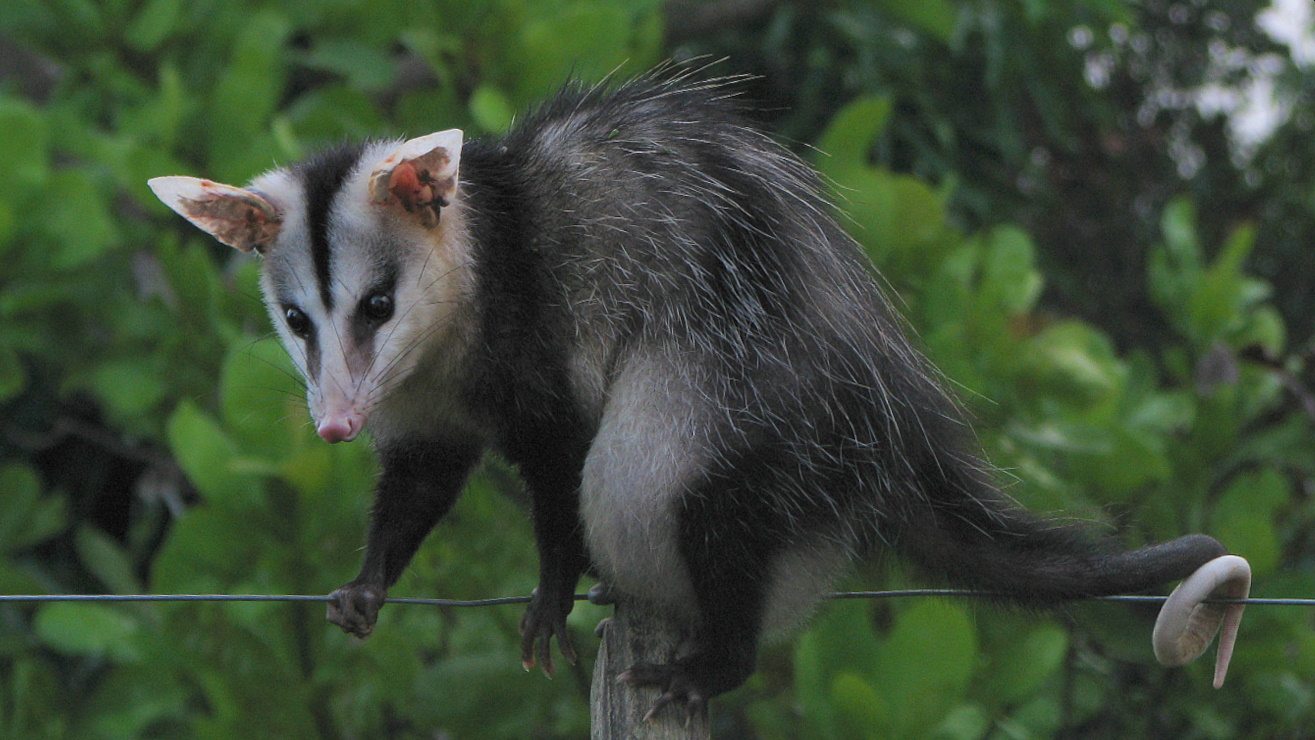
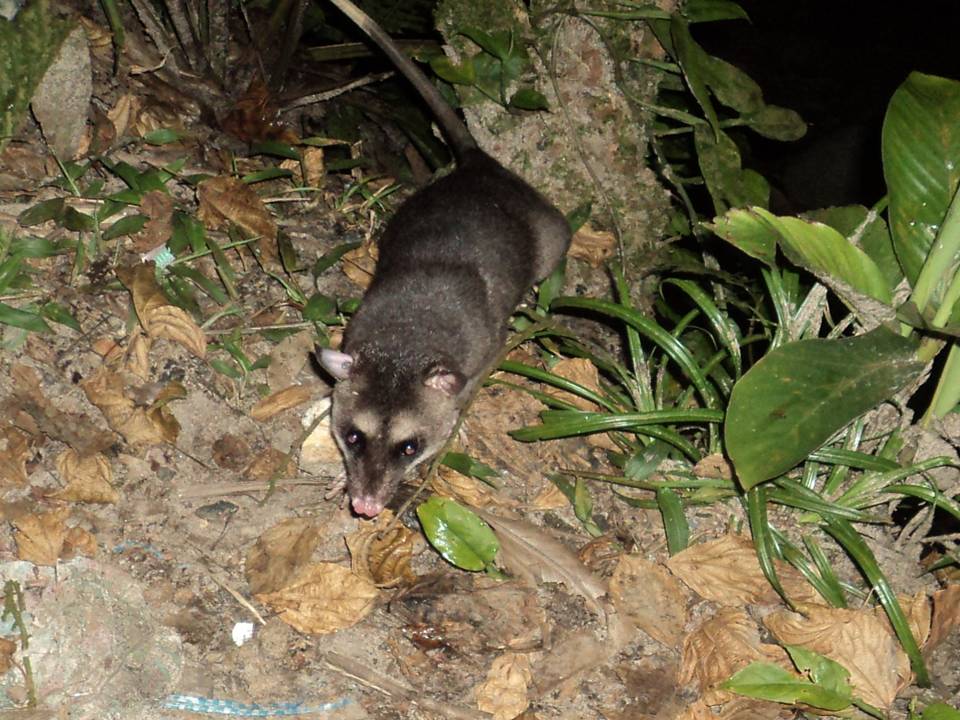
The common name "four-eyed" derives from a striking morphological feature: the presence of two white or yellowish spots located just above the true eyes, which create the illusion of a second pair of eyes. This visual adaptation may act as a defense mechanism against predators, confusing them during the animal's nocturnal activities. In the Pantanal context, where biodiversity is governed by the water cycle, Philander opossum demonstrates remarkable resilience, adjusting its behavior and distribution as the level of the Paraguay River and its tributaries rises and falls annually.
Despite being a relatively common species, the gray four-eyed opossum is often unknown to the general ecotourism public, which focuses on larger mammals. However, for researchers and observers of local fauna, it represents the complexity of life in the lower strata of the forest. Its presence is vital for maintaining the food web, serving as prey for larger predators such as the jaguar and various birds of prey, consolidating its importance in the ecological integrity of the world's largest floodplain.
Physical Description
The gray four-eyed opossum is a medium-sized marsupial, featuring a robust and elongated body that facilitates movement both on the ground and in arboreal vegetation. Adults measure, on average, between 25 and 35 centimeters in length (head and body), with a tail that can be equal to or slightly larger than the body size, ranging from 25 to 33 centimeters. The weight of an adult individual in the Pantanal generally oscillates between 200 and 600 grams, although males tend to be slightly larger and heavier than females, evidencing a slight sexual dimorphism.
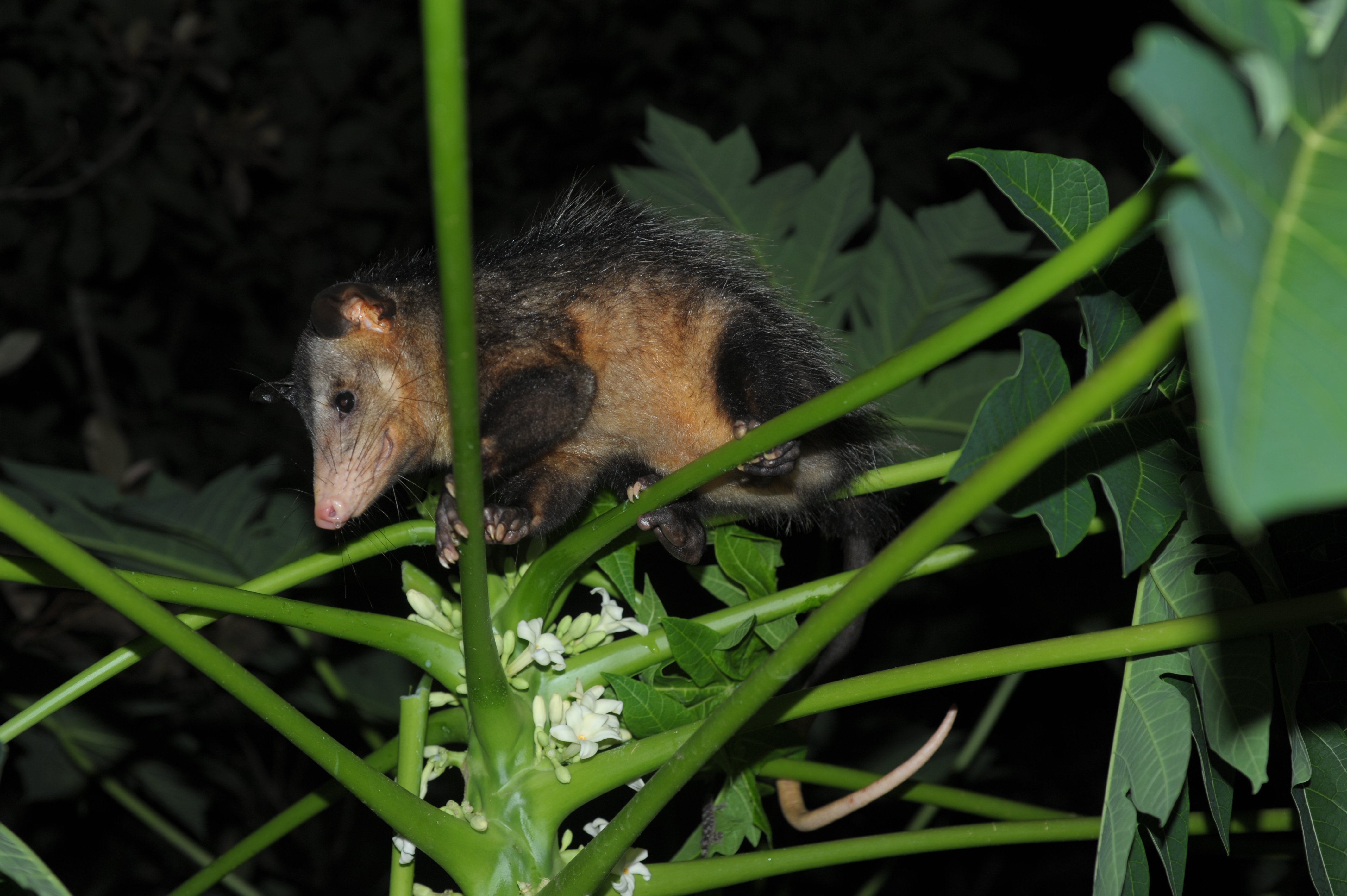
The fur is dense, short, and soft, with a dorsal coloration ranging from dark gray to bluish-gray, while the ventral region is distinctly lighter, presenting tones of cream, yellowish, or off-white. The most distinctive feature, as mentioned, is the white supraocular spots, which contrast strongly with the dark face. The ears are large, rounded, and hairless, possessing a dark coloration that aids in thermoregulation and keen hearing, essential for detecting prey and predators in the dark of the forest.
The tail of Philander opossum is prehensile, an evolutionary adaptation crucial for semi-arboreal life. The base of the tail (about one-third of its length) is covered by fur similar to the body, while the rest is scaly and ends in a light or white tip. Its paws have agile toes with well-developed claws, and the hallux (the "thumb" of the hind paws) is opposable and clawless, functioning like a human thumb to grasp branches firmly. Unlike other marsupials, Philander females have a well-developed marsupium (pouch), where the young complete their development after premature birth.
Habitat and Distribution in the Pantanal
In the Pantanal, the distribution of Philander opossum is strongly influenced by topography and the hydrological regime. Unlike other marsupials like the capybara, which occupies open areas, the gray four-eyed opossum is a specialist of forest environments. It is found predominantly in riparian forest areas, gallery forests, and in the so-called "landis" — forest formations that occupy drainage depressions and remain humid or flooded for much of the year. Studies conducted in the Poconé region indicate that the species is practically absent in the "cordilheiras" (elevated areas that do not flood), preferring floodable habitats where biological productivity is higher.
The preference for areas near water bodies, such as the banks of the Paraguay River and the Transpantaneira highway, is due to the abundance of food resources and the protection offered by dense vegetation. During the flood period, when much of the plain is submerged, the gray four-eyed opossum uses the middle and upper strata of the forest, demonstrating great skill as a climber. In the ebb and dry seasons, it is frequently seen foraging on the humid ground, among the leaf litter, in search of invertebrates that emerge with the receding waters.
Geographically, Philander opossum occurs throughout the Pantanal, in both Mato Grosso and Mato Grosso do Sul, extending through almost all of Central and South America, from Mexico to northern Argentina. However, Pantanal populations have specific behavioral adaptations to deal with the flood pulse, which makes them unique in terms of applied ecology. The preservation of biodiversity corridors along rivers is vital for this species to continue to disperse and maintain genetic variability between the different sub-regions of the biome.
Behavior
The Philander opossum is essentially nocturnal and solitary. Its activities begin shortly after sunset and extend until the early hours of the morning, a period in which it uses its keen vision and sharp sense of smell to navigate the complex environment of the Pantanal. Although it is an excellent climber, using its prehensile tail to balance on thin branches, the gray four-eyed opossum spends a significant amount of time on the ground, being classified as a semi-arboreal species. It is known to be a competent swimmer, an indispensable skill for survival in a biome that remains flooded for several months.
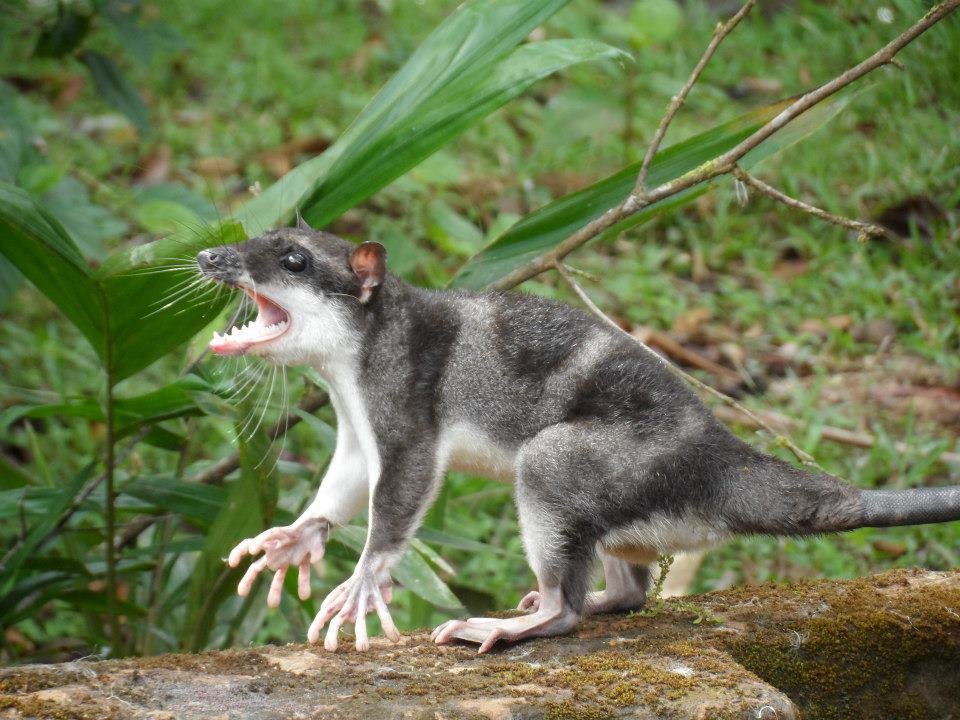
In terms of temperament, the gray four-eyed opossum is notably more aggressive and agile than the white-eared opossum (Didelphis albiventris). When cornered, it does not hesitate to show its teeth, emit hissing vocalizations, and even attack to defend itself. Unlike some relatives that use "thanatosis" (playing dead), Philander prefers rapid flight or direct confrontation. During the day, it shelters in tree hollows, abandoned bird nests, or in cavities protected by dense vegetation, often lining these sites with dry leaves for greater comfort and thermal insulation.
Social behavior is limited to mating periods and parental care. Individuals maintain home ranges that may overlap, but avoid direct interactions outside the breeding season. In the Pantanal, it has been observed that population density and movement patterns change drastically with the seasons: during the flood, animals are confined to "islands" of vegetation or the forest canopy, which increases intraspecific competition for resources. This behavioral plasticity is what allows the species to thrive in such a dynamic and challenging environment.
Diet
The diet of Philander opossum is omnivorous and generalist, which gives it a great adaptive advantage in the Pantanal. As an opportunistic predator, it consumes a wide range of food items, depending on seasonal availability. Approximately half of its diet is composed of small animals, including insects (beetles, ants, and grasshoppers), spiders, earthworms, crustaceans (such as freshwater crabs, abundant during the ebb), small reptiles, amphibians, and even small rodents or young birds. Its agility allows it to capture moving prey with surgical precision.
In addition to animal protein, the gray four-eyed opossum consumes a significant amount of plant matter, mainly wild fruits. In the Pantanal, it plays a crucial role as a seed disperser for various tree species, such as the "leiteiro" and "pimenteira." By ingesting the fruits and defecating the seeds in locations distant from the parent plant, it aids in the regeneration of riparian forests. During the dry season, when the supply of fruits may decrease, the species increases the consumption of invertebrates found in the humid leaf litter of river and corixo banks.
The ecological role of Philander opossum in the Pantanal food web is twofold: it acts as an important pest controller, keeping insect populations in balance, and serves as a vital food source for top predators. Animals such as the giant otter (in water-land transition areas) and the maned wolf (in drier edge areas) may occasionally prey on this marsupial. This varied diet and its intermediate position in the trophic chain make the gray four-eyed opossum a fundamental link for energy flow in the ecosystem.
Reproduction
The reproductive biology of Philander opossum in the Pantanal is closely linked to the rain cycle and resource availability. The reproductive period generally begins at the end of the dry season (August/September) and reaches its peak during the rainy season and the start of the flood (November to February). This synchrony ensures that when the young are weaned and begin to forage independently, the environment is in its phase of highest biological productivity, with an abundance of insects and fruits.
Gestation is extremely short, lasting about 13 to 15 days, after which young are born in an embryonic state. These tiny newborns climb the mother's belly to the marsupium, where they attach to the teats to complete their development. The number of young per litter generally varies from 4 to 7, although records of up to 9 young have been documented in ideal conditions. Parental care is exclusive to the female, who carries the young in the pouch for several weeks and, later, on her back, until they are ready to face the challenges of the Pantanal alone.
Conservation Status
Currently, Philander opossum is classified by the International Union for Conservation of Nature (IUCN) as a species of Least Concern (LC). This classification is due to its wide geographical distribution, large estimated population, and capacity to adapt to different types of habitats, including areas slightly disturbed by man. In Brazil, the Chico Mendes Institute for Biodiversity Conservation (ICMBio) also maintains the status of "Least Concern" in its national assessments, reflecting the stability of the species in biomes such as the Amazon, Atlantic Forest, and the Pantanal.
However, the situation in the Pantanal requires continuous attention due to increasing threats to the biome. Habitat loss resulting from deforestation for pasture formation and the degradation of riparian forests directly impact gray four-eyed opossum populations, which depend on forest cover to survive. Furthermore, the intense wildfires that have plagued the region in recent years represent a mortal danger for small mammals of limited mobility, destroying their shelters and food sources. The fragmentation of gallery forests along the Paraguay River can also isolate populations, reducing gene flow.
Another relevant threat is predation by domestic animals, such as dogs and cats, in areas near human settlements and farm headquarters. Although not at imminent risk of extinction, the conservation of Philander opossum depends on maintaining the integrity of the flood pulse and protecting Permanent Preservation Areas (APPs). Wildlife monitoring projects along the Transpantaneira are fundamental to understanding how global climate change may affect the population dynamics of this marsupial in the long term.
Curiosities
One of the most fascinating curiosities about Philander opossum is its natural resistance to the venom of certain snakes, such as pit vipers (genus Bothrops). Like other members of the family Didelphidae, the gray four-eyed opossum has proteins in its blood that neutralize the hemorrhagic toxins of the venom, allowing it not only to survive bites but also to feed on young venomous snakes. This fact places it in a prominent position in local culture, where it is often confused with the common opossum but respected for its bravery and utility in controlling venomous animals near rural dwellings.
In the realm of ecotourism in the Pantanal, the gray four-eyed opossum is a "hidden gem" of nocturnal safaris. Although most tourists seek to spot the jaguar, observation focused on small mammals reveals intriguing behaviors, such as the opossum's ability to walk on thin lianas with the precision of a tightrope walker. Its white spots over the eyes shine intensely under the light of flashlights, creating a memorable visual effect for nature photographers. Furthermore, its importance to science is vast, being frequently used in studies on the evolution of South American marsupials and the ecology of zoonotic diseases.
Finally, the relationship of the gray four-eyed opossum with Pantanal folklore is subtle but present. In some riparian communities, it is believed that the animal possesses "four eyes" to watch the world of the living and the world of spirits simultaneously, a mystical interpretation of its unique facial marking. Whether as a spiritual guardian or as a tireless worker of the forest, Philander opossum continues to be a vital and fascinating component of Brazilian biodiversity, symbolizing the resilience and beauty of wildlife in the heart of the Pantanal.
References
[1] IUCN. (2016). *Philander opossum*. The IUCN Red List of Threatened Species. Available at: https://www.iucnredlist.org/species/16900/22176974
[2] ALHO, C. J. R. (2008). *Biodiversidade do Pantanal*. Editora UNIDERP.
[3] PAGLIA, A. P. et al. (2012). *Lista Anotada dos Mamíferos do Brasil*. 2nd Edition. Fundação Biodiversitas.
[4] EISENBERG, J. F.; REDFORD, K. H. (1999). *Mammals of the Neotropics, Volume 3: The Central Neotropics: Ecuador, Peru, Bolivia, Brazil*. University of Chicago Press.
[5] POTT, A.; POTT, V. J. (1994). *Plantas do Pantanal*. Embrapa-SPI.
[6] ICMBIO. (2018). *Livro Vermelho da Fauna Brasileira Ameaçada de Extinção*. ICMBio. Available at: https://www.icmbio.gov.br