
Taxonomic Classification
| Category | Classification |
|---|---|
| Kingdom | Plantae |
| Phylum | Tracheophyta |
| Class | Polypodiopsida |
| Order | Salviniales |
| Family | Salviniaceae |
| Genus | Salvinia |
| Species | S. auriculata |
Description
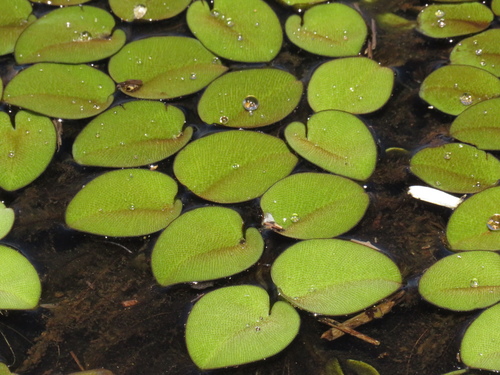
Salvinia auriculata, popularly known as Eared Watermoss or Orelha-de-onça, is a small floating aquatic fern that forms dense mats on the water’s surface. Its morphology is quite peculiar and adapted to aquatic life. The leaves are arranged in whorls of three, with two floating and one submerged, which is modified and filamentous, functioning as a root. The floating leaves are oval to suborbicular, with entire margins and a prominent midrib. Coloration varies from light green to dark green, and can acquire reddish tones under intense solar exposure.
The upper surface of the floating leaves is covered by multicellular papillae, which are hair-like structures arranged in groups of four, joined only at the base and free at the ends, forming a kind of “basket” that retains air bubbles. This characteristic gives the plant a remarkable ability to repel water (hydrophobicity), essential for its buoyancy and to avoid waterlogging. The size of the floating leaves generally varies from 1 to 3 cm in length but can be larger under ideal conditions.
The submerged part of the plant, which resembles roots, is actually a modified leaf, highly branched and filamentous, responsible for absorbing nutrients from the water. It does not have true roots. Sporocarps, reproductive structures containing spores, are globose and grouped in chains, usually attached to the base of the submerged leaves or between the floating leaves, although they are less frequently observed than the vegetative structures.
Salvinia auriculata stands out for its capacity for rapid proliferation, forming extensive floating “mats” or “islands.” These mats can be so dense that they can support the weight of small animals and even people in some situations, evidencing the robustness of their structure as a whole.
Geographic Distribution
Salvinia auriculata has a vast geographic distribution, being native to the tropical and subtropical regions of the Americas. Its occurrence extends from the southern United States to Argentina, covering a large part of Latin America. It is a common species in various aquatic biomes, from small bodies of water to large rivers and lakes.
In Brazil, the species is widely distributed, being found in practically all states, especially those with large hydrographic basins. It is particularly abundant in regions with a hot and humid climate, where conditions are ideal for its development.
In the Pantanal, Salvinia auriculata is one of the most conspicuous and abundant aquatic macrophytes. It can be found in all sub-regions of the biome, from the floodplain areas of Nhecolândia and Abobral to the river and corixo regions of the Miranda and Aquidauana Pantanal. Its presence is striking in marginal lagoons, bays, corixos, vazantes, and river backwater areas, where the current is milder, allowing its fixation and proliferation. The flood and drought dynamics of the Pantanal directly influence its distribution and abundance throughout the year.
Habitat and Ecology
Salvinia auriculata is a floating aquatic plant that thrives in freshwater environments, preferably with little or no current. Its ideal habitat includes lagoons, dams, canals, ditches, river backwaters, and flooded areas, where the water surface is calm and protected from strong winds. The species is quite tolerant of variations in water pH but prefers slightly acidic to neutral waters.
In terms of luminosity, the Eared Watermoss is heliophytic, meaning it requires good solar incidence for its optimal development, although it can tolerate some shade. Water temperature is a crucial factor, with the plant showing more vigorous growth in high temperatures, typical of tropical and subtropical regions. The availability of nutrients in the water, especially nitrogen and phosphorus, is fundamental for its rapid proliferation.
Ecologically, Salvinia auriculata plays an ambiguous role in the ecosystem. In controlled densities, it offers shelter and food for small aquatic invertebrates, juvenile fish, and amphibians. It contributes to the stabilization of water temperature and the reduction of evaporation. However, in cases of uncontrolled proliferation, it can form mats so dense that they block sunlight, harming the photosynthesis of other submerged aquatic plants and reducing dissolved oxygen levels in the water, which can lead to the death of fish and other aquatic organisms. This characteristic makes it a species with invasive potential in environments where it is not native, or where conditions favor its excessive growth.
Ecological Importance
Salvinia auriculata, despite its potential for invasion, plays a significant ecological role in the Pantanal. Its dense floating mats serve as an important habitat and refuge for a variety of organisms. Small fish, such as lambaris and juveniles of larger species, find protection from predators and foraging areas among its modified roots. Aquatic invertebrates, such as insect larvae and microcrustaceans, also use these mats as a substrate for feeding and reproduction, forming the base of the food chain.
In addition, the presence of Salvinia auriculata contributes to the stabilization of sediments and the filtering of nutrients in the water column. Its mats can act as “natural filters,” absorbing excess nutrients, such as nitrogen and phosphorus, which could lead to the eutrophication of water bodies. This absorption capacity can be beneficial in environments with some pollution load. The plant cover also helps reduce erosion of the banks and mitigate the force of waves in open areas.
Uses and Economic Importance
Currently, Salvinia auriculata does not have large-scale direct economic uses. However, some potential and indirect applications have been explored. Due to its rapid growth rate and ability to absorb nutrients, it has been studied for phytoremediation of polluted waters, especially for the removal of heavy metals and excess nutrients in effluents. This application, although promising, is still in the research and development phase.
In some riverside communities, it can be used on a small scale as green manure, incorporated into the soil to enrich it with organic matter. Its biomass can also be considered for biogas production, although economic viability depends on factors such as production scale and available technology. There are no records of significant food or medicinal use of this species. The main negative economic “importance” lies in the costs associated with its control in areas where it becomes a pest, impacting navigation, fishing, and local biodiversity.
Reproduction and Phenology
Salvinia auriculata has a relatively simple life cycle, with predominantly asexual reproduction, but also capable of sexual reproduction by spores. Asexual reproduction is the most efficient and common, occurring by vegetative fragmentation. Small pieces of the plant, containing axillary buds, can break off and give rise to new plants, allowing for rapid and efficient colonization of new environments. This fragmentation capacity is one of the main factors for its rapid proliferation and invasive potential.
Sexual reproduction occurs through the production of spores, which are formed in sporocarps. There are two types of spores: megaspores (female) and microspores (male), produced in distinct sporocarps. Sporocarps are globose structures, usually grouped in chains, that develop at the base of the submerged leaves. After release, the spores germinate in the water, giving rise to male and female gametophytes, which reproduce sexually to form a new sporophyte (the plant we know). However, the formation of sporocarps and sexual reproduction are less frequent and less important for the dispersal and colonization of the species compared to vegetative reproduction.
The phenology of the Eared Watermoss is closely linked to the water cycle of the Pantanal.
References
[1] IUCN. (2019). Salvinia auriculata. The IUCN Red List of Threatened Species. Available at: https://www.iucnredlist.org/species/164055/84250278 [2] POTT, A.; POTT, V. J. (1994). Plantas do Pantanal. Embrapa-SPI. [3] ALHO, C. J. R. (2008). Biodiversidade do Pantanal. Editora UNIDERP. [4] EMBRAPA PANTANAL. (2010). Guia de identificação de plantas aquáticas do Pantanal. Embrapa Pantanal. [5] BIANCHINI JR., I.; FLECK, N. G. (2007). Plantas aquáticas: aspectos ecológicos e manejo. Editora UFSCar. [6] VELOSO, H. P.; RANGEL FILHO, A. L. R.; LIMA, J. C. A. (1991). Classificação da vegetação brasileira, adaptada a um sistema universal. IBGE.