Introduction
The Callithrix penicillata, popularly known as the black-tufted marmoset or mico-estrela, is one of the most charismatic and adaptable primate species in Brazil. Although its main distribution is concentrated in the Cerrado biome, this small mammal finds a strategic refuge in the Pantanal, especially in transition areas and riparian forests bordering the region's large rivers. As the smallest primate recorded in the Pantanal plain, the black-tufted marmoset plays a fundamental ecological role, acting both as a predator of small invertebrates and as an important seed disperser and pollinator of certain plant species.
Scientific Classification
| Kingdom | Animalia |
| Phylum | Chordata |
| Class | Mammalia |
| Order | Primates |
| Family | Callitrichidae |
| Genus | Callithrix |
| Species | Callithrix penicillata |
| Common name | Black-tufted Marmoset, Mico-estrela |
In the context of the Pantanal, the presence of Callithrix penicillata is an indicator of the rich biodiversity of seasonal forest areas and "cordilheiras" — slightly elevated portions of land that do not flood. Its ability to survive in varied environments, from preserved forests to areas altered by human activity, makes it a fascinating object of study for researchers seeking to understand the resilience of Pantanal fauna in the face of climate change and land use. Furthermore, its curious nature and diurnal habits make it one of the most sighted animals by tourists traveling along the Transpantaneira in search of local fauna.
The importance of the black-tufted marmoset to the Pantanal ecosystem goes beyond its omnivorous diet. It serves as an environmental sentinel, being sensitive to drastic habitat changes, although it possesses remarkable behavioral plasticity. Its interaction with other emblematic species, such as the jaguar and the maned wolf, occurs mainly in the food chain dynamics, where the small marmoset can occasionally serve as prey for larger predators or birds of prey, maintaining the region's trophic balance.
Physical Description
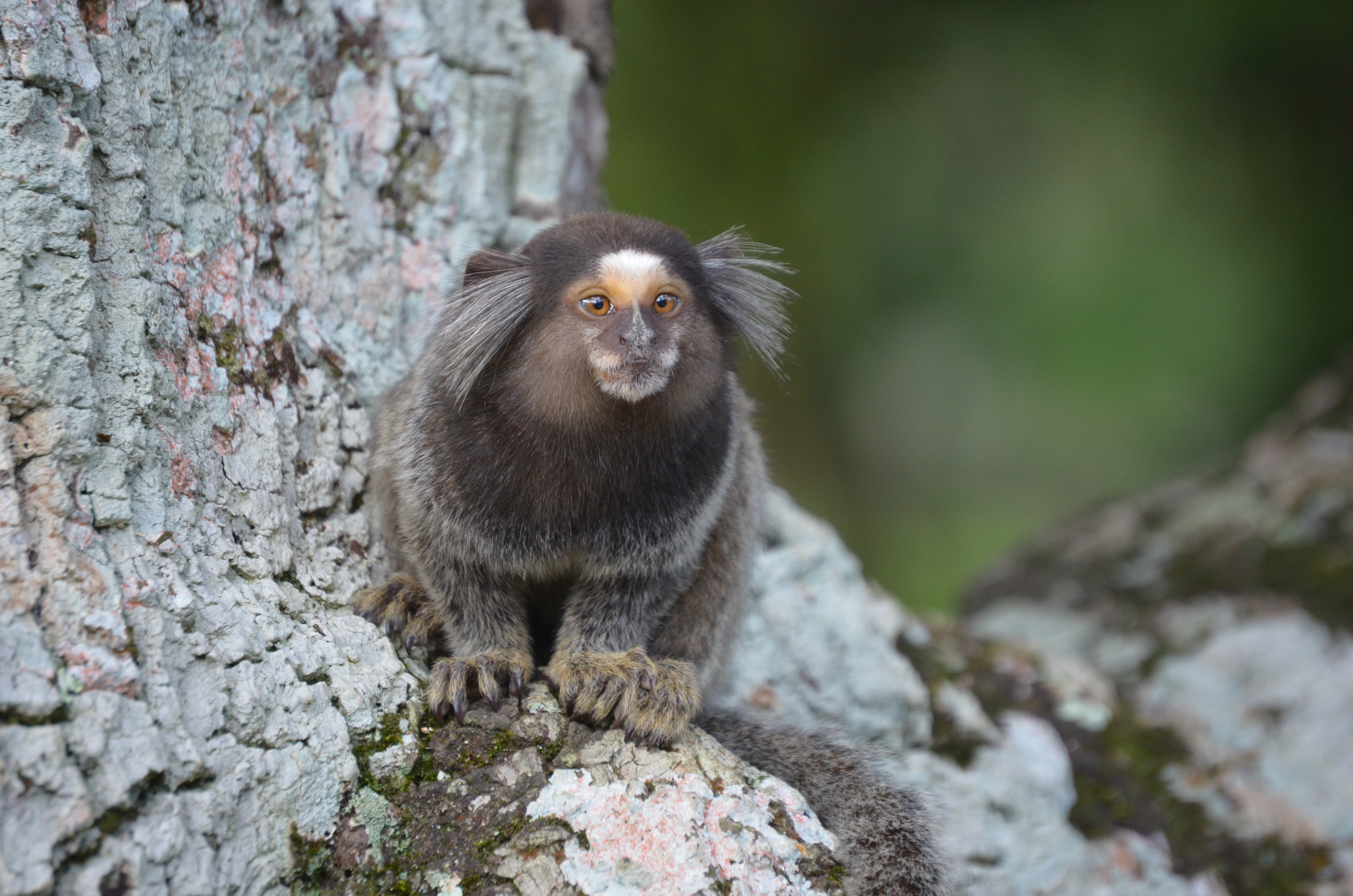
The black-tufted marmoset is a small primate, characterized by a morphology perfectly adapted to arboreal life. Adults present a weight ranging between 300 and 450 grams, with a body length of approximately 20 to 25 centimeters, not counting the tail, which is considerably long and can measure up to 30 centimeters. The most distinctive feature of the species, which gives it its common name, are the long tufts of black hair located around the ears (auriculars), which contrast with the well-defined patch of white hair on the forehead.
The body fur is dense and presents a striated or marbled pattern, with tones of gray, black, and brown, interspersed with dark golden hairs. The neck and face are predominantly black, which highlights the white frontal patch. The tail is prehensile only in infancy, becoming an organ of balance in adulthood; it exhibits a characteristic ringed pattern, with alternating bands of light gray and black. Its hands and feet have claw-like nails (tegulae), except on the hallux (big toe), which has a flat nail. This adaptation is essential for the animal to climb vertical trunks and scarify tree bark in search of sap.
Habitat and Distribution in the Pantanal
Callithrix penicillata is an endemic species of Brazil, with an original geographical distribution covering the Cerrado, Caatinga, and areas of Atlantic Forest. In the Pantanal, its occurrence is more pronounced on the edges of the biome, where vegetation mixes with Cerrado and Seasonal Forest phytophysiognomies. It is frequently found in riparian forests along the Paraguay River and its tributaries, as well as in forest patches (capões) and ridges (cordilheiras), which offer shelter and food during flood periods.
Unlike other more demanding primates, the black-tufted marmoset demonstrates a preference for secondary forests and edge areas, being extremely efficient in colonizing fragmented habitats. In the Pantanal ecosystem, it occupies middle and lower strata of vegetation, using the dense network of branches to move quickly and avoid predators. Its distribution in Mato Grosso and Mato Grosso do Sul places the Pantanal as an area of expansion and contact, where the species can be observed both in wild environments and in areas near lodges and farm headquarters.
Behavior
Black-tufted marmosets are strictly diurnal and highly social animals, living in family groups ranging from 2 to 15 individuals. The social structure is generally based on a breeding pair and their descendants of different generations. They possess a complex communication system that includes high-pitched vocalizations for alerts, territorial marking through scent glands, and a series of facial expressions and body postures that reinforce social bonds and hierarchy within the group.
Territorial behavior is marked; groups defend home ranges that can vary from 1 to 5 hectares, depending on the availability of food resources. During the day, they dedicate a large part of their time to foraging and grooming, an essential activity for hygiene and strengthening social relationships. In the Pantanal, it is common to observe them in quick and acrobatic movements between trees, demonstrating impressive agility. At nightfall, the group retreats to safe sleeping sites, generally in tree hollows or dense vine tangles, to protect themselves from nocturnal predators.
Diet
The diet of Callithrix penicillata is omnivorous and opportunistic, but with a notable specialization: gumivory. They possess elongated and narrow lower incisors, which function as tools to scarify (dig) the bark of certain trees and stimulate the production of exudates (gum or sap). This resource is vital, especially during the dry season in the Pantanal, when fruit supply decreases drastically. Gum provides complex carbohydrates, calcium, and other essential minerals for the animal's survival.
In addition to sap, marmosets consume a wide variety of native fruits, flowers, nectar, and fungi. The protein portion of their diet is composed of insects (such as crickets and caterpillars), spiders, small lizards, amphibians, and occasionally bird eggs and chicks. In the Pantanal ecosystem, this diversified diet makes the marmoset an important controller of insect populations and a pollinating agent. Its interaction with the local flora is so intimate that the animal knows the fruiting cycles of various species, moving through the territory according to the seasonal availability of food.
Reproduction
The reproductive system of the black-tufted marmoset is fascinating and involves a high degree of cooperation. Generally, only the dominant female of the group reproduces, inhibiting the ovulation of other females through chemical signals (pheromones). The gestation period lasts about 150 days, almost always culminating in the birth of twins, although single or triplet births may occur. The offspring are born relatively large, weighing about 10% of the mother's weight.
Parental care is shared by all group members, a behavior known as alloparental care. The father and older siblings carry the offspring on their backs most of the time, delivering them to the mother only for nursing. This strategy allows the female to recover her energy more quickly, enabling up to two gestations per year. In the Pantanal, births usually coincide with periods of greatest food abundance, ensuring that offspring have access to nutrients necessary for rapid growth and weaning, which occurs around three months of age.
Conservation Status
Currently, Callithrix penicillata is classified by the International Union for Conservation of Nature (IUCN) and ICMBio as a species of "Least Concern" (LC). This classification is due to its wide geographical distribution, large population, and remarkable ability to adapt to degraded environments. However, this does not mean the species is free from threats. In the Pantanal, recurrent forest fires and the conversion of native forests into pastures represent significant risks, reducing shelter areas and food sources.
Another growing problem is illegal wildlife trade, as the marmoset is frequently captured to be illegally sold as a pet due to its docile appearance. Furthermore, the introduction of the species into biomes where it does not occur naturally, such as in certain areas of the Atlantic Forest, can generate ecological imbalances and hybridization with other marmoset species. In Brazil, ICMBio monitors populations and promotes environmental education actions to discourage keeping these primates in domestic captivity and protect their natural habitats.
Curiosities
One of the most interesting curiosities about the black-tufted marmoset is its intelligence and learning capacity. Studies show they can use simple tools and possess excellent spatial memory to locate gum-producing trees. In the Pantanal, they are known for "following" other larger animals, taking advantage of insects flushed out by the passage of a capybara or a giant otter near the banks.
For Pantanal ecotourism, the marmoset is a star in its own right. Its constant presence near trails and visitor centers provides tourists with a unique opportunity to observe primate behavior at close range. In local culture, the "mico" is seen with sympathy, although guides always warn never to feed them, as human food consumption can cause serious diseases and alter the group's natural behavior. Its importance for the regeneration of the Paraguay River riparian forests reaffirms that, despite its small size, the black-tufted marmoset is a giant in ecological relevance for the Pantanal.
References
[1] IUCN. (2021). *Callithrix penicillata*. The IUCN Red List of Threatened Species. Available at: https://www.iucnredlist.org/species/3572/191700683
[2] ICMBIO. (2018). *Livro Vermelho da Fauna Brasileira Ameaçada de Extinção*. ICMBio. Available at: https://www.icmbio.gov.br
[3] ALHO, C. J. R. (2008). *Biodiversidade do Pantanal*. Editora UNIDERP.
[4] EMBRAPA PANTANAL. (2010). *Primatas do Pantanal: Guia de Campo*. Embrapa Pantanal.
[5] PEREIRA, L. C.; MENDES, S. L. (2006). Ecologia e comportamento de *Callithrix penicillata* (Primates, Callitrichidae) em fragmentos florestais no sudeste do Brasil. *Revista Brasileira de Zoologia*, v. 23, n. 4, p. 1067-1076.
[6] RYLANDS, A. B.; MITTERMEIER, R. A.; FONSECA, G. A. B. (2005). *A Primate Biogeography of the Brazilian Amazon*. Conservation International.
[7] POTT, A.; POTT, V. J. (1994). *Plantas do Pantanal*. Embrapa-SPI.