Introduction
The tayra (Eira barbara), popularly known in Brazil as irara or papa-mel, is one of the most versatile and intriguing mammals of the Pantanal. Belonging to the Mustelidae family, the same as the giant otter and the Neotropical otter, the tayra stands out for its agility both on the ground and in the treetops. Its name "irara" comes from the Tupi yra-ra, which means "honey-eater," a reference to one of its favorite foods. In the Pantanal ecosystem, it plays a fundamental role as a seed disperser and as an opportunistic predator, contributing to the balance of the food web in forested and transition areas.
Scientific Classification
| Kingdom | Animalia |
| Phylum | Chordata |
| Class | Mammalia |
| Order | Carnivora |
| Family | Mustelidae |
| Genus | Eira |
| Species | Eira barbara |
| Common name | Tayra |
Unlike many other mustelids that are strictly nocturnal or aquatic, the tayra is predominantly diurnal and highly terrestrial, although it is an excellent climber. Its presence in the Pantanal is associated with a variety of habitats, from dense riparian forests to wooded savannas. It is a curious and intelligent animal, often seen crossing roads or moving through the canopy in search of food. Its wide distribution throughout the Neotropics and its ability to adapt to different environments make it a successful species, although it still faces challenges related to habitat loss.
The study of Eira barbara is essential to understand the dynamics of seed dispersal in the Pantanal. By consuming a wide variety of fruits and moving over long distances, the tayra helps maintain the genetic diversity of many native tree species. Furthermore, its role as a predator of small vertebrates helps control populations of rodents and other animals, making it a key piece in the ecological health of the biome.
Physical Description
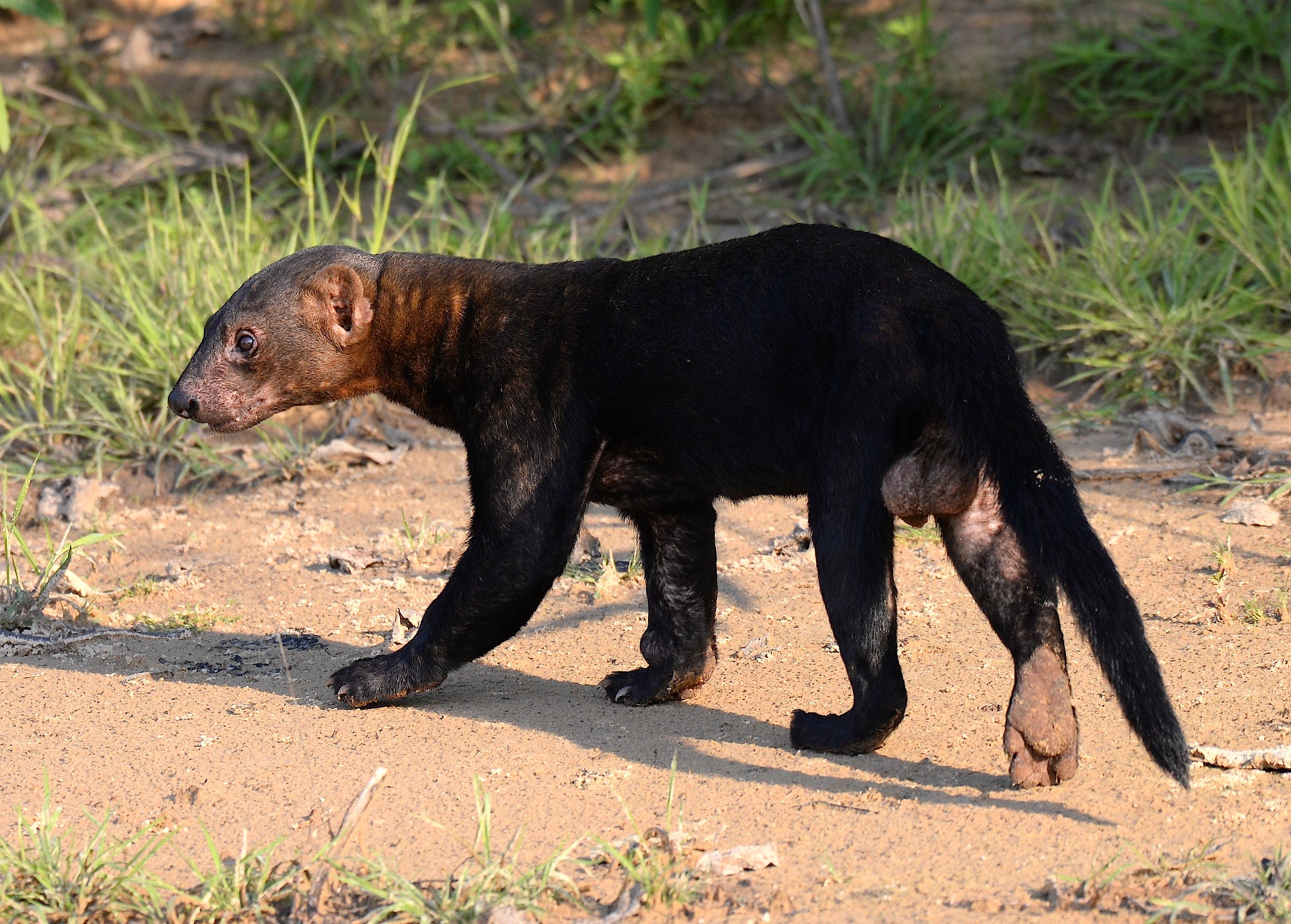
The tayra has an elongated and robust body, with a total length that can vary from 90 cm to 115 cm, including the long and bushy tail, which measures between 35 cm and 45 cm. Adults weigh between 3 kg and 7 kg. Its fur is short and dense, with a coloration that is usually dark brown or black over most of the body. A striking feature is the head and neck, which are often lighter, ranging from gray to yellowish-brown. Many individuals also have a distinct yellow or orange diamond-shaped patch on the throat.
Its limbs are long and strong, with large paws equipped with non-retractable claws that are excellent for climbing and digging. The head is relatively large with small, rounded ears. Its eyes are dark and provide good vision, complemented by a sharp sense of smell. The tayra's dentition is typical of a generalist carnivore, with strong canines and molars capable of processing both meat and plant matter. There is no significant sexual dimorphism, although males may be slightly larger than females.
Habitat and Distribution in the Pantanal
In the Pantanal, the tayra is found in a wide range of environments. It has a preference for forested areas, such as riparian forests, gallery forests, and "cordilheiras" (elevated wooded areas). However, it is also frequently seen in wooded savannas (cerradões) and even in areas of transition with open fields. Its ability to move both on the ground and in the trees allows it to exploit resources in different strata of the vegetation.
Its distribution is wide, covering both the Northern and Southern Pantanal. It is common to observe it in regions with high biodiversity, such as the Transpantaneira and the surroundings of the Miranda and Aquidauana rivers. During the flood season, the tayra concentrates in the non-flooded wooded areas, while in the dry season, it can expand its movement through the drier forests. It is a territorial animal, but its home range can be quite large, reflecting its active and searching nature.
Behavior
The tayra is a predominantly diurnal animal, with peaks of activity in the early morning and late afternoon. It is usually solitary, but can be seen in pairs or small family groups (mother and pups). It is an extremely active and restless animal, spending much of the day moving in search of food. Its movement is characterized by a combination of walking, running, and agile climbing, being able to jump between branches with ease.
One of its most notable behaviors is its curiosity. Tayras often stop to observe their surroundings, sometimes standing on their hind legs to get a better view. They are also known for their intelligence; there are reports of tayras hiding fruits to ripen and consume later. Although they are not aggressive towards humans, they are brave animals and can defend themselves vigorously if threatened. Their communication includes a variety of vocalizations, such as barks and growls, as well as scent marking to delimit territory.
Diet
The tayra is an opportunistic omnivore with a very varied diet. In the Pantanal, its food includes small mammals (such as rodents and small monkeys), birds, eggs, reptiles, and a large amount of insects. However, fruits represent a significant part of its diet, especially during the season of greater abundance. As its name "papa-mel" suggests, it has a great fondness for honey and bee larvae, often destroying hives to reach them.
Its role as a seed disperser is crucial. By consuming fruits from trees such as the acuri and various species of figs, and later defecating the seeds in different locations, the tayra contributes to the forest regeneration of the Pantanal. This dietary flexibility is a great advantage, allowing the species to adapt to seasonal changes in the availability of resources in the biome. It is a skilled hunter, using its sense of smell to locate prey and its agility to capture them in the trees or on the ground.
Reproduction
The reproduction of the tayra can occur at different times of the year, without a strictly defined season, although there may be peaks associated with periods of greater food availability. The gestation period is approximately 63 to 70 days. The female gives birth to a litter of 1 to 3 pups, usually in a protected den such as a hollow tree, a hole in the ground, or dense vegetation. The pups are born blind and helpless, with a lighter fur that darkens as they grow.
The female provides all the parental care, protecting and feeding the pups until they are able to follow her on her daily excursions. The young remain with their mother for several months, learning hunting and climbing techniques. Sexual maturity is reached at around two years of age. The tayra's longevity in the wild is not precisely known, but in captivity, they can live for more than 15 years. Their relatively low reproductive rate makes the preservation of breeding individuals essential for the maintenance of populations.
Conservation Status
Currently, Eira barbara is classified by the International Union for Conservation of Nature (IUCN) as "Least Concern" (LC) globally, due to its wide distribution and adaptation to different types of environments. However, this classification does not mean that the species is free from threats, especially in biomes under pressure like the Pantanal.
The main threats to Eira barbara include habitat loss and fragmentation due to the expansion of agriculture and the recurring forest fires in the Pantanal. Deforestation reduces the availability of hollow trees for shelter and reproduction, in addition to decreasing the supply of wild fruits. Another significant problem is conflict with humans; in rural areas, tayras are sometimes persecuted for attacking domestic poultry or for damaging commercial beehives.
Conservation efforts in the Pantanal focus on the creation and maintenance of Private Natural Heritage Reserves (RPPNs) and the promotion of sustainable agricultural practices that preserve riparian forests. Fauna monitoring projects, such as those carried out by Onçafari and the Pró-Carnívoros Institute, help to better understand the population density and movement patterns of the species, providing essential data for long-term management and protection strategies.
Curiosities
One of the most interesting curiosities about the tayra is its relationship with honey, which goes beyond simple consumption. Field reports suggest that they can "plan" the consumption of certain fruits, picking them while still green and leaving them in specific locations to ripen before being eaten. This capacity for anticipation is a strong indication of advanced intelligence among mustelids. Furthermore, despite being carnivores by classification, tayras in the Pantanal can have up to 60% of their diet composed of plant matter at certain times of the year.
In the local Pantanal culture, the tayra is sometimes seen as a mystical or astute animal, starring in folk tales about its ability to trick other animals to get food. For ecotourism, it is a "secondary star" that often surprises visitors who expect to see only the big cats. Its agility in crossing the tree canopy is comparable to that of primates, earning it the nickname "monkey-dog" in some regions of Latin America.
Another notable fact is its physical resistance. Tayras are known to be extremely strong animals for their size, capable of facing larger predators if cornered. In the Pantanal, they share territory with giants such as the jaguar and the giant otter, occupying a unique ecological niche that combines terrestrial and arboreal habits, which gives them a strategic advantage in the search for resources in such a dynamic environment.
References
[1] IUCN. (2016). *Eira barbara*. The IUCN Red List of Threatened Species. Available at: https://www.iucnredlist.org/species/41644/45212023
[2] ICMBIO. (2018). *Red Book of Threatened Brazilian Fauna*. ICMBio. Available at: https://www.icmbio.gov.br
[3] ALHO, C. J. R. (2008). *Biodiversity of the Pantanal*. UNIDERP Publishing.
[4] CHEIDA, C. C.; KASPER, C. B.; TRAPANI, R. (2006). Diet of the tayra (*Eira barbara*) in the Serra da Canastra National Park, Minas Gerais, Brazil. *Brazilian Journal of Zoology*, 23(4), 1005-1011.
[5] EMBRAPA PANTANAL. (2024). *Mammals of the Pantanal*. Embrapa Pantanal. Available at: https://www.embrapa.br/pantanal/publicacoes
[6] EISENBERG, J. F.; REDFORD, K. H. (1999). *Mammals of the Neotropics, Volume 3: The Central Neotropics: Ecuador, Peru, Bolivia, Brazil*. University of Chicago Press.
[7] SOS PANTANAL. (2024). *Fauna of the Pantanal*. SOS Pantanal. Available at: https://sospantanal.org.br/fauna-do-pantanal/