Introduction
The Procyon cancrivorus, popularly known as the crab-eating raccoon or South American raccoon, is a carnivorous mammal of the Procyonidae family that plays a fundamental ecological role in the wetlands of South America. In the Pantanal, this species finds one of its most important refuges, adapting perfectly to the flood and ebb regime that characterizes the biome. Often confused with its North American cousin (Procyon lotor), the crab-eating raccoon is distinguished by specific morphological adaptations for life in tropical and semi-aquatic environments.
Scientific Classification
| Kingdom | Animalia |
| Phylum | Chordata |
| Class | Mammalia |
| Order | Carnivora |
| Family | Procyonidae |
| Genus | Procyon |
| Species | Procyon cancrivorus |
| Common name | Crab-eating raccoon |
The popular name "mão-pelada" (naked-hand) derives from a striking anatomical feature: the absence of dense fur on its paws, which gives it extraordinary tactile sensitivity. This adaptation is crucial for its foraging behavior, allowing the animal to locate and identify prey submerged in murky waters or under mud. In the Pantanal ecosystem, Procyon cancrivorus acts as a generalist mesopredator, occupying niches near rivers such as the Paraguay River and the Cuiabá River, where the abundance of aquatic resources favors its survival.
The importance of the crab-eating raccoon to the Pantanal goes beyond its position in the food chain. As an omnivorous animal, it acts as a seed disperser and controller of invertebrate and small vertebrate populations. Its presence is an indicator of the health of water bodies and gallery forests. Although it is a predominantly nocturnal animal, the crab-eating raccoon has become a charismatic figure for ecoturismo in the region, being frequently spotted by visitors traveling along the Transpantaneira highway during night safaris in search of local fauna.
Physical Description
Procyon cancrivorus has a medium build, with the body measuring between 45 and 70 centimeters in length, plus a robust tail ranging from 25 to 35 centimeters. The weight of a healthy adult in the Pantanal generally oscillates between 3 and 8 kilograms, depending on food availability and the season. Its fur is dense and coarse, presenting a coloration that varies from bluish-gray to dark brown, almost black in some individuals, providing excellent camouflage during its nocturnal activities.
One of the most distinctive features of the species is the black facial "mask" that surrounds the eyes, contrasting with the lighter rest of the face. This marking is a common feature among procyonids and helps reduce light reflection, improving night vision. The tail is voluminous and has between 7 to 10 well-defined black rings, a useful feature for visual identification in the field. Unlike other carnivores, the crab-eating raccoon has short legs and long, agile fingers, with non-retractable claws that are fundamental for handling food and climbing trees with ease.
Sexual dimorphism in Procyon cancrivorus is not pronounced, although males tend to be slightly larger and heavier than females. The most notable feature, which gives the species its Portuguese name, is the very short and sparse fur on the front and hind paws. This "nakedness" of the extremities is not just aesthetic; it maximizes the sensitivity of the tactile receptors in the palms of the hands, allowing the animal to "see" through touch while feeling the bottom of Pantanal channels and bays in search of food.
Habitat and Distribution in the Pantanal
The geographical distribution of Procyon cancrivorus is vast, extending from Costa Rica in Central America to Uruguay and northern Argentina. In Brazilian territory, the species occurs in practically all biomes, but it is in the Pantanal that it exhibits a notable population density due to the omnipresence of aquatic environments. The crab-eating raccoon is a generalist animal in terms of habitat but demonstrates a clear preference for transition areas between dry land and water, such as gallery forests, cordilheiras (highlands), and the edges of temporary bays.
In the mosaic of Pantanal landscapes, Procyon cancrivorus is frequently found in areas directly influenced by the hydrological regime. During the flood season, they concentrate on the higher parts of the terrain, using tree hollows and dense canopies as refuge. During the ebb, they expand their home range to the beaches that emerge along the Paraguay River and its tributaries. The species has also adapted well to human presence in certain areas, being common to find it near farm headquarters and ecological inns, especially in locations such as Porto Jofre, where the offer of food scraps can attract opportunistic individuals.
Below, a table summarizes the main characteristics of the preferred habitat of the crab-eating raccoon in the biome:
| Environment Type | Use by Species | Availability in the Pantanal |
|---|---|---|
| Gallery Forests | Shelter, reproduction, and foraging | High (along rivers and channels) |
| Bays and Channels | Main site for obtaining aquatic prey | Seasonal (dependent on the flood pulse) |
| Cordilheiras (Highlands) | Refuge during peak floods | Moderate (non-flooding areas) |
| Anthropized Areas | Opportunistic food search | Increasing (near inns and roads) |
Behavior
Procyon cancrivorus is a predominantly nocturnal and crepuscular animal, starting its activities at sunset. During the day, it usually rests in protected places, such as tree hollows, cavities in fallen logs, or dense tangles of vegetation. In the Pantanal, its activity is closely linked to temperature and humidity; on very cold or extremely dry nights, the activity pattern may undergo changes, although the species is considered cathemeral in some specific situations of resource abundance.
Socially, the crab-eating raccoon is a solitary animal. Encounters between adults generally occur only during the breeding season or in places with a very high concentration of food. They are territorial animals, although their territories can overlap considerably, especially between males and females. Communication between individuals is done through varied vocalizations, including whistles, squeaks, and growls, in addition to scent marking with urine and anal glands to delimit areas of dominance and indicate reproductive readiness.
A fascinating and often misinterpreted behavior is the habit of "washing" food. Observed both in captivity and in nature, the crab-eating raccoon dips its prey or objects in water and manipulates them vigorously with its front paws. Ethological studies suggest that this behavior does not have a hygienic purpose, but rather a tactile one. Water increases the sensitivity of the paws, allowing the animal to obtain detailed information about the size, texture, and viability of the prey before ingesting it. In the Pantanal, this behavior is vital for distinguishing live crabs from debris or stones in the muddy bottom of rivers.
Diet
The diet of Procyon cancrivorus is one of the most varied among Neotropical carnivores, classifying it as a generalist and opportunistic omnivore. In the Pantanal ecosystem, its diet is strongly influenced by seasonality. As the scientific name itself suggests (cancrivorus means "crab-eater"), crustaceans form the basis of its diet in many regions. However, the crab-eating raccoon consumes a wide range of items, from small vertebrates to wild fruits.
Its main prey includes small fish, amphibians (such as frogs and toads), small reptiles, mollusks, and a wide variety of insects. The crab-eating raccoon is a skilled hunter that uses its front paws as precision tools to remove prey from crevices in rocks or under submerged logs. In addition to animal protein, it consumes significant amounts of fruits from palms and other native trees of the Pantanal, playing an important role in seed dispersal through its feces, which helps in the regeneration of gallery forests.
The ecological role of the crab-eating raccoon is that of a population regulator. By preying on species that are often neglected by larger carnivores, such as the jaguar, it helps maintain the balance of aquatic and terrestrial microfauna. In areas near human settlements or inns on the Transpantaneira, the crab-eating raccoon may exhibit "scavenger" behavior, feeding on organic waste, which requires attention from environmental managers to avoid conflicts and the transmission of diseases between wild and domestic animals.
Reproduction
The reproductive cycle of Procyon cancrivorus in the Pantanal seems to be synchronized with the availability of food resources, which in turn depends on the flood pulse. Although they can reproduce throughout the year in some parts of their distribution, in the Pantanal biome, a peak of births is generally observed coinciding with the beginning of the rainy season, when the supply of amphibians and insects increases drastically.
After a gestation period lasting approximately 60 to 64 days, the female gives birth to a litter ranging from 1 to 3 cubs, with 2 being the most common number. Parental care is the exclusive responsibility of the female. She chooses safe places for birth, usually tree hollows located at a considerable height from the ground to avoid terrestrial predators and sudden floods. The cubs are born blind and dependent, opening their eyes around the third week of life.
The maturity of young crab-eating raccoons is reached gradually. They remain under the mother's protection for several months, starting to accompany her on hunting forays around the 7th or 9th week. During this period, they learn the complex tactile foraging techniques necessary for survival. Sexual maturity is reached around one year of age for females and a bit later for males. The longevity of the species in nature is estimated at about 10 to 12 years, although in captivity they can exceed 15 years.
Conservation Status
Currently, Procyon cancrivorus is classified by the International Union for Conservation of Nature (IUCN) as a species of "Least Concern" (LC) status. In Brazil, the ICMBio assessment follows the same category, indicating that the species has a wide distribution and relatively stable populations. However, this classification does not mean that the crab-eating raccoon is free from threats, especially in a biome as dynamic and pressured as the Pantanal.
The main threats to the species in the Pantanal include habitat loss and fragmentation due to the conversion of native areas into exotic pastures and large agricultural enterprises. The deforestation of gallery forests is particularly harmful, as it eliminates essential shelter and breeding sites. Another critical factor is roadkill on highways that cross the biome, such as BR-262 and the Transpantaneira itself, where the animal's nocturnal habit makes it vulnerable to vehicle traffic.
In addition, the crab-eating raccoon suffers from retaliatory hunting by poultry farmers, as the animal can occasionally prey on domestic birds. Disease transmission from domestic animals, such as rabies and distemper, also represents a risk to wild populations. Conservation efforts in the Pantanal should focus on protecting riparian forests and creating wildlife corridors, ensuring that this unique mesopredador continues to fulfill its vital role in the ecosystem.
Fun Facts
The crab-eating raccoon is a source of many curiosities that fascinate researchers and tourists. One of the most notable is its extreme manual dexterity. Its paws are so sensitive that it can identify the species of a snail or the size of a crab just by touch, without needing to see it. This "tactile vision" is one of the most advanced among mammals. In the Pantanal, it is common to see them "dancing" with their hands in the water, a movement that is actually a refined search for food.
Another interesting fact is its relationship with the North American raccoon (Procyon lotor). Although they look similar, the crab-eating raccoon has much longer legs and a shorter, coarser coat, adaptations to the tropical climate and the need to walk in flooded areas. Furthermore, while the North American cousin is famous for its urban adaptability, the South American crab-eating raccoon remains more linked to natural aquatic environments, although it is beginning to show signs of adaptation to anthropized areas in the Pantanal.
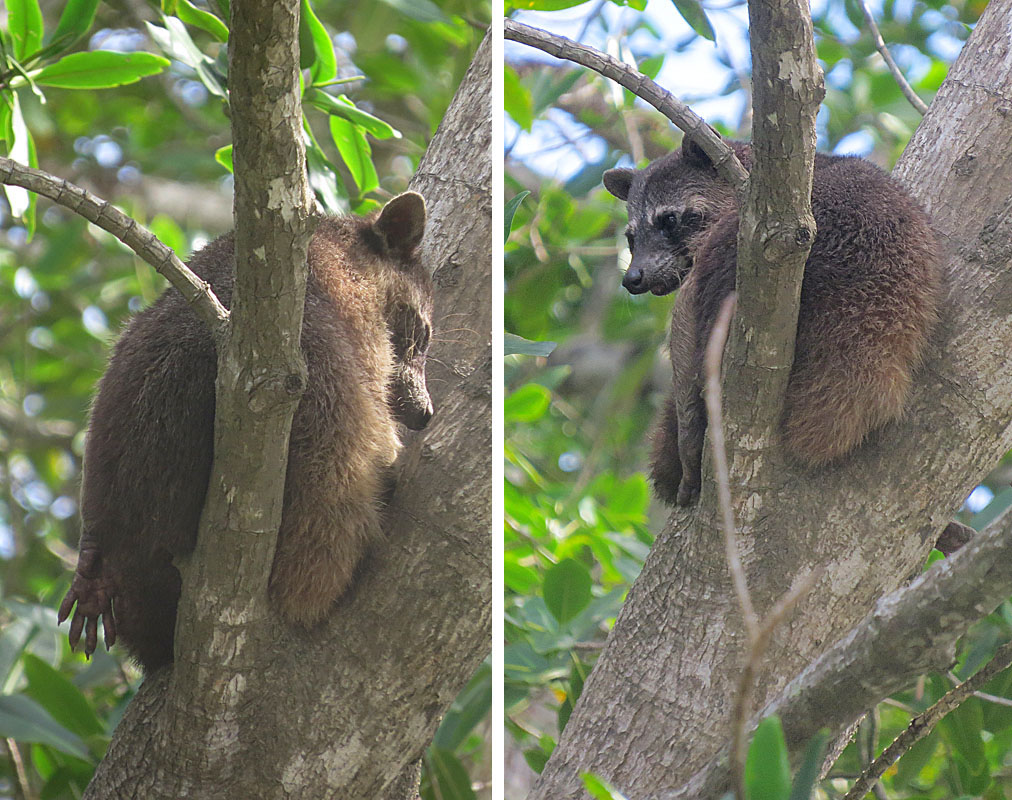
Finally, the crab-eating raccoon is an excellent climber and swimmer. When threatened, its first reaction is often to seek refuge in the heights of trees or dive into the water. Its ability to descend trees head-first, thanks to the flexibility of its hind joints, is a feat shared with few other carnivores. In the Pantanal, seeing a crab-eating raccoon skillfully navigating between the branches of a sarã or swimming across a channel is a testament to the evolutionary success of this species in the world's largest wetland.