

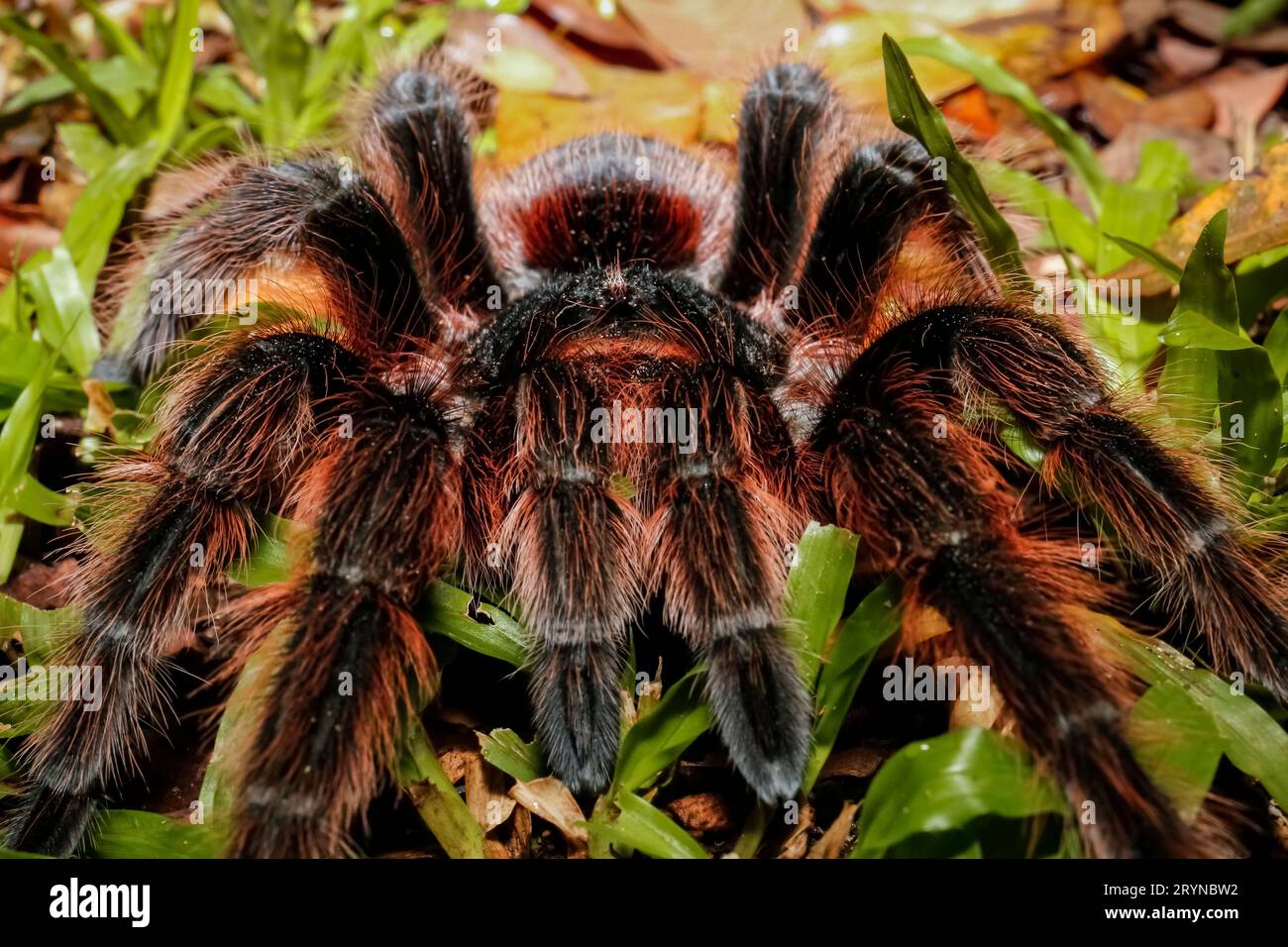
Brachypelma hamorii (Pantanal Tarantula)
Introduction
Brachypelma hamorii, commonly known regionally as the Pantanal Tarantula, is one of the most emblematic and visually distinctive arachnid species found in the transitional areas and dry forests of the Pantanal biome. Belonging to the family Theraphosidae, this large tarantula plays a fundamental role in the ecological balance of the region, acting as a top invertebrate predator and controlling populations of various insects and small vertebrates [1].
Its presence in the Pantanal ecosystem is an indicator of environmental health, as the species depends on preserved microhabitats for constructing its burrows and maintaining its reproductive cycle. Although often confused with other species of the genus due to its vibrant coloration, B. hamorii stands out for its relative docility and longevity, making it an important subject of study for understanding arthropod biodiversity in South America [2].
Scientific Classification
| Category | Description |
|---|---|
| Kingdom | Animalia |
| Phylum | Arthropoda |
| Class | Arachnida |
| Order | Araneae |
| Family | Theraphosidae |
| Genus | Brachypelma |
| Species | B. hamorii |
Description
Brachypelma hamorii is characterized by its robust body and deep black coloration, contrasted by intense orange or reddish rings on its joints, specifically on the patella (knee), which gives rise to the common name “red-knee” [3]. Adult specimens can reach a leg span of 12 to 14 centimeters, with a weight ranging between 15 and 20 grams. The cephalothorax is broad and features a light-colored edge, while the abdomen is covered with urticating hairs that serve as the primary defense mechanism.
Sexual dimorphism is evident at maturity: females are significantly more robust and have a much longer lifespan than males. Additionally, adult males develop copulatory bulbs on their pedipalps and tibial hooks on the first pair of legs, structures essential for the mating process [4]. The coloration tends to be more vibrant immediately after ecdysis (molting), gradually becoming more opaque over time.
Distribution and Habitat
Although the genus Brachypelma has its center of diversity in North and Central America, B. hamorii finds suitable habitat in the Brazilian Pantanal and adjacent savanna and dry forest regions [5]. It prefers well-drained soils where it can excavate deep burrows or occupy natural cavities under rocks and fallen logs. The species avoids permanently flooded areas, concentrating in “cordilheiras” (terrain elevations) and gallery forests that remain dry during seasonal floods.
The species’ distribution is influenced by prey availability and soil composition, which must allow the maintenance of the integrity of underground galleries. In the Pantanal, its occurrence is associated with dense vegetation areas that provide protection against aerial predators and maintain moderate humidity levels inside the burrows, essential for the animal’s hydration [6].
Behavior
The Pantanal Tarantula exhibits predominantly terrestrial and nocturnal habits. During the day, it remains sheltered in its burrow, the entrance of which is often reinforced with silk to detect vibrations and maintain stable internal temperature. At dusk, the spider positions itself at the entrance of the shelter or moves short distances in search of food. It is a solitary and territorial species, interacting with others only during the reproductive period [7].
In terms of defense, B. hamorii is considered minimally aggressive. When threatened, its first reaction is to seek refuge in the burrow. If cornered, it uses its hind legs to scrape the abdomen and release urticating hairs into the air, which can cause severe irritation to the mucous membranes and eyes of potential predators. The attack posture, with the front legs raised and chelicerae exposed, is used only as a last resort [8].
Feeding / Nutrition
As an opportunistic ambush predator, B. hamorii has a varied diet consisting mainly of large insects such as crickets, cockroaches, and beetles. However, due to its size, adult individuals can occasionally capture small vertebrates, including lizards, small rodents, and amphibians [9]. Prey detection is achieved through sensory hairs (trichobothria) that perceive vibrations in the soil and air movements.
The feeding process involves immobilizing the prey with the chelicerae and injecting venom containing digestive enzymes responsible for liquefying the victim’s internal tissues. The spider then sucks the nutritious content, leaving only the exoskeleton or chitinous remains. In the dynamic Pantanal environment, the species can endure long fasting periods, especially during adverse climatic conditions, thanks to its efficient metabolism [10].
Reproduction
The reproductive cycle of B. hamorii is marked by complex rituals. After the final molt, the male spins a “sperm web” to load his copulatory bulbs and begins searching for a receptive female, guided by pheromones. Mating generally occurs at the beginning of the rainy season, when humidity favors male activity. During copulation, the male uses his tibial hooks to hold the female’s chelicerae, preventing cannibalism [11].
Several weeks after copulation, the female deposits between 200 and 400 eggs in a silk sac (ootheca), which she protects and regularly turns to ensure uniform embryo development. The small spiders (spiderlings) hatch after about two to three months and remain in the mother’s burrow for a short period before dispersing. Growth is slow, and sexual maturity may take 5 to 7 years to reach [12].
Ecological Importance
Within the Pantanal ecosystem, B. hamorii acts as an important regulator of invertebrate populations, preventing insect outbreaks that could affect local vegetation. Additionally, it serves as prey for various larger predators such as birds of prey, coatis, and certain species of hunting wasps (Pompilidae), which use tarantulas as hosts for their larvae [13].
Its burrows also play a secondary ecological role, occasionally serving as shelter for other small animals after abandonment. The presence of this species is an indicator of a balanced environment, as its low reproductive rate and slow growth make it particularly sensitive to drastic habitat changes and indiscriminate pesticide use in adjacent areas [14].
Conservation Status
Currently, B. hamorii is classified as Vulnerable on the IUCN Red List and is included in Appendix II of CITES [15]. The main threats to its survival include habitat fragmentation due to agricultural expansion around the Pantanal and illegal wildlife trade motivated by its exotic appearance and docile temperament.
Conservation measures focus on protecting natural areas and enforcing strict controls against specimen removal from the wild. Environmental education programs are essential to demystify the negative image of spiders and promote peaceful coexistence between local inhabitants and these arachnids, highlighting their importance for biodiversity and natural pest control [16].
Curiosities
- Extreme Longevity: Females of this species can live over 30 years under ideal conditions, one of the longest lifespans among terrestrial invertebrates.
- Limb Regeneration: Like other arthropods, the Pantanal Tarantula can regenerate lost legs during molting, fully recovering functionality after several molts.
- Aerial Defense: The urticating hairs released by the spider have small hooks that attach to the aggressor’s skin, causing persistent inflammatory reactions without the need for a direct bite.
- Prolonged Fasting: Thanks to its low metabolism, a healthy adult individual can survive several months without food, provided it has access to water.
- Multifunctional Silk: Besides lining burrows, silk is used to create “sensory mats” around the shelter, functioning as an alarm system against intruders.
References
[1] WIKIPEDIA. (n.d.). Brachypelma hamorii. Available at: https://en.wikipedia.org/wiki/Brachypelma_hamorii [2] THE TARANTULA COLLECTIVE. (n.d.). Mexican Red Knee Tarantula. Available at: https://www.thetarantulacollective.com/caresheets/brachypelma-hamorii [3] INATURALIST. (n.d.). Brachypelma hamorii. Available at: https://www.inaturalist.org/taxa/264094-Brachypelma_hamorii [4] BEKE.CO.NZ. (n.d.). Systematic revision of Brachypelma red-kneed tarantulas. Available at: https://www.beke.co.nz/slike/gluposti/Systematic revision of Brachypelma.pdf [5] A-Z ANIMALS. (n.d.). Inside Brazil’s Incredible Tarantula Diversity. Available at: https://a-z-animals.com/articles/inside-brazils-incredible-tarantula-diversity/ [6] TOCA DAS TARANTULAS. (2019). Acanthoscurria gomesiana. Available at: https://tocadastarantulas.travel.blog/2019/05/28/acanthoscurria-gomesiana/ [7] THE BIO DUDE. (n.d.). Mexican Red Knee Tarantula Care Sheet. Available at: https://www.thebiodude.com/blogs/arachnid-caresheets/mexican-red-knee-tarantula-brachypelma-hamorii-caresheet-and-bioactive-guide [8] CEC. (n.d.). Sustainable Trade in Tarantulas. Available at: https://www.cec.org/files/documents/publications/11697-sustainable-trade-in-tarantulas-action-plan-north-america-en.pdf [9] ANIMALIA.BIO. (n.d.). Brachypelma hamorii. Available at: https://animalia.bio/brachypelma-hamorii [10] REPTILES MAGAZINE. (n.d.). Tarantula Diet and Nutrition. Available at: https://reptilesmagazine.com/tarantula-diet-and-nutrition/ [11] RESEARCHGATE. (n.d.). Reproduction in Theraphosidae. Available at: https://www.researchgate.net/publication/261949577_On_the_Brazilian_Amazonian_species_of_Acanthoscurria_Araneae_Theraphosidae [12] TARANTULA CRIBS. (n.d.). Lifespan and Growth of Brachypelma. Available at: https://tarantulacribs.com/pages/grammostola-pulchripes-chaco-golden-knee-tarantula-care-guide [13] BIOFACES. (n.d.). Ecological Importance of Spiders. Available at: https://blog.biofaces.com/aranhas-caranguejeiras-os-artropodes-gigantescos/ [14] SCI.NEWS. (n.d.). Conservation of Brazilian Tarantulas. Available at: https://www.sci.news/biology/article00692.html [15] IUCN RED LIST. (n.d.). Brachypelma hamorii. Available at: https://www.iucnredlist.org/species/89162313/89162316 [16] CITES. (n.d.). CITES Checklist of Species. Available at: https://cites.org/sites/default/files/esp/resources/pub/checklist11/Indice_de_especies_CITES.pdf