

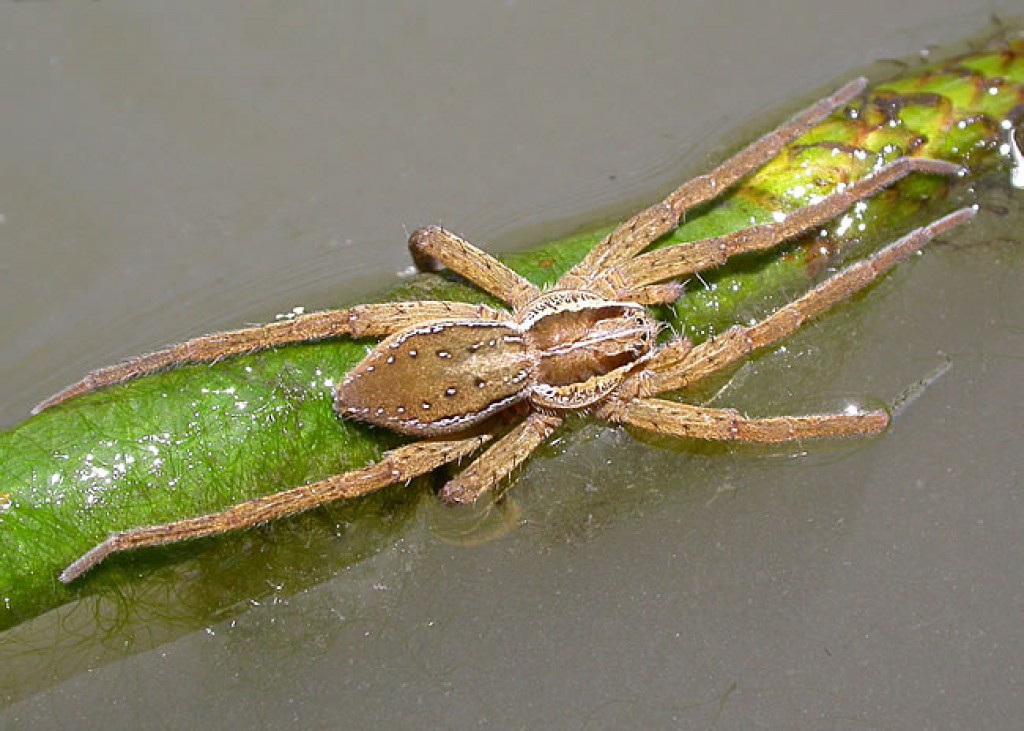
Dolomedes sp. (Fishing Spider)
Introduction
Dolomedes sp., popularly known as the fishing spider or water spider, is a semi-aquatic arachnid belonging to the family Pisauridae. In the Pantanal ecosystem, this species plays a fundamental role as a top predator among invertebrates, inhabiting the banks of rivers, lagoons, and seasonally flooded areas. Its unique ability to move across the water surface makes it a specialized component of local biodiversity.
The presence of Dolomedes sp. in the Pantanal is an indicator of the health of water bodies, as they depend on clean water and preserved marginal vegetation to hunt and reproduce. As generalist predators, they help in the population control of various aquatic insects and small vertebrates, maintaining the trophic balance in the transition zones between land and water.
Scientific Classification
| Category | Classification |
|---|---|
| Kingdom | Animalia |
| Phylum | Arthropoda |
| Class | Arachnida |
| Order | Araneae |
| Family | Pisauridae |
| Genus | Dolomedes |
| Species | Dolomedes sp. |
Description
Dolomedes sp. presents a robust body and long legs, adapted for locomotion in aquatic environments. Females are significantly larger than males, reaching between 15 and 26 millimeters in body length, while males range from 7 to 13 millimeters. The predominant coloration is dark brown or gray, often with lighter lateral stripes that aid in camouflage against the substrate of dry leaves and aquatic debris.
A distinctive feature is the hydrophobic (water-repellent) hairs that cover their legs and body. These hairs allow the spider to use the surface tension of the water to walk, run, and even jump across the surface without sinking. Additionally, they have eyes arranged in two rows, providing the sharp vision necessary to detect subtle movements of prey and predators.
Distribution and Habitat
In the Pantanal, Dolomedes sp. is widely distributed, occurring in both the Northern and Southern Pantanal. It prefers habitats with calm or slow-moving waters, such as the edges of bays, channels (corixos), and drainage areas (vazantes). The presence of floating vegetation, such as water hyacinths and salvinias, is essential, as it serves as a hunting platform and shelter against aerial predators.
Although emblematic of the Pantanal, the genus Dolomedes has a global distribution, with several species occurring throughout South America. However, the population density in the Pantanal is favored by the flood and ebb cycle, which creates vast areas of aquatic-terrestrial interface ideal for its development.
Behavior
The fishing spider is a predominantly nocturnal ambush predator, although it can be active during the day in shaded areas. It remains motionless at the water’s edge or on floating plants, with its front legs touching the surface to detect vibrations. Upon sensing the movement of prey, it moves quickly across the water to capture it.
Unlike many spiders, Dolomedes sp. does not build webs to capture food. It has the remarkable ability to dive and remain submerged for up to 30 minutes, using an air bubble trapped in its body hairs to breathe. This behavior is used both to hunt underwater prey and to escape from predators such as birds and larger fish.
Diet / Nutrition
The diet of Dolomedes sp. is diverse and opportunistic. It feeds mainly on aquatic insects, such as dragonfly and mosquito larvae, but its fame as a “fisher” comes from its ability to capture small vertebrates. In the Pantanal, it is common to observe them preying on small fish, tadpoles, and even small juvenile amphibians that approach the surface.
The hunting strategy involves injecting venom and digestive enzymes into the prey, which immobilize and dissolve internal tissues, allowing the spider to absorb nutrients in liquid form. They are capable of consuming prey that weighs up to five times their own body weight, demonstrating a remarkable metabolic efficiency for their size.
Reproduction
The reproductive cycle of Dolomedes sp. in the Pantanal is often associated with the period of greatest availability of water resources. After mating, the female produces a spherical egg sac that she carries carefully between her chelicerae (mouthparts). This parental care ensures the protection of the eggs against predators and desiccation.
Shortly before hatching, the female builds a “nursery web” among the marginal vegetation, where she deposits the egg sac. She remains nearby guarding the web until the hundreds of small spiders hatch and disperse. This maternal care behavior is a hallmark of the Pisauridae family, significantly increasing the survival rate of the offspring.
Ecological Importance
Dolomedes sp. plays a crucial role in the Pantanal food web. As a predator, it helps regulate insect populations that can become pests or disease vectors. At the same time, it serves as a food source for a variety of larger animals, including wading birds, fish, and lizards, facilitating the transfer of energy between aquatic and terrestrial environments.
Furthermore, being sensitive to chemical pollutants and physical changes in its habitat, the species acts as a bioindicator of environmental quality. A drastic reduction in its populations can signal early ecological problems, such as water contamination by pesticides or the degradation of riparian vegetation.
Conservation Status
Currently, Dolomedes sp. is not listed in global threat categories by the IUCN, being generally considered “Least Concern” due to its wide distribution. However, in the specific context of the Pantanal, the species faces growing threats from habitat loss, heavy metal pollution (such as mercury), and climate change that alters the flood regime.
The conservation of this species directly depends on the preservation of Permanent Preservation Areas (APPs) along water bodies. Measures to protect the Pantanal biome, such as fire control and sustainable management of water resources, are fundamental to ensuring the survival of the fishing spider and the entire associated ecosystem.
Curiosities
- Prolonged Diving: The fishing spider can create an “air armor” around its body, allowing it to breathe underwater for long periods.
- Walking on Water: Thanks to surface tension and hydrophobic hairs, it can reach surprising speeds on the water, resembling an aquatic “skateboarder.”
- Multidirectional Vision: Its eight eyes allow for nearly 360-degree vision, essential for detecting predators in an open environment like the Pantanal.
- Sexual Cannibalism: As in other spider species, sexual cannibalism can occur, where the female consumes the male after mating to obtain extra nutrients.